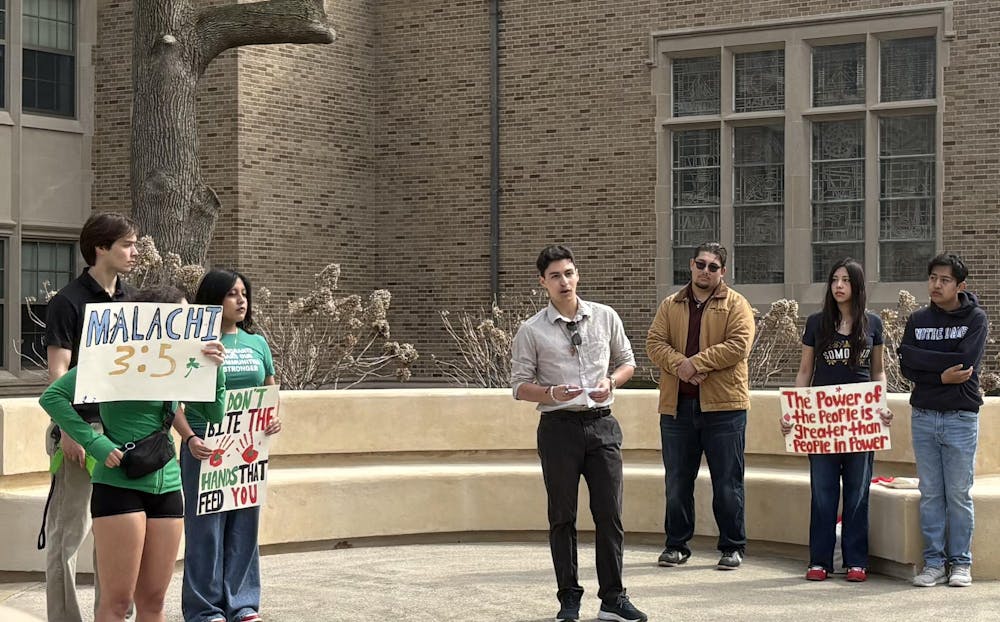
In light of current politics and an event with the American Civil Liberties Union over winter break, a group of Notre Dame students came together with a vision to host a protest on campus celebrating immigrants on Saturday, March 21.
In an interview with The Observer ahead of the event, freshman Dario Romero described the goal of the event as a chance to “create unity through solidarity” in line with the call for students to be “a force for good.”
Freshman Eric Facundo said in an interview, “Honestly, the catalyst has really been politics.” He went on to explain that previous administrations, including the Obama administration, have deported immigrants, but their objections focused on the current administration’s methods. He cited there are “safe zones” for immigrants such as schools, but under the Trump administration, this is “something that we see slowly going away.”
Facundo explained that they wanted clubs from Notre Dame to help, but none that were contacted were willing to do so. Because the demonstration was not sponsored by a club, the group was unable to put up posters and instead engaged in outreach through social media.
Prior to the event, freshman Militza Algredo-Huerta noted that the protest was happening at the same time as a St. Patrick’s Day social event, but thought they could still draw a crowd because it was a topic that people cared about.
Around 50 people were in attendance.
Scheduled speakers included Fr. Joseph Corpora, Romero, Sonia Lumley, Tiffany Gervacio, Luis Fraga and Facundo, with Bennett Witherell serving as the emcee throughout.
Corpora, a Holy Cross priest and associate director of the Transformational Leaders Program, opened the event with prayer, saying, “Merciful God, we pray to you for all the men, women and children who have died after leaving their homelands in search of a better life. Though many of their graves bear no name, to you each one is known, loved and cherished.”
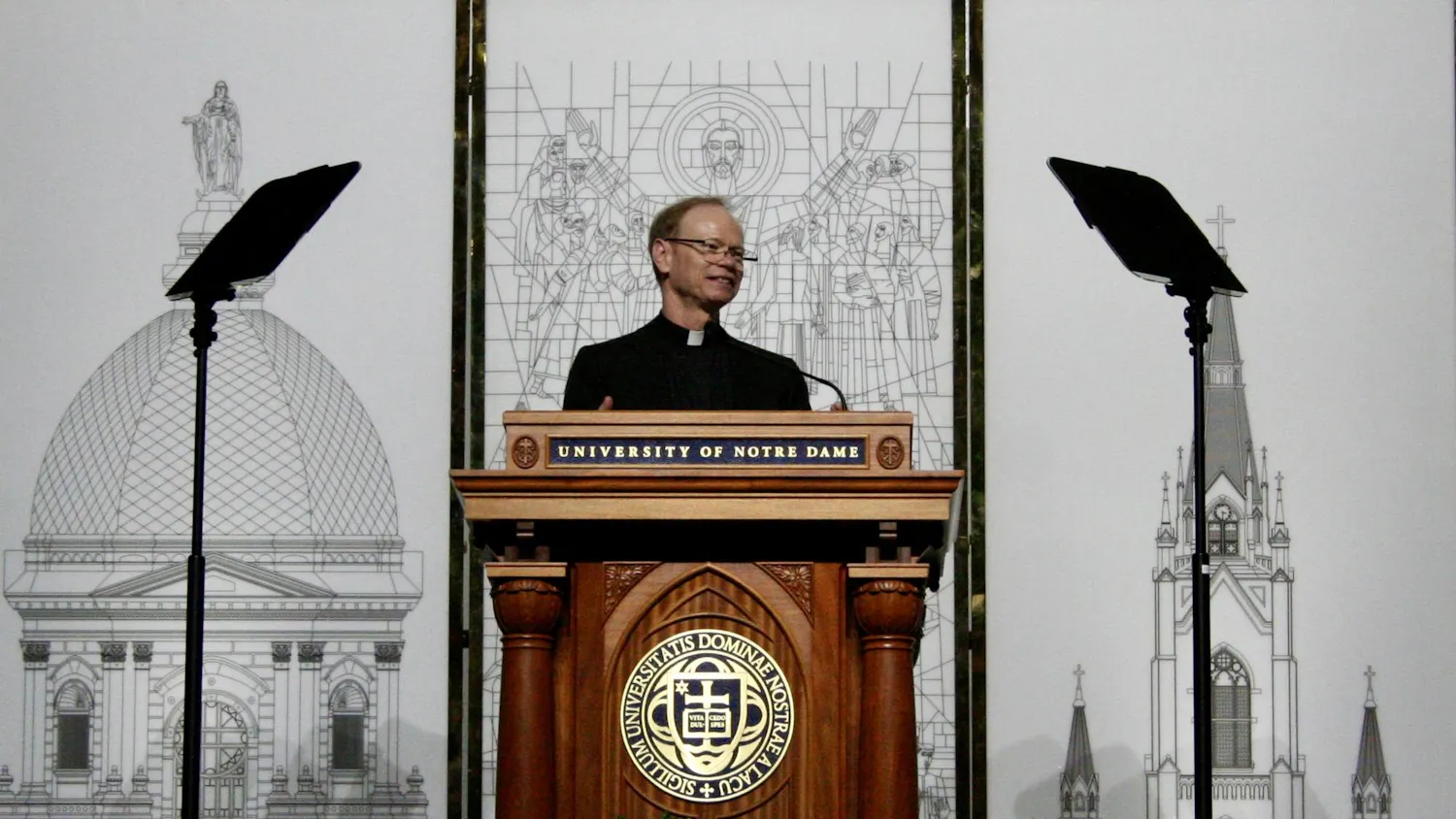
Corpora gave his speech following his opening prayer, offering a perspective of hope. Amid living in a time of darkness, he said darkness should not be considered the opposite of light; rather, “darkness is the active rejection of light.” To counter darkness, Corpora pointed out people need to witness to the light, and while John the Baptist is long dead, individuals today can carry on this testimony.
Corpora previously wrote a letter to the editor in The Observer related to immigration.
Romero was the first student speaker. Although the graphic the organizers had been circulating online ahead of the event noted he was a member of the Student Coalition for Immigration Advocacy, SCIA was not a sponsor of the event.
He emphasized the call to be a force for good and noted, “Immigration enforcement, like it or not, is an issue that affects each and every one of us.”
“Stand up for those who are most marginalized, give the voiceless a voice and create solidarity for unity to combat these pressing issues of our time,” Romero said.
Gervacio, a key student organizer for this event, began by saying she came to this space with a heavy heart and yet is filled with hope for the power of this moment. She said the University is “a predominantly white institution” and allows its community to live “in a bubble.”
“But outside of this bubble, our reality is harsher. While we sit in classrooms and write papers and attempt to go about our daily lives, our loved ones are being targeted at home. Our communities are filled with ICE agents who bring fear into everyday lives. Fear when someone knocks at the door. Fear when someone leaves their home just to buy groceries. Fear of existing in brown skin,” Gervacio said. “Our families are being separated by our borders. Not just physical borders, but emotional ones, psychological ones, generational ones. Our families are being separated. Our bodies are here in Indiana, but our hearts, our hearts are back home with our families, with our people, our communities. Worried. Waiting. Wondering if the next phone call will change everything.”
Gervacio said she has been a part of this movement since 2006, when she was in the womb and her mother was attending protests. She reminded attendees, “power is the ability to effect change. That power does not belong to any administration. It does not belong to any government that tries to silence us. That power belongs to us.”
Fraga, a political science professor, called upon Bishop Mark Seitz’s March 15 pastoral letter on mass deportation and mass detention, specifically highlighting the section about Pope Leo XIV personally asking him to “stand in solidarity with suffering migrant families and not to remain silent.” Additionally, he noted “the current national campaign of mass detention and deportations is a grave moral evil.”
Mentioning an article from Commonweal magazine, he said this moment has led to protests, and more importantly, increased “neighboring.” Calling upon the reflections of Martin Luther King Jr., he noted that only in darkness are the stars visible. From this, he invited people to pray daily for the healing of communities.
Following Fraga’s speech, Witherell allowed anyone who felt called to share to do so.
Freshman Tyler Castano then spoke, highlighting the pain of being forced to speak the English language, and argued that simply by being in America, a person is American.
Castano brought up the principles of a republic, calling out that even if “only for a certain people at a certain amount of time,” the principle of a republic, going back to Ancient Rome, is “the voice of the people,” and at the end of the day all are “human beings.”
“In a republic, we do not have kings. We do not have tyrants. We do not have princes. Except for those of us who may be Christians, in which our only rule is the king of the universe and the prince of peace, Jesus Christ,” Castano said.
While freshman Algredo-Huerta was invited to be a part of organizing this event, she opted not to because of other commitments. In an interview with The Observer, she said, “If I wanted to be a part of this, I wanted to do it in a way that was giving my 100 percent, and I just knew that I was not at the capacity to do that in this present moment.” She did, however, end up speaking, and told her story of her parents being forced to work instead of going to school, but giving her the opportunity to come to Notre Dame.
Facundo spoke after the final speech, reminding people, “It takes a lot of bravery and courage, especially in a school like this, to come out and show out for the immigrant community, to show your love and advocacy for them.”
Freshman Lesly Calixto closed out the event by leading a call and response chant in which she said, “Show me what democracy looks like,” and the crowd responded, “This is what democracy looks like.”
Editor's Note: Contents of this article have been removed after publishing on a case-by-case basis to protect the safety of individuals and their families.