
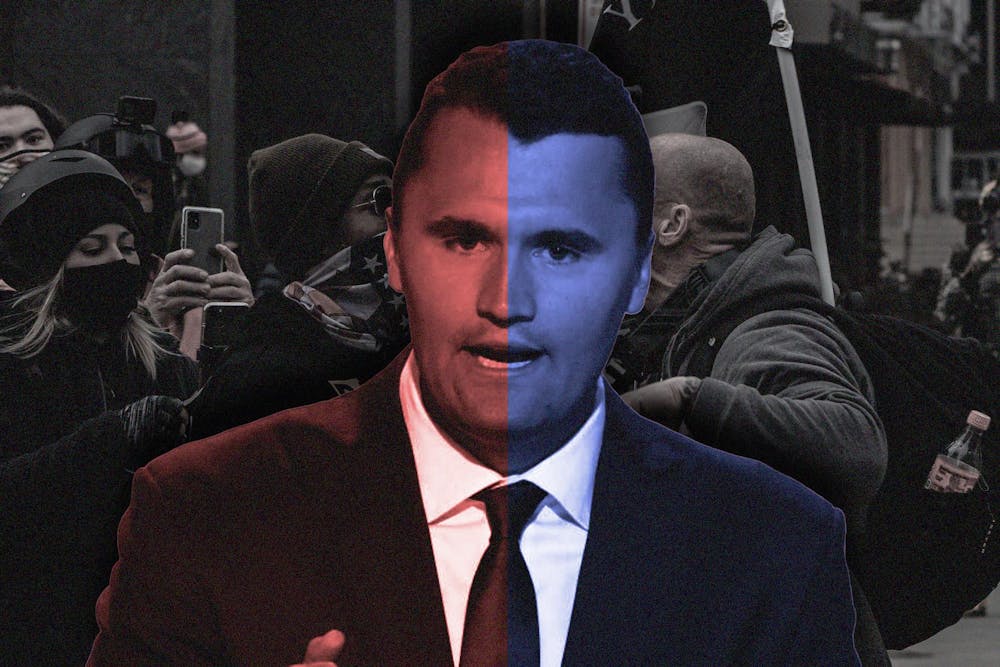
The six months after the assassination of Charlie Kirk have allowed me to reflect on its lessons with the gift of time. When conservative activist and podcaster Charlie Kirk was killed on Sept. 10, 2025, it sent shockwaves through the United States and the world. To me, it seemed that the mounting polarization had finally reached its pinnacle, and as I watched the media, politicians and the country in the following days, I was waiting for something miraculous to happen. I was waiting for unity. Yet, no one could agree on anything.
First, it was the events of the assassination itself. Who shot him? Why? What was their political leaning? Did his family see the events in the flesh? To me, these questions only served one purpose: to distract and to pull people apart. If we spend more time researching the facts of a case, rather than pondering the death of the deceased, we immediately become desensitized. Rumors of Kirk’s family being in attendance were spread over various media platforms, including the BBC, before they changed it.
For many, the lie about his family came off as an attempt to elicit sympathies from the people who did not agree with Kirk. Yet, this only did the opposite. Upon the discrediting of this rumor, the discrediting became the focus. When a public figure is polarizing, sympathy is often generated by emphasizing their proximity to widely accepted symbols of innocence or virtue — family life, charity or church attendance, to name a few examples. These associations are usually meant to soften or complicate public judgment. I don’t doubt that there is evidence of Charlie Kirk being associated with any number of these things, but the fabrication of it in this instance was worse than its absence. For many, it raised a confounding question. If the presence of his family at the assassination was needed to earn sympathy, was the sympathy deserved?
Survivors of school shootings, who witnessed the death of their fellow friends and classmates, may find Kirk’s comments that gun deaths are a “prudent deal” of the Second Amendment, at the very least, in poor taste. Avid defenders of the Second Amendment might understand his point. I could go on in the same fashion for any number of statements he made, but a person’s value should not be measured by the rhetoric they spew. It should be valued by the fact that they are human.
The lesson I learned from the assassination was how far from unity society is. No one is blameless, nor does any one group hold the entirety of the blame. Death by targeted shooting or assassination in politics is always sad. It shows that society is unable to be tolerant. Tolerance is a necessity to democracy. Any act of political violence shows intolerance. Yet, as Kirk himself said, “You will never live in a society when you have an armed citizenry and you won’t have a single gun death. That is nonsense. It’s drivel. But I am — I think it’s worth it.”
Even in a society that treats gun deaths as the price of certain freedoms, they should still be recognized as an evil — albeit a necessary one to some. Looking back to the lessons America has learned from the killing of Kirk, I struggle to find one. When misinformation, further polarization and disunity are the effects of political violence, and no moral lessons about the dignity of the human person are derived, it shows the inability of society to come together, even for a moment.
Amaris O'Connor is a sophomore from London, United Kingdom currently living in Flaherty Hall. She is a political science major and spends most of her free time reading or making different iced coffee combinations. You can contact Amaris at aoconn27@nd.edu.


