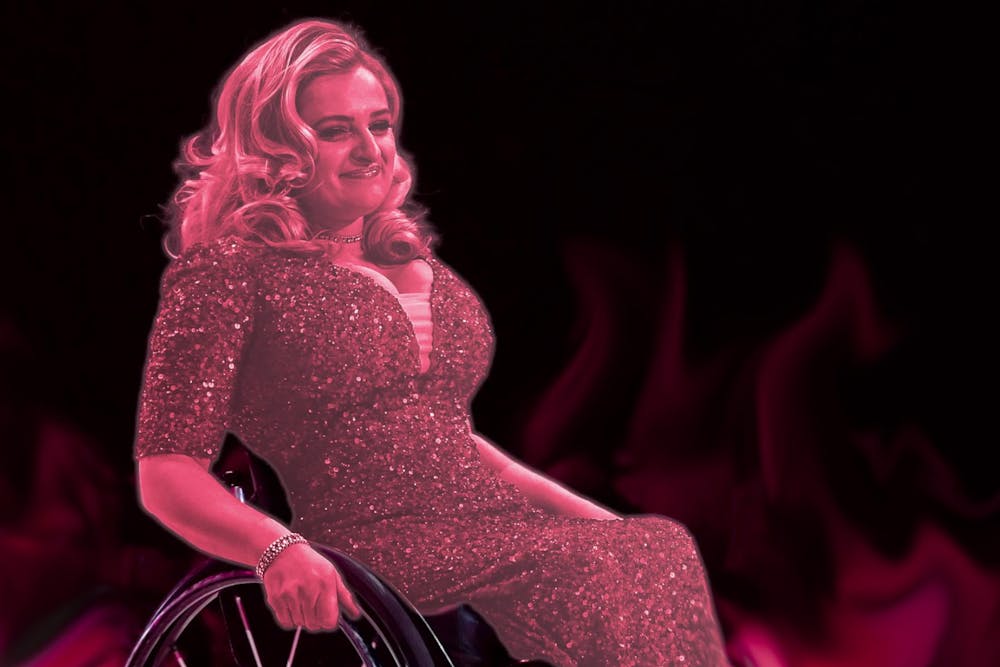
On Friday, April 17, Ali Stroker, joined by music director and pianist Nate Patten, offered a wonderful night of stories and songs at the DeBartolo Performing Arts Center. Stroker made history in 2015 when she became the first actor who uses a wheelchair to take the Broadway stage. In 2019, she won a Tony Award for her portrayal of Ado Annie in the revival of “Oklahoma!”. In addition to her theater credits, she has appeared in film and television, both on screen and through voice acting.
Stroker’s show was, as she put it, an opportunity to tell some stories and sing some of her favorite songs. The setlist was a mix of musical theater show tunes, country music and pop songs, but, despite the varying genres, they all complemented each other well. The concert opened with “(You Make Me Feel Like) A Natural Woman,” and her voice immediately commanded attention. At once, I knew I was in for a special evening.
Stroker’s performance of her signature song from “Oklahoma!,” “I Cain’t Say No,” was a highlight of the night. Her delivery and stage presence were absolutely hysterical, and it is clear to see how it won her a Tony. For the duration of the song, Stroker was fully Ado Annie, effortlessly falling into the role.
Stroker truly excels when singing comedic numbers, and this was especially evident in her rendition of “Diva’s Lament,” which is filled with many contemporary Broadway references and jokes about the industry. However, she also has command over heartfelt songs, such as during her performance of “Somewhere That’s Green” from “Little Shop of Horrors.”
Exclusive for her performance at the University of Notre Dame, she welcomed audiences into her creative and rehearsal process. Giving some context, she let us know that she was recently invited to a special event where she has to select a “dream show” and perform a number from it. In preparation, she decided to test the song, “Back to Before” from “Ragtime,” out on us but gave the warning that we were the first audience to ever hear her perform it. It was a fantastic addition to her repertoire but also felt real and intimate. She had the lyrics for reference on her phone and was working with Patten for cues. The song did not feel unprepared, however, sounding just as polished as the rest of the show.
The most powerful part of the night was hearing her share her life’s story and journey to Broadway. At the age of 2, she was involved in a car accident that caused damage to her spinal cord, thus paralyzing her from the waist down. She said that she only can remember being in a wheelchair and, growing up, it was normal to her. Her first experience performing was at the age of 12 in a production of “Annie” directed by a classmate and performed in her backyard. Stroker identified this as the moment that ignited her passion to perform. For the first time, when people stared at her, it wasn’t for her wheelchair; it was because she was singing, and she was the star. Stroker said that when using her voice she feels most free, saying, “When I sing, I’m just myself, and I can fly.”
A major focus of the show was raising awareness for accessibility. While many of the theater houses are completely accessible, backstage areas are not. Stroker is a leading activist for making Broadway more accessible, stating, “If you’re the first, you better open your mouth and talk about disability.” For her, performance is a form of productive advocacy, explaining that being onstage allows people to stare. She wants to welcome others into her world and strives to encourage dialogue and change.
The entire show was translated into American Sign Language by three interpreters onstage. At one point in the show, Stroker recalled her experiences working at the Deaf West Theatre in Los Angeles, a company that specializes in performances in which roles are signed and translated to voice so that the show is accessible to all audiences. Stroker put down her hand-held mic, told the interpreters they could take a short respite and simultaneously sang and signed “Mama Who Bore Me” from the musical “Spring Awakening.” I was captivated and struck by the seamless integration of the two storytelling methods.
Stroker concluded the concert in a rousing performance of her self-proclaimed anthem, “Be a Lion,” evocative of how empowering her stage presence and storytelling were Friday night.