When one believes to know the truth, it becomes burdensome; it makes you feel responsible for its dissemination and prompts you to discourage falsities. A Catholic university proclaims to know one thing from which everything flows: Jesus resurrected. With this comes a certain morality, certain obligations and binding customs, which have been developed through millennia. This baggage imposes itself on the Church’s institutions — like Notre Dame. One of the most notable tensions between the Catholic mission and modern ideals lies in the preservation of academic freedom — the tolerance, discourse and investigation of diverse ideas. The Church actively advocates for its form of morality and worldview, and its institutions are expected to do the same. How can an institution that presumes certain truths meet the neutral and objective standard our modern world has for universities — especially when the discourse contradicts its own principles? I argue that a Catholic university can not meet the objective neutrality expected of a university in our age. I also argue most schools possess an illusory neutrality; at least Catholic institutions are transparent about the foundational axioms that define the marketplace of discourse.
The Catholic Church has stalls in the universal marketplace, and Notre Dame is one of its vendors. Both can not be passive. They move and act for, as Matthew states, “the gates of hell shall not prevail against it.” The Catholic identity, as mentioned in The Application for Ex Corde Ecclesiae for the United States, has “distinctive characteristics that are essential for Catholic identity,” one being that reflection and research should be done “in the light of the Catholic faith.”
This follows from the principle that there is “no contradiction in the truth,” Fr. John Paul Kimes, canon lawyer and assistant professor of the practice at Notre Dame Law School, wrote in a statement to The Observer. “Authentic research and Church teachings are not at odds.”
This is drawn from Ex Corde Ecclesiae Section 17, itself drawing from the Second Vatican Council’s Gaudium et Spes, saying methodical research “can never truly conflict with faith”, because both “derive from the same God.” An example of this active action lies in Canon 810 of the Code of Canon Law where it states that professors in a Catholic university must be “outstanding in integrity of doctrine and probity of life and that they are removed from their function when they lack these requirements.”
So then, how can a Catholic institution, with its preconceived notions of unitive truth, be satisfactorily free in its academic discourse? It is impossible. The Church has its beliefs, and it acts upon them. The Holy Cross’ mission statement proclaims a desire for “truth to be promoted in every imaginable way.” But when that truth is preconceived by the institution hosting the discourse surrounding its validity, critics may reasonably argue that it stifles the marketplace of ideas. However, this critique assumes secular universities are “neutral” marketplaces. They are not. The reality is that secular universities possess their own iterations of canon law, ecumenical councils and dogmatic decrees — some of which stand in direct opposition to Catholic doctrine. The traditions from which many secular universities draw are often concealed under the guise of objective neutrality and academic freedom — until the ever-present line is expressed.
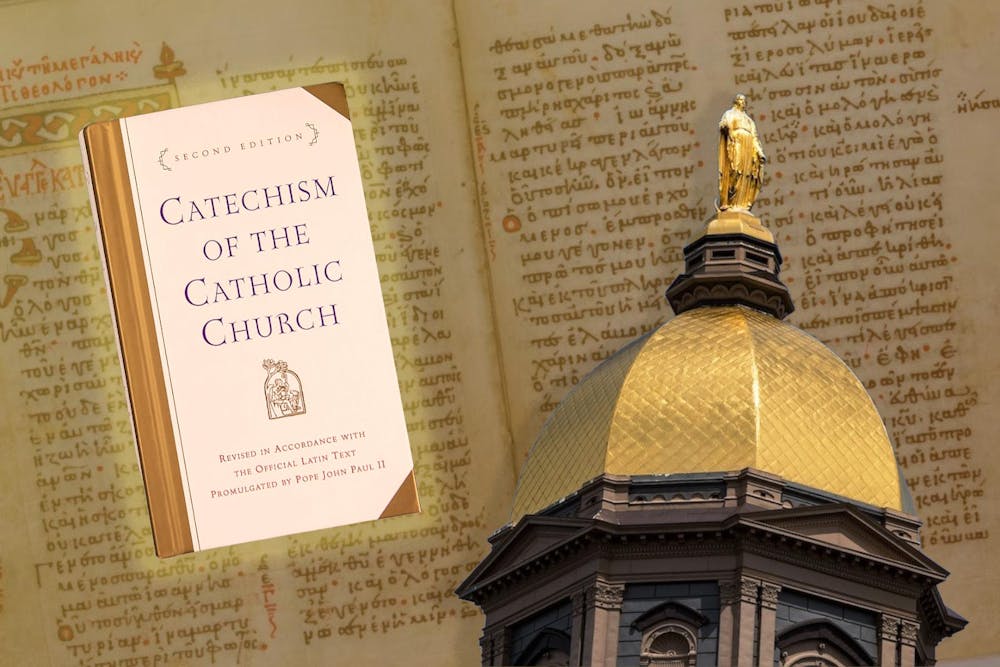
Consider abortion, a topic whose fundamental nature is defined by one’s perspective in the debate: a matter of life and death or an inconsequential removal of cells. It is also, possibly, the most distinctly Catholic stance, where Catholics can only be on the anti-abortion side of the debate. Catechism of the Catholic Church §2272 is uncompromising: “A person who procures a completed abortion incurs a latae sententiae excommunication.” Even helping one get an abortion incurs this automatic excommunication from office and sacraments (see also canon 1397). Usually, the abortion-rights advocate does not believe that non-viable cells at conception are imbued with the same rights a human obtains later in life — as they do not constitute the kind of life imbued with rights; therefore, legislating against the abortive act is an intrusion. A conflict arises between the death of a human and the intrusion of one’s rights. Here the neutral and objective marketplace of ideas should flow in its untampered course. Right? No.
By virtue of its Catholic identity, Notre Dame absolutely must, by every metric possible to measure its actions, be against and prohibit the abortion-rights position to be actualized or promoted. In theory, it would weigh in one side as to not help with the advancement of the abortion-rights side and therefore the procurement of abortions. Likewise, the secular universities advocate with the opposite intentions. In the marketplace of ideas, within the academic environment and throughout school culture, the abortion-rights position is permitted and often promoted, while the anti-abortion advocate faces undeniable ostracization from both faculty and students. Both are acting politically, not neutrally.
This can be seen from staff council statements from the University of Pittsburgh, to student magazines quoting their chancellor’s support for the “ability to access necessary health care services” and even to funded reproductive health law centers with the goal of “helping advocates attack bans and criminalization at state and national levels.” The institutional support swings the other way too with the banning of certain talks and advertisements in Texan and Christian universities. However, the cards are out there. There is no guise of objective neutrality to be seen. You know the general environment expected at a Christian university, with its moral beliefs plastered on a charter, creed or canons for you.
While UCLA uses state money to fund an abortion law advocacy center, the UCLA Academic senate Committee on Academic Freedom boldly claims, “CAF stands opposed to partisan intrusion — of any sort — into teaching and learning at the university or any political tests imposed on scholarship or science.” I have not found a statement on the center’s establishment. The political test is stated in their mission statement: “Our mission is to increase access to abortion and contraception.” Granted, abortion-rights advocacy is not their only proclaimed function; they also focus on “racial and economic disparities in maternal health outcomes” and “gender bias that limits reproductive justice.” But if we take an honest look and recognize that this is not only an “abortion sanctuary,” as a UCLA professor writing for the student magazine claims, but also an organization co-founded by the CEO of Planned Parenthood Los Angeles, we can see it is clearly partisan. You can also consult any of the law center’s newsletters.
Political or religious affiliations impact one’s actions. The same stands for institutions that claim to be neutral hosts. Notre Dame serves the global academic community best when it does not mimic the illusory neutrality of its peers but offers a consistent alternative. If it exists, academic freedom is best produced through a defined and consistent framework. If Notre Dame refuses to mask its mission, it can remain one of the few places where the marketplace of ideas is governed by a visible creed. If Notre Dame is to be Catholic, it must act while holding the Catholic baggage and define the marketplace it hosts. Clarity serves us all better.
Diego Gonzalez is a student of the class of 29' and a Philosophy-Theology and Arabic double major with a Greek minor. He lives in Coyle/Zahm/Fisher and he has no hobbies besides doom scrolling. He is opinionated and slow to his opinions, so if there are issues you can't wait to share, contact: dgonza38@nd.edu. He likes to fight about them, so don't be shy.