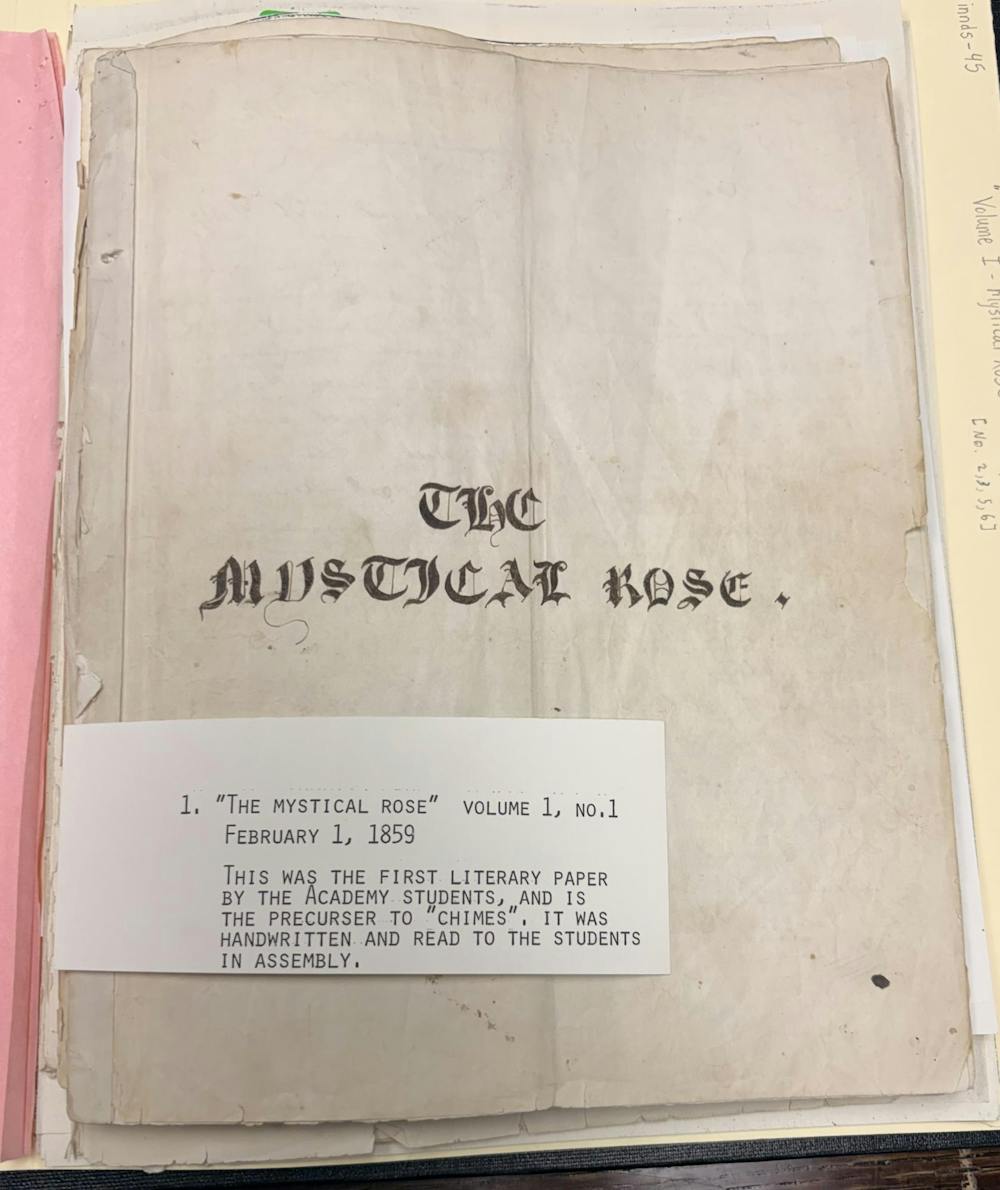
The Mystical Rose, debuting on Feb. 1, 1859, was a literary publication at Saint Mary’s College — the first of many papers to come. Handwritten in loopy cursive, The Mystical Rose was not distributed to a large student body, but printed in a single volume that was read out to the whole school.
Beginning with The Mystical Rose — published from 1859 to 1863 — papers, magazines and journals have passed through the school. Publications that predate the foundation of The Observer in 1966 include The Static (1926-1961) and The Crux (1956-1967).
Eric Walerko, college archivist at Saint Mary’s, explained that past papers are time capsules for impactful moments in Saint Mary's history, and the culture of the United States at the time they were published.
“Most of these publications can give a very unique insight into not just what’s going on in the world or campus at the time, but also what student life was like at the time,” Walerko said.
Writing for The Crux
The Crux emerged in 1957 in response to a desire for more frequent news publications on campus. Chimes was available as a student publication, but it was a literary journal that had a greater focus on the arts and literary work, and The Observer did not exist yet. At the time, Saint Mary’s had a journalism department on campus that published The Static monthly, but the Student Council desired a weekly publication.
Gail Donovan, Susan Pichler and Susan Fitzgerald Rice wrote for The Crux in the early 1960s.
“The student council at Saint Mary’s had decided that the College needed a newspaper that was a little more up to date, not so professional, that could be produced quickly of happenings on the campus at Saint Mary’s and Notre Dame,” Pichler said.
She recalled distinctly liking the name of the publication, which Pichler explained is to ”get to ’the crux’ of the matter.”
Pichler attended Saint Mary’s with her sister. The two both served as editors-in-chief of the publication during their respective senior years. As an English major and daughter of a journalist herself, Pichler remembers having a distinct interest in journalism and writing.
Anyone could write for The Crux. It covered campus news, clubs, classes, little stories from around campus and national or global affairs. Fitzgerald Rice recalls planning weekly topics with The Crux staff.
The paper was typed on two legal-sized sheets of paper, making four pages, which were stapled together and distributed to students at meal times. Pichler explained the paper would be distributed to the girls while they waited for the doors to the dining hall, located then in Le Mans Hall, to open.
Donovan, now a writer for Saint Mary’s alumni magazine Avenues, wrote for her high school paper before joining the Crux in college. She graduated from Saint Mary’s in 1963, and served as co-editor of the paper in her senior year with Diane Shalela Fritel. Donovan shared that the paper had been organized under a faculty advisor named William Slavick, an English teacher at Saint Mary’s who was finishing his doctorate at Notre Dame.
Throughout her time as a journalist in high school, Donovan interviewed a variety of people, including Christopher Dawson, a historian from Great Britain, and John F. Kennedy after following him for an entire day on the campaign trail for U.S. senator in Massachussetts.
“I followed him from something like seven in the morning until 10 or 11 at night to Western Massachusetts, and finally got the interview, and I started out with, ‘Mr. Kennedy, I’ve been following you all day.’ And he said, ‘So, I’ve noticed.’ And he just went on with a spiel that was every writer’s dream. I didn’t have to ask him another question.” Donovan said.
While she was a student, Donovan witnessed the transition from Sister Madeleva’s presidency at Saint Mary’s to that of Sister Maria Renata Daily.
“That was a very dark time for Saint Mary’s. Sister Madeleva had retired in our sophomore year and a history professor was named President. And, all of a sudden, the place went from this kind of joyful place to a cloud over it,” Donovan said.
Donovan said The Crux did not address this cultural change, and only later did she learn to be more forthcoming with her writing.
A lasting impact
Pichler worked for a short time as an English teacher before stepping away from a career in teaching when she got married and had kids. Regardless, she continued to have a deep appreciation for journalism and continues to read print papers.
“Hardly anybody on our street actually gets the printed paper, but I’m in love with two good newspapers,” Pichler said.
Fitzgerald Rice said The Crux gave her invaluable communication skills.
“Your entire life depends on your ability to be articulate ... I’ve certainly learned in my time that a lot of people don’t have the kind of training that we had,” Fitzgerald said. “We had a sister who was our counselor, and I don’t recall that she went over the language, but if we had errors, she probably caught them.”
Donovan went on to work in education, eventually serving as dean of Wheelock College in Boston. Her career reasserted the importance of strong communication to her.
“I’ve been a teacher, a principal and a school superintendent. I don’t find writing difficult at all, and supervising people, I think that you see what people didn’t learn along the way,” she said.
Surviving copies of the Mystical Rose, Static and The Crux are preserved in the archives at Saint Mary’s along with other publications throughout the school’s history.
“The archive is here to preserve the history of the college, and in doing so, it’s imperative that we preserve the work of its students,” Walerko said.