
On Tuesday afternoon, the Kroc Institute hosted Eman Abdelhadi, assistant professor at the University of Chicago, as a part of the Intersectionality and Peace Series for a talk titled “Adrift: U.S. Muslims and the End of Liberalism.”
The event began with Abdelhadi’s lecture on American Muslim politics across the last 26 years and how the group serves as a diagnostic case for the broader fracture within the Democratic Party. Her lecture was followed by an open discussion allowing the students and faculty in attendance to discuss the lecture before opening it back up to questions for Abdelhadi.
Last year, Abdelhadi had been slated to speak at the annual peace conference but was disinvited at the last minute, with administrators citing a University security policies requiring a police presence at all events regarding Israel and Palestine. The decision received backlash and was interpreted as censorship and silencing of pro-Palestinian voices. Abdelhadi released her own statement condemning the disinvitation.
“I think right now, all of the institutions of our society are under attack. All of the things that ironically make us great are under threat whether that’s free speech, higher education, our right to protest. The way to face that is to stand up to it and insist on our right to free communication, on our right to academic freedom, on our right to free speech,” Abdelhadi said in an interview with The Observer.
In a statement to The Observer, Mary Gallagher, dean of Notre Dame’s Keough School of Global Affairs, wrote, “An invitation for Professor Abdelhadi to return at a later date was extended following last year’s cancellation, which was due to insufficient time to secure appropriate safety and security arrangements. We are pleased to have welcomed her this year.”
As a previous fellow at the University, Abdelhadi said her relationship with Notre Dame and her desire to stand up to censorship brought her back.
“I feel accountable to my community and to God to do the right thing, and my accountability is not to the bosses or the institutions and politicians. So, at the end of the day, I want to be able to say that I did everything I could; I did what I thought was right,” Abdelhadi said.
Abdelhadi began her lecture by discussing voting patterns during George W. Bush’s presidency, specifically mentioning that in the wake of 9/11, Muslims switched from relatively invisible to a highly targeted group in American politics. “In the Republican Party, Muslims become the consistent boogeyman that is brought up every election … Muslims are constantly instrumentalized as this enemy number one for the Republican Party, which naturally pushes them into the arms of the Democratic Party,” Abdelhadi said.
As a result, Muslims in the United States were beginning to become semi-incorporated into the Democratic Party by 2008, and this incorporation was further advertised by Barack Obama’s presidential campaign. Although the Democratic Party won the majority of Muslim votes, Abdelhadi stressed that many were hesitant to trust Obama.
“He did not end the war in Iraq. He did not end the war in Afghanistan. He did not close Guantanamo Bay. He famously dropped many drones, illegally killing many, many civilians in Yemen and elsewhere. And so within the Muslim American community, there was a sort of discomfort,” Abdehadi said.
In the 2020 election, the demographic was no longer the main rhetorical device of the campaign. Muslims in the United States seemed to be split into two groups: a progressive coalition that voted for Bernie Sanders and a more conservative group that sided with conservative Christians.
Abdelhadi highlighted a caveat to understanding this trend. “People have such an instinctive belief in Muslim social conservatism,” Abdelhadi said. “On almost any issue, there’s almost as many Muslims who believe the more left wing position.”
According to Abdelhadi, the beginning of the genocide in Gaza was a reckoning moment for many Muslims, especially those promised incorporation into the Democratic Party. The Democratic Party’s support for Israel resulted in a shift in support among Muslim voters, with some voting uncommitted or voting for the Green Party candidate in the 2024 election.
“This does not represent an ideological shift to the right. This represents an anger at the Democratic Party. And in fact, that is the case for so many groups of color that the Democrats lost in 2024. When you look at the data on their actual beliefs, there hasn’t been a rightward shift, and what that tells [us] is that this is a protest vote,” Abdelhadi said.
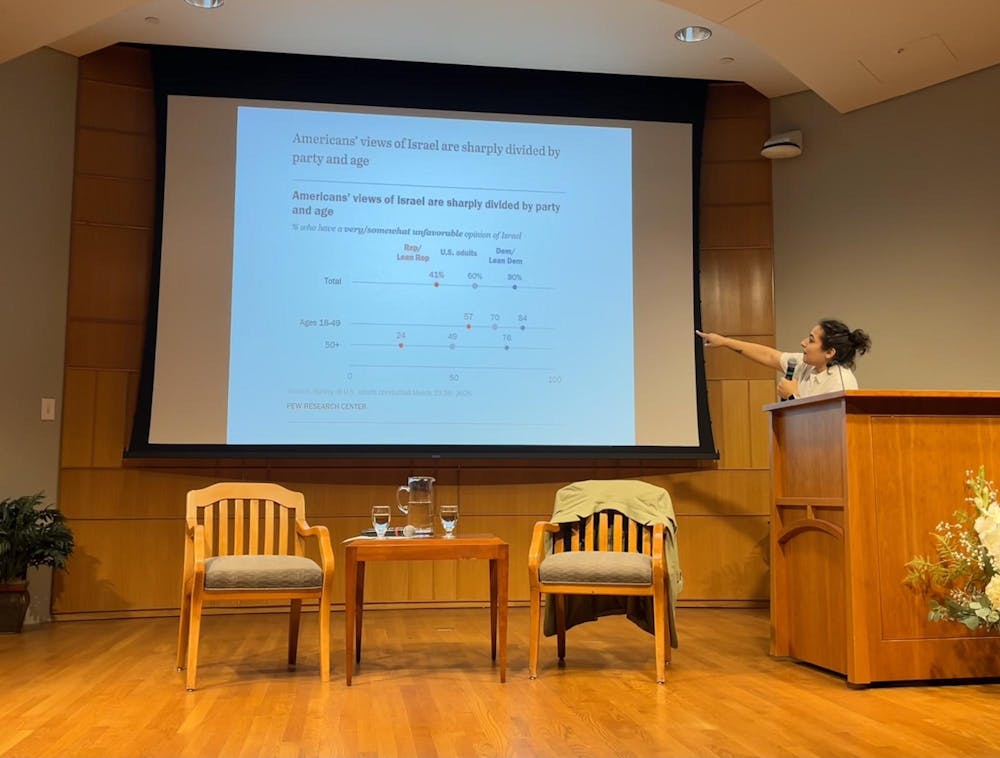
Abdelhadi paralleled this trend with the general public, particularly younger voters. According to the Pew Research Center, 80% of Democrats see Israel unfavorably, and Republicans ages 18 to 49 hold a similarly negative opinion. Abdelhadi said the protest wave of 2023 and 2024 stemmed from the youth of the general public, not just Muslims.
“It might have been Muslim led in certain areas, but young people en masse took to the streets to protest the genocide of Palestinians, and the Democratic Party responded by calling them antisemitic, sending in the police, advocating for them to lose their jobs, supporting their doxing, supporting their censorship. It’s not just American Muslims who suddenly saw themselves as not incorporated in this project of liberalism, but Gaza also comes to cast a shadow on the entire project of liberalism,” Abdelhadi said.
Abdelhadi believes the election results were indicative of a failure of both American democracy and Democratic politicians. “I think the reason the Democrats lost against the most unpopular president in American history in 2024 is because they offered nothing. They literally offered nothing. The American public didn’t move to the right — they did,” Abdelhadi said.
Furthermore, Abdelhadi stressed the intersectionality of these political issues, particularly when it comes to justice and constitutional rights. She said the events in Palestine held a mirror to American society.
“You think you’re free? You can’t protest. You think you’re free? If you say your opinion on social media, you’re going to lose your job. You think you’re free? Your politicians know that you all believe this thing, and they still won’t do it,” she said. “You think you have a democracy, where is it?”
In a final call to action, Abdelhadi said, “And so we can continue to raise that mirror, right? To address these things, we have to do it in a coalition; we have to say that Muslim issues are not just Muslim issues.”


