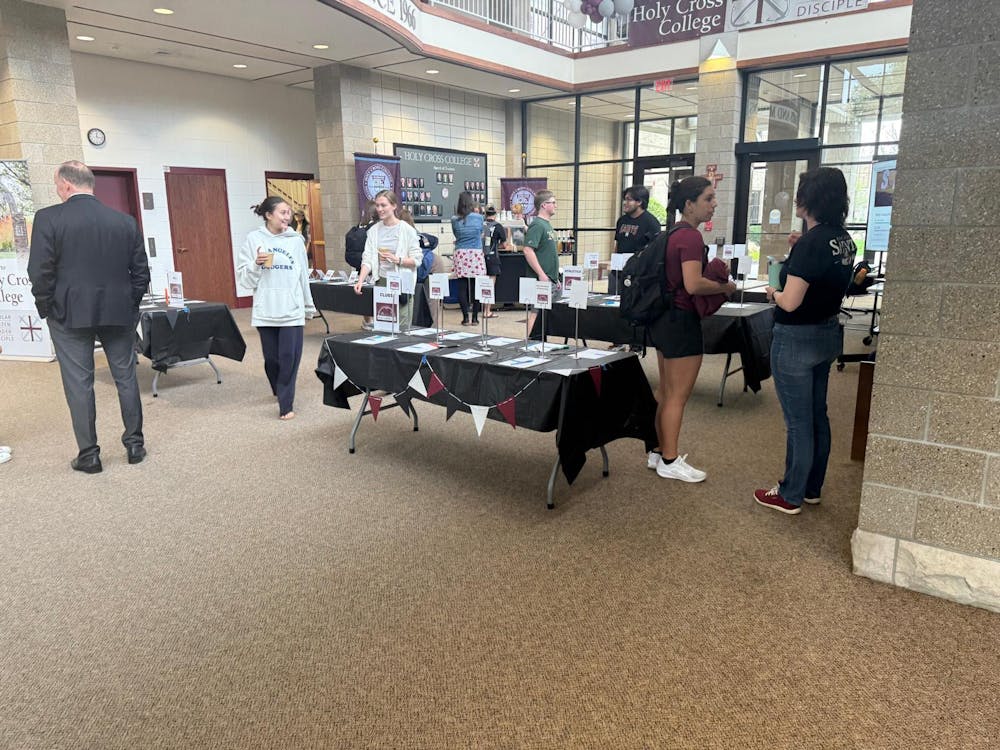
As Holy Cross College shifts its annual giving efforts to surround a showcase of student-led initiatives, one such project is focusing on what students throw away and what it could become.
Senior biology major Nicholet Zabuna and junior mathematics major Janysse Barrera-Zelaya are leading a project aimed at reducing dining hall waste, while creating a campus garden to provide fresh and sustainable food. The project, presented Thursday as a part of Holy Cross Day, combines food rescue, composting and gardening.
Zabuna explained that within the dining hall they have two goals. “The first thing is to try and rescue food that is left over and take it downtown to the food bank. The second would be composting what is thrown away by the students.”
To address this, they are looking to get two bins: One for things that cannot be composted and one for remains that can be composted. “When we compost the food remains, we’ll use it as manure,” Zabuna said.
This composting system would directly support a campus garden, which Zabuna and Barrera-Zelaya hope to transform into a year-round space. While the garden already exists, Barrera-Zelaya described it as “lacking.”
The project is one of 17 student-led initiatives featured in this year’s Holy Cross Day, the college’s annual giving event. This year marks the first time that students have been invited to submit funding proposals. In previous years, the event focused primarily on broadening institutional needs like academics, scholarships and faculty or staff-led ideas.
“Students didn’t really have a part in it,” Sarah Charles, director of Development for Annual Giving & Operations, said for past Holy Cross Days. “We wanted to change that this year.”
Zabuna and Barrera-Zelaya’'s vision goes beyond simply growing food — they want to address broader concerns regarding food quality and sustainability on campus.
“If you go into the dining hall, you’ll see there are more processed foods and foods that aren’t grown here,” Barrera-Zelaya said. “So, we wanted to have a garden so we could have a fresh supply of vegetables and fruits available for everyone here at the college.”
The project emphasizes education and hands-on experience — an aspect important for learning and applying learned information. Zabuna believes understanding the effort behind growing food can change how people view waste.
“If someone doesn’t know what it takes to grow a fruit or vegetable, there’s no way they are going to value it,” Zabuna said. “We want to give them a hands-on experience to be like ‘I put in 4 months of work, I can’t waste the food just like that.’”
The inspiration for the project stems from academic and personal experience, with both students citing Catholic teachings and Pope Francis’ second encyclical, Ladato Si’. Zabuna pointed to coursework focused on the common good, noting that ideas discussed in class oftentimes do not leave the classroom.
Barrera-Zelaya traced her inspiration to a theology course that exposed her to different environments in Indiana.
“If you care for the land, it will give back,” Barrera-Zelaya said. “We are meant to be caretakers of this land.”
Despite the project’s ambition and strong messaging, the team said they have faced challenges, when it comes to funding, awareness and impatience.
“Spreading the word has been difficult, trying to get people to understand both how much work it takes and how to grow things in a sustainable way. You can do it the shortcut way, using fertilizers, but it’s toxic. If you want to do it the right way, it takes longer and more money,” Barrera-Zelaya said.