
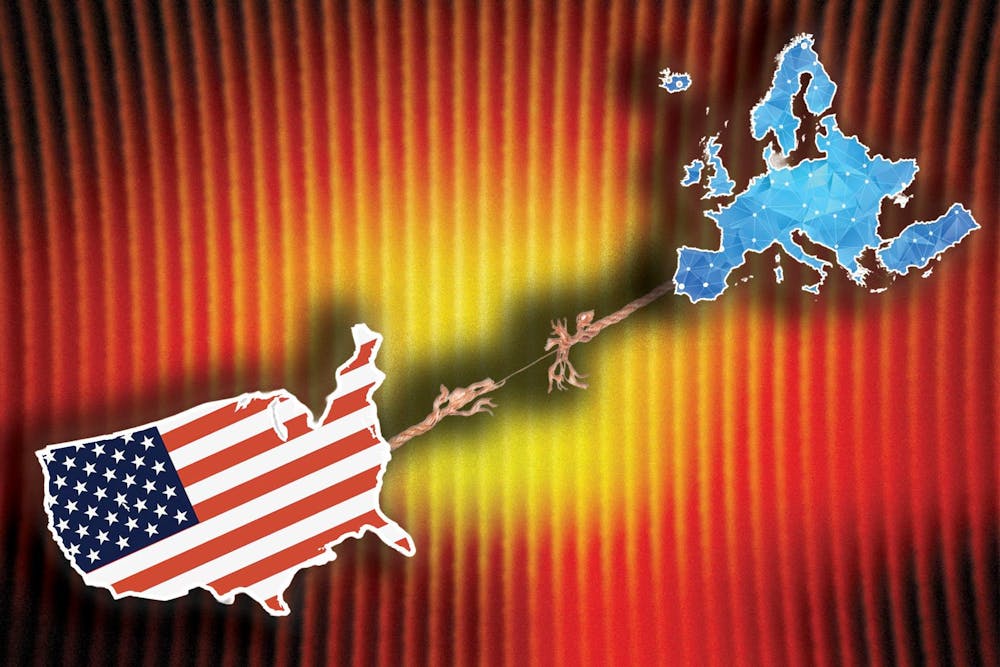
There’s been something I’ve been wanting to communicate back to my friends from my time in Europe for a while because it seems so close to obvious that to mention it is a waste of breath. Europe is fed up with the United States. This stereotype is so common that it feels like a waste of digital ink to write. On the internet, we see Europeans complain about the American tourists who wear sweatpants everywhere and are loud in restaurants. If you interact with those of a far left persuasion, you know people who see America as the epitome of imperialist capitalism. Every few years, you see headlines about European politicians being upset that America has left/broken the rules of some international accord. But I think the feeling is that at the end of the day, Europe accepts that, for all our faults, the United States is important for international security and stability. Our relationship with Europe is akin to a sitcom couple. Homer may forget an anniversary, but by the end of the episode he’ll make it up to Marge, and all will be well. However, the more I talk to people, listen to political debates among European leaders and read the news here, the more I feel that the United States has crossed a line. Politicians and institutions that usually would sheepishly take our side are refusing to do so, and Europe is making plans for how to do things without the United States.
I’ll start in the country I’ve come to know the best: Germany. A contingent of Germany has always had hang-ups with the United States. Germans chafed under the influence that the United States had over the development of West Germany. Some Germans felt that the US pushed the country to be a pawn in the Cold War instead of pursuing reconciliation with East Germany. Other Germans, though, have seen the US as protector. In their minds, America helped protect West Germany from falling under Soviet influence and continues to guarantee peace in Europe. This dynamic is perfectly illustrated by the German Green Party, die Grünen. The Greens were founded as a pacifist party, opposed to NATO. As of late, the party has come to strongly back German involvement in NATO, seeing the U.S.-backed alliance as an important guarantor of stability in Europe. Today, however, many institutions that have almost always been on the side of the United States in Germany are turning against American influence. German Chancellor Friedrich Merz, who is a former chair of a U.S.-German friendship institute, stated that one of his goals upon election was to strengthen Europe to achieve “real independence from the US,” and has refused to join the Iran War. In fact, every single political party in Germany that’s represented in the German parliament has made it a policy to avoid joining the Iran War. One such party is the AfD, which JD Vance campaigned for. Now party leader Alice Weidel is reportedly requesting that party members reduce their U.S. contacts and trips to the country.
Germany is not alone in trying to chart a future less dependent on the US. Trump stated that the U.K. would assist with clearing mines from the Strait of Hormuz, which British Prime Minister Sir Keir Starmer contradicted. Instead, the United Kingdom, along with France, has been holding meetings with 41 nations including Canada, Italy and Germany about attempts to re-open the strait. Noticeably, the U.K. and France have gone to lengths to clarify this would not be a part of the ongoing conflict, and the US has not participated in these meetings.
We’re already getting the taste of the consequences of a world in which Europe is unwilling to support the United States. The Trump administration has repeatedly asked its allies to assist in the ongoing conflict with Iran to no avail. As a result, the United States is largely bearing the cost of the war alone. The Pentagon requested $200 billion from Congress to pay for the war in March, which would wipe out all “savings” from the administration’s earlier DOGE cuts and would be double what the United States pays each year in food aid for our citizens. I can only imagine this price tag will get bigger and bigger the longer the war takes.
In a bit of non sequitur, I’d like to emphasize that Europe’s growing antipathy toward America has not extended to me as an American. I’ve never been treated worse for my background by anyone in this country. The people I’ve talked to have been more likely to extend their sympathies to me for having to live in a country with such crazy politics, instead of judging me for my country’s actions. The turn of Europe away from America is not motivated by hatred of America and Americans. What motivates the European-American breakup is exhaustion with us. The people I talk to are tired of trying to understand what motivates our erratic foreign policy. They are tired of the United States asking for more and more, while still complaining Europe isn’t contributing enough. To be honest, I can’t blame them.
Contact Patrick Kompare at pkompare@nd.edu.


