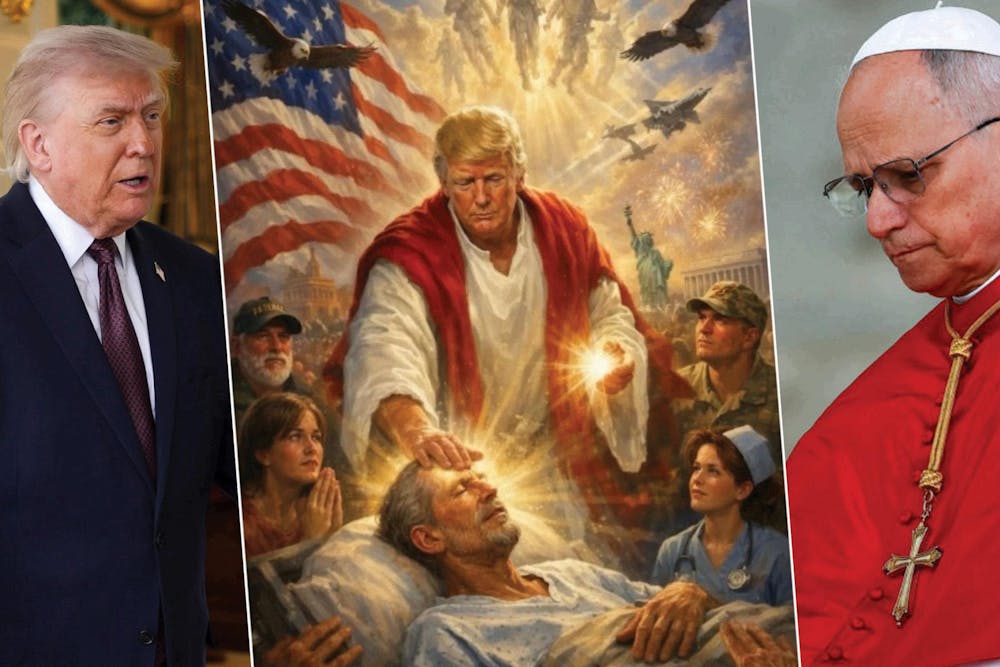
Amid an ongoing unpopular war and skyrocketing gas prices, the former president nonetheless finds time to criticize the leadership of the Catholic Church and portray himself as Christ. In an online temper tantrum that should concern all Catholics of faith, Trump wrote that the first American pope is “weak on crime” and “terrible for foreign policy,” before complaining that he does not want a pope who criticizes the President of the United States. Setting aside the irony for a moment, the exchange not only reflects a misunderstanding of Catholic theology but also highlights traps Catholics can fall into when participating in civic life.
It is clear from Trump’s statements that he lacks a fundamental understanding of the role of the pope. As the successor of St. Peter and shepherd of the Church, the pope’s mission is not to develop foreign policy platforms or prescribe domestic criminal justice policy. Neither Pope Leo nor Pope Francis has done so.
What they have done, however, is insist that the Church cannot be indifferent in the face of evil. The Beatitudes teach that those who hunger and thirst for righteousness, along with the peacemakers, are blessed. Pope Leo’s appeals to world leaders are grounded in Catholic Social Teaching, which affirms the preferential option for the poor and calls for solidarity. It is a reminder that we are our brothers’ and sisters’ keepers, and that what happens to the least among us concerns us all.
I could write at length about everything Trump misunderstands about the Catholic Church in this latest outburst. (For one, popes are not selected from a list like a dinner menu. And while Trump’s fragile ego may suggest otherwise, the Holy Spirit does not guide the Church toward a pope simply to punish him.) But a more important lesson of humility is left for us: the Church itself.
This moment should remind Catholics of our call to place humanity above idolatrous partisan loyalty and to resist the temptation to treat political leaders as prophets or political movements as religions. When politics becomes sacred, our moral vision becomes distorted.
This is not to suggest that Catholics should disengage from politics or retreat into apathy. In fact, the opposite is true. Catholicism calls us to love our neighbors and to speak out against injustice. It calls us to follow Christ’s example by extending grace to those on the margins of society — immigrants, workers, caregivers, those struggling with addiction and all of us in need of mercy.
I myself am a proud Catholic Democrat, but I know that Catholics across the political spectrum can find grounding in Church teaching, which demands more than partisan loyalty. Even as College Republicans fan the flames and defend MAGA over the Church by dismissing the Vatican as acting like a “hippie NGO,” we are reminded that Catholic Social Teaching is not meant to serve as a political prop. It asks us instead to examine our consciences, to challenge injustice even when it is politically inconvenient, and to support policies that uphold the inherent dignity of every human person.
This week, Catholics celebrated Divine Mercy Sunday, a reminder that the doors of mercy are always open and that even the gravest sins can be forgiven through Christ’s love. We are also called to pray for God’s mercy upon our nation. May all of us, including our leaders, receive that mercy and be moved toward good works.
So the next time headlines emerge about the Pentagon lambasting a cardinal for promoting peace or political leaders reacting defensively when challenged, take a breath. Choose mercy. And then fulfill your Catholic calling to participate in civic life in a way that defends the dignity of the human person.
Alex Young
Former president of the Notre Dame College Democrats
Class of 2026
April 13