The faculty senate convened for its monthly meeting Tuesday evening, where members primarily discussed artificial intelligence (AI) initiatives on campus, along with updates on a recent faculty appointment and an ongoing attendance policy proposal.
Ron Metoyer, vice president and associate provost, presented updates on the University’s Data, AI and Computing working group. Amy Stark, chair of the faculty senate and a biology professor, noted Metoyer’s appearance was unusual, as he had proactively requested to speak to the Senate last fall.
Metoyer explained the working group was tasked with developing recommendations for how the University should approach data, AI and computing within its curriculum.
“We likely need to figure out, at some point, how to get data, AI and computing as a competency into the core curriculum,” Metoyer said. “But we know that creating a new way of knowing is a very difficult thing to do when it comes to the core curriculum.”
He added that the group identified a need for more courses related to AI and computing, emphasizing the importance of building course capacity across departments. The report also considers whether additional majors, minors or concentrations should be introduced in these areas.
Metoyer said the group’s findings are directly informing a proposal to the Lilly Endowment, which recently called for submissions focused on AI and higher education.
“It is both intended to be centered on students and what we are doing for our students to meet this moment and help develop the skills and abilities that they may need,” Metoyer said.
The proposal is expected to include three components: curriculum, pedagogy and student support services. Within the pedagogy section, the University is seeking funding to compensate faculty for the time required to redesign courses to reflect advancements in AI.
“It takes effort building up our own literacy, and it takes time to make these changes,” Metoyer said.
He also highlighted an existing AI mini-grant program, which allows faculty to apply for between $300 and $1,000 to support work in this area. Additional ideas under consideration include funding for faculty during the summer, an online version of an AI Academy and the creation of a physical collaboration space, potentially in Hesburgh Library.
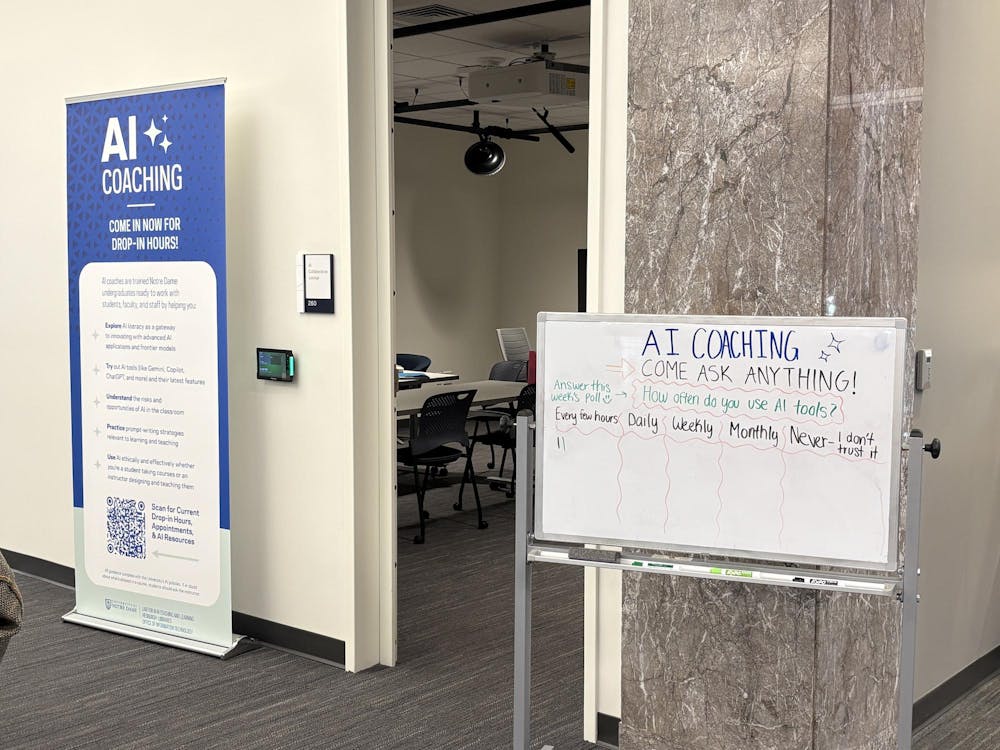
Metoyer noted the University has already opened an “AI collaboration hub” on the second floor of Hesburgh Library, located east of the dean’s office, which provides a space for AI coaching and collaboration.
Before concluding, Metoyer addressed several broader academic concerns. He said administrators are working to improve student participation in Course Instructor Feedback forms, including developing a 30 to 60-second video featuring Fr. Pete McCormick to highlight their importance.
Metoyer also noted discussions around grade inflation, which have gained attention at institutions such as Harvard, may prompt the creation of a University working group.
“I think it is also a big topic, because the federal government has mentioned grade inflation,” Metoyer said.
Additionally, he addressed increased demand for proctored exam rooms and ongoing conversations about device usage during assessments. A working group led by director of the Office of Academic Standards Ardea Russo is currently drafting a policy to clarify what faculty can restrict in the classroom.
Following Metoyer’s presentation, the Senate turned to updates regarding the appointment of Susan Ostermann as director of the Liu Institute for Asia and Asian Studies.
The chair report from the meeting read, “In our last meeting, we discussed the best ways to address the concerns relating the Liu Institute for Asia and Asian Studies Director appointment and the lessons moving forward. I met with Fr. Dowd earlier in March to raise the concerns I had heard from the Faculty Senate, and he expressed a willingness to address them. Due to the attention this matter attracted from those outside of campus, the most appropriate venue for this meeting was decided to be an Executive Committee meeting.”
Stark shared key takeaways from an Executive Committee meeting that had occurred immediately prior to the faculty senate meeting.
“The biggest takeaways was an announced commitment to academic freedom, a commitment to the Catholic character of the University, a commitment moving forward to be eyes wide open about scrutiny that Notre Dame might face internally and externally,” Stark said.
The senate concluded by revisiting a proposed motion on attendance policies introduced last month by music theory professor Johanna Frymoyer. Because Frymoyer was not present at the meeting and the report remains unfinished, the Senate voted to postpone consideration of the motion until a future meeting.