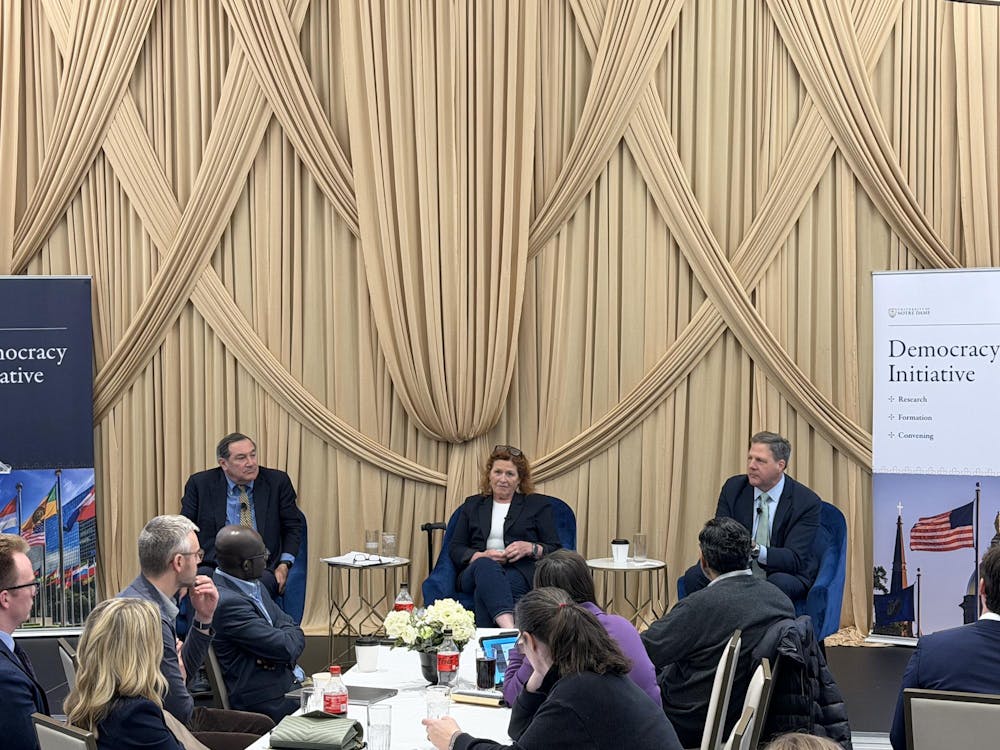
The Rooney Democracy Institute hosted a moderated conversation between former Governor Christopher Sununu (R-NH), former Senator Heidi Heitkamp (D-ND), and former Senator Joe Donnelly (D-IN), with Donnelly serving as moderator Wednesday afternoon.
Held in McKenna Hall, this talk was one of three keynote addresses as part of the Democracy and Bridging the Rural-Urban Divide Conference. The conference’s goal is to work on solving geographic polarization in the United States, which has deepened since the 1990s.
Suzanne Mettler, a profesor at Cornell University, was the first of the three addresses. Her talk was titled “Rural Versus Urban: The Growing Divide That Threatens Democracy.” The second address was “Governing Across the Rural-Urban Divide” keynote, with Sununu, Heitkamp, and Donnelly.
Heitkamp and Donnelly are both serving as members of the Brookings-AEI Commission on U.S. Rural Prosperity and are pursuing a speaking tour across America.
The final keynote, entitled “How Competing for Votes Can Bridge the Divide,” featured a panel with Jane Kleeb, Democratic Party Chair of Nebraska, and Mattie Parker, Republican Mayor of Fort Worth.
Beginning the keynote discussion, Donnelly asked what issues cut across the urban-rural divide. Heitkamp highlighted her belief that all issues cut across this divide.
“What a cab driver in New York City wants for his family is no different than what a farmer in Carrington wants. They want good health care. They want a good education for their kids. They want to be safe in their own home. They want to know that they’re protected from outside influences,” Heitkamp said.
She noted delivery of these issues changes from place to place, but the true issues that people have maintain the same.
Sununu said the job of government is to create opportunities for the people, and people vote on the “core issues of security and prosperity for their families.”
Heitkamp continued Sununu’s point and said the best way to combat these issues in a divided society is by calling out these issues between rural and urban biases created through public perception.
Sununu also discussed the tariffs as having harmed the rural class and how the advent of new technology and AI has harmed workers in the urban cities. He noted jobs in agriculture in rural areas will always be necessary, but other jobs in cities may become less in demand.
Heitkamp, speaking to students in the audience, asked students who lived in small towns whether or not they would be returning home after graduation. She then noted that leadership in small towns and rural areas is necessary to work towards bridging the gap by recruiting talent at home.
Heitkamp referenced a New York Times article about the husband of former Homeland Security Secretary Kristi Noem, noting that despite recent scandal, the people of his hometown support him, regardless of political party.
This trust from small communities, Heitkamp said, allows people to belong to a community and is something that must be discussed more.
Sununu then addressed the question of young people leaving rural communities. He stated that in New Hampshire, they worked to bring back young adults who were in their late twenties as opposed to those in their early twenties.
“They are starting to have relationships, think about education, taxes start to matter. They want to start having families. Things that matter to them and so they start making, I would just say, more rational decisions,” he said.
Heitkamp then discussed the difference between working in rural and urban America, saying that in order to bring young families back to rural America, these areas must work to help with maternity leave, daycare and other family concerns.
Sununu claimed people become divided based on politics in Washington, as opposed to the politics in local areas, such as school boards.
The panel concluded by taking questions from the audience.
Following the discussion, Sununu told The Observer that students can help bridge political divisions by focusing on local engagement rather than national politics.
“Get involved locally with things that really impact you, your family and your future. That’s where you can have the most impact,” Sununu said. “You start with breaking down the polarization pieces at a local level, and I think it just gets you understanding how things work, what the priorities are, focusing on areas that folks like that can have the most impact.”
Heitkamp also encouraged students to build relationships across differences by spending time in one another’s communities.
“There are so many forces out there that try to divide people, and we know that proximity is one of the best disinfectants for that contagion,” said Heitkamp. “That is getting to know each other, getting to know other life experiences.”