
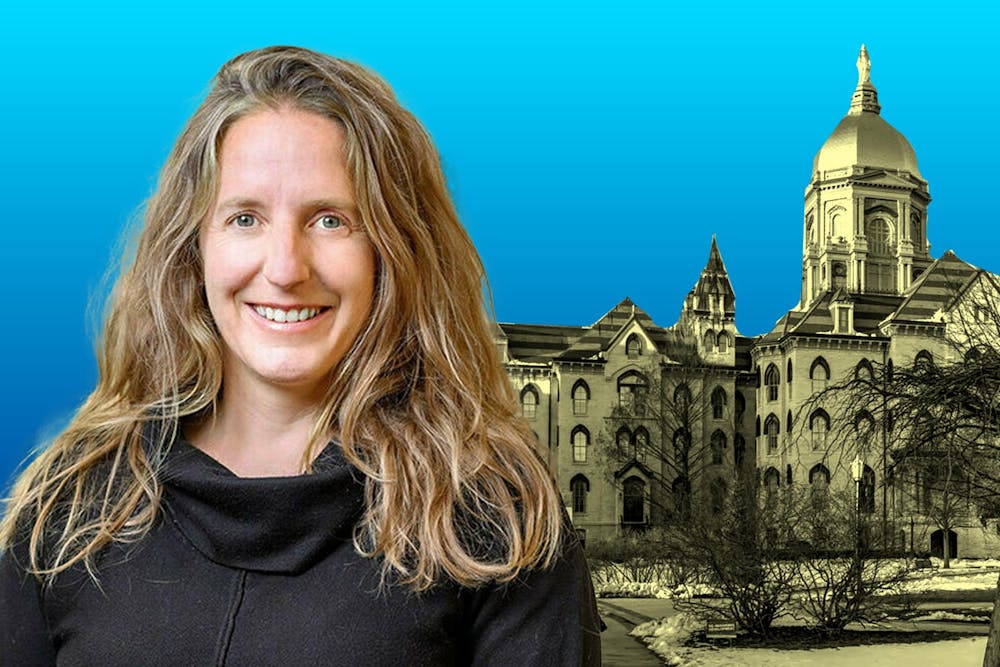
On Feb. 26, Susan Ostermann, who had been appointed to serve as director of the Liu Institute for Asia and Asian Studies, withdrew from the role. Following the Supreme Court’s Dobbs decision, Ostermann had publicly expressed views supporting legal protections for access to abortion. The appointment triggered a pressure campaign by people who object to her support for abortion access and found her published claims mistaken and offensive.
As a Catholic, an alumnus and a current member of the faculty, I’d like to explain why I believe this episode diminishes our community, including for those who hold principled views against legal access to abortion. It diminishes our reputation and viability as a leading global Catholic research university; it diminishes our ability to advance the Catholic intellectual traditions, including those pertaining to abortion and human dignity; and it diminishes our internal discourse and cohesion. I’ll address each in turn.
First, the episode signals that the free exchange of ideas on mainstream topics of maternal health and access to abortion — and perhaps other issues of scholarly and public salience — is not secure here. In order to understand the incentives that members of this community now face, simply work backwards from her decision. For example, step into the shoes of any member of the faculty: We clearly understand that if we were to publicly express certain views on sensitive Catholic topics, we could face a grave risk to our careers. In our profession, a long, productive and successful career commonly includes leadership in departments, centers, institutes and labs, as well as awards, including prestigious ones such as named professorships. A cautious faculty will result in a chilling silence on campus across a range of issues. Many, including those watching from outside, will reasonably ask themselves: Do I want to work in an environment like this? Ultimately, this will diminish the quality of the faculty and the scholarly reputation of the University. The same logic will play out among current and prospective students, staff, administrators and alumni, diminishing the quality and reputation of other core segments of the University.
Second, the episode undermines our ability to develop knowledge. The public statements by opponents to the appointment consistently judged her arguments without engaging with them. Consider Fr. Miscamble’s essay in First Things: He lists the titles of her op-eds as if their headlines alone constitute a refutation; he describes his reaction to her work as “rather sickening,” and he declares her appointment a “travesty” and a “scandalous” act. These are verdicts, not arguments — nowhere does he engage a specific claim that she makes on its own terms. The statement by the local bishop adopted the same style of reasoning, calling her claims “ludicrous” and “outrageous” and leaving it at that. Karen E. Park, writing in the National Catholic Reporter, argues compellingly that this conclusory approach to argumentation deprives the Catholic intellectual tradition of the rigorous engagement that it needs to develop. This is especially dispiriting at a moment when the University’s own Strategic Framework commits to “mobilizing the University’s intellectual and institutional resources to advance scholarship on Catholicism.” The University’s executive leadership should take note of the rigor and specificity in Park’s case for academic freedom in a Catholic setting and be prepared to make one of their own the next time the moment requires it.
Third, the form and style of the opposition to her appointment have diminished the unity and discourse of our community. Reasonable people can disagree about access to abortion and the qualifications for leadership. However, there is a distinction between good-faith disagreement and the deliberate weaponization of argument. Fr. Dowd’s own Statement on Free Expression draws this line precisely: remarks that “seek to vilify, rather than counter arguments” are “corrosive of the culture of inquiry we seek to cultivate and certainly do not reflect the values at the core of Notre Dame’s mission.” Individuals like Miscamble, organizations like the Sycamore Trust and outlets like the Irish Rover are free to express their views, but our community — including members who agree with their position on abortion — can call them to account when they seek to vanquish rather than persuade. When actors from on and beyond campus use “corrosive” tactics like these, they are seeking to impose their own positions at the expense of pluralism and open inquiry. We must stand more valiantly in support of these core values that have long defined this University. Fr. Dowd’s Statement is not merely aspirational language, but must be a commitment we are prepared to defend when it is tested.
There is a long Catholic tradition of independence and intellectual openness at Notre Dame, embodied in institutions such as the Land O’Lakes agreement, the Institute for Social Concerns, the Klau Institute for Civil and Human Rights, and in Fr. Dowd’s own Statement. Ostermann was pressured into stepping aside by a campaign that circumvented normal administrative procedures. That is a setback for this community. We are all diminished. Let us recommit to defending academic freedom, to rigorously developing Catholic intellectual traditions and to the civil and collegial discourse that those traditions demand.
Thomas Mustillo
Associate professor of politics and global affairs
Class of 1991
March 2


