During my childhood, Michael Jackson was treated as an American folk hero. I grew up in the wake of his untimely death in 2009, which instantly shifted his image in the public consciousness from a circus freak to a mythical visionary. His music was played constantly, and family members who grew up during his imperial phase in the ’80s spoke of him with stunned reverence. They talked about him like he was an omnipotent extraterrestrial who mercifully graced us humans with song and dance. It seems this attitude toward Jackson is quite commonplace; no public entertainer has come close to cultivating his level of aura. Taylor Swift, Drake and Bad Bunny have only grazed his worldwide domination. But underneath the success, there was a darkness to Jackson. His eccentricities were rooted in serious psychological damage, and there are, of course, the numerous allegations of child sexual abuse leveled against him. Trying to deal with all this in one biopic film is no small task, yet “Michael” boldly stepped up to the plate this past weekend.
“Michael” is unashamedly an exercise in image rehabilitation, having been commissioned by Jackson’s estate shortly after the explosive “Leaving Neverland” documentary aired in 2019. It has also been through production hell since then; the entire third act, which explicitly addressed the CSA allegations, had to be completely reshot due to a forgotten legal settlement that prohibited dramatization, resulting in a ballooning budget of nearly $200 million. The resulting film is less a film and more a reenactment of Michael Jackson’s peak — a reenactment it admittedly pulls off really well.
The film shows no interest in innovating the biopic genre, opting for the tried-and-true cradle-to-grave approach, albeit stopping just before his career became tainted by damaging allegations. We open on the Jackson family living in Gary, Indiana, as tyrannical patriarch Joseph Jackson (Colman Domingo) ruthlessly grooms his sons to be a superstar band. Here, after a surprisingly graphic scene of corporal punishment on a young Michael, the movie swiftly establishes the main conflict of the film: Michael’s tumultuous, abusive relationship with his father.
Now, this is a perfectly fine angle for a Michael Jackson biopic. The psychological and physical harm inflicted on him by his father was the root of many of Michael’s issues. Yet the film uses it as an all-too-neat way to quarantine all the darkness of Michael’s life in one external party. It deprives Michael himself of any kind of interiority — we get no real sense of his inner world, the pain he carried, the anger he fostered, the pathological behavior he developed. He’s simply depicted as a sweet, whimsical nymph with a harmless Peter Pan syndrome. Michael Jackson is probably one of the richest subjects ever for psychoanalysis: you could use his life to explore race, masculinity, beauty, abuse, media, celebrity, trauma and so much more. Yet, the film barely explores any of these. The film’s most interesting moment is a cut between Michael staring at a storybook illustration of Peter Pan and him visiting a plastic surgeon — a juxtaposition that quietly suggests his obsession with Disney and childhood fantasy instilled the Eurocentric beauty standards that would fuel his body dysmorphia and plastic surgery addiction. But beyond this surprisingly inspired analysis, there’s not much to sink your teeth into.
This issue of superficiality becomes especially egregious when the film arrives at his imperial phase of “Off the Wall” and “Thriller.” The film has shockingly little interest in actually depicting the making of these albums. “Off the Wall” was a watershed moment in Jackson’s career, establishing his creative freedom and brilliance. Yet, the film dedicates a few throwaway lines to explaining its creation. Producer Quincy Jones, who arguably should be one of the most important characters in a Michael Jackson biopic, has barely any screentime. And then all the film dedicates to the making of “Thriller,” the most important pop album of all time, is a two-minute montage of Michael writing lyrics on notepads. What were they thinking?
Jackson was not just a gifted vocalist but a gifted songwriter. He was highly meticulous, obsessing over every little detail of a song’s composition. He and Quincy Jones were brilliant studio craftsmen who made some of the most immaculately produced pop music of all time. Yet, the film doesn’t care about any of that. It’s deeply insulting to Jackson’s legacy to ignore the passion and talent he poured into his studio albums. I’m surprised a biopic that’s so insistent on painting him as a demigod has so little interest in demonstrating his generational songwriting talent.
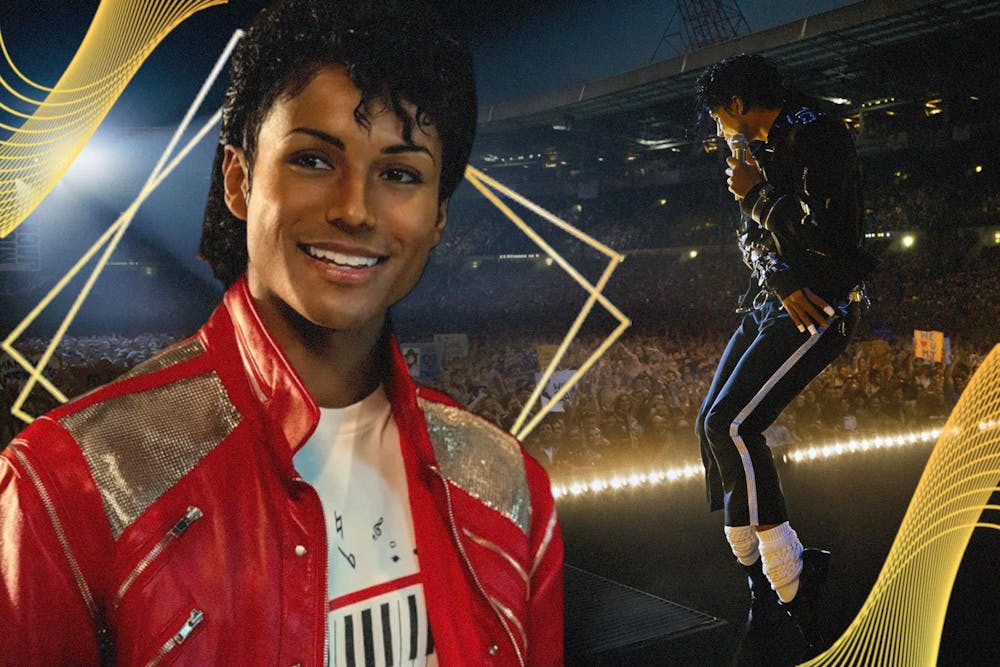
So if the movie isn’t exploring Michael Jackson’s psyche or creative process, what does it spend two hours doing? Well, it’s mainly recreating some of the most iconic moments from Jackson’s career: his television debut, the “Beat It” music video, the “Thriller” music video, the debut of the moonwalk and the Victory Tour. Now, one might ask what’s the point in these verbatim reenactments when you can just watch the originals on YouTube. And yet the sequences are undeniably well-crafted, with lavish sets and confident direction. They’re also massively elevated by Jaafar Jackson’s incredible performance as his uncle: there are some moments where he is truly indistinguishable from the actual Michael Jackson. But beyond the uncanny physical resemblance, he deftly captures Michael’s whimsical demeanor and fluid physicality. And though the film ending on an awkward time jump to the Bad World Tour is baffling, Jaafar’s final performance of “Bad” — one of my favorite Jackson songs — floored me. For all the film’s structural and narrative problems, it still dazzles with Jackson’s peerless showmanship and reality-bending magnetism.
“Michael” is not a particularly good biopic, but it is an effective one. You won’t find a deep character study of Jackson’s wounded, complex inner life, nor will you walk away with a better understanding of how some of the greatest albums of all time were made. But you will walk away understanding why he was one of the greatest entertainers who ever lived.