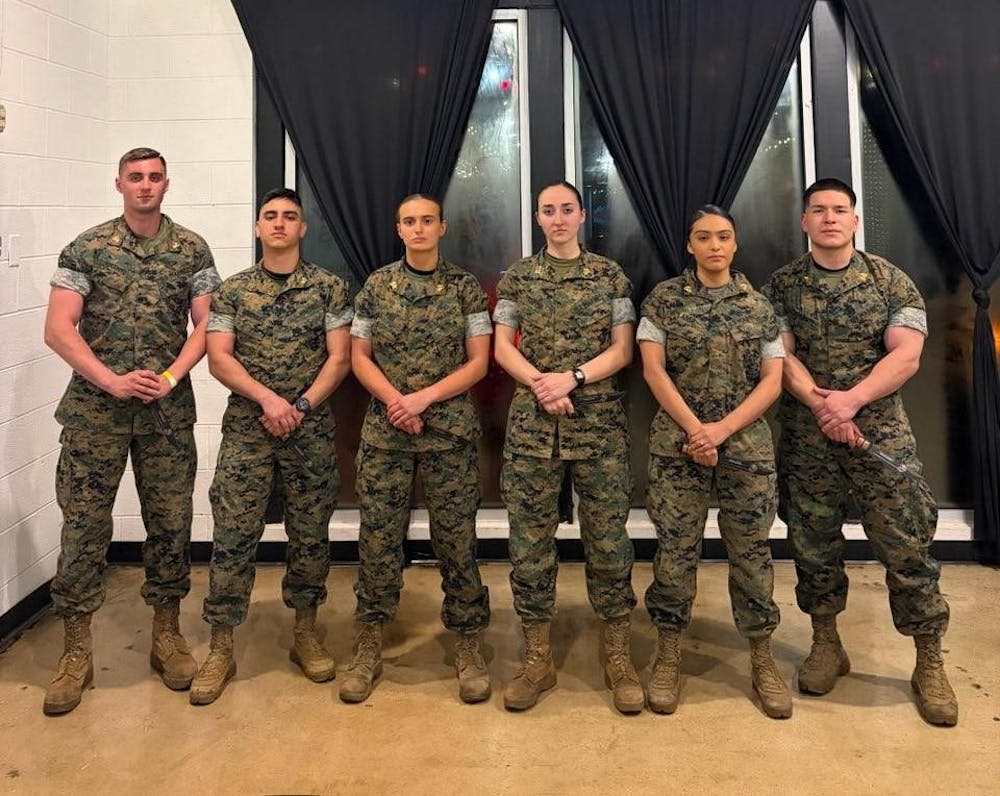
Across the three branches of ROTC in the tri-campus community, 60 students will be commissioning into the U.S. armed forces. The class of 2026 also sees the first students from the tri-campus community commissioning into the Space Force.
Lt. Col. William Kobbe, professor of military science, shared that 23 students will commission into the Army.
Kobbe explained that of the 23 seniors, 20 will graduate from the University of Notre Dame, one will graduate from Saint Mary’s College and two will graduate from Holy Cross College. Seven of the 23 students are considered distinguished military graduates, meaning they are in the top 20% as selected by the Army.
He noted that unlike the Navy or Air Force, students coming from A ROTC have the option to commission into one of three components: active duty, Army Reserve or the National Guard. This year, 16 graduates are going active duty, five are going reserve and two are going to the National Guard.
Senior Lucas Brenninkmeyer is an environmental engineer commissioned as an active duty engineer officer. He will start his role Sept. 14 but does not yet know the location of his assignment.
Explaining his role once he commissions, he said, “It is a lot of people managing. I will be in charge of probably between 30 and 40 people.” He will be coordinating these people to get whatever training and tasks his superiors request completed effectively.
Describing how he came to be interested in the military, Brenninkmeyer explained that as a kid, he always joked, “I didn’t want a desk job.” He continued, “I started looking into the military, and then as I got older, I got more and more interested.” He explained that the job appealed to him because it was a way he could serve and “a great way to become a better version of myself.”
Kobbe shared that of the 16 going active, three of these 16 have elected to do an education delay, with one pursuing medical school at Harvard University and two pursuing law school at Gonzaga University and the University of Notre Dame respectively.
Of five going into reserve, “three are going to be military intelligence officers. One is going to be a medical service officer, and one is going to be an engineer officer,” Kobbe said.
Senior Matt Santini, a finance major, is commissioning into the reserve as a military intelligence officer. He earned a four-year ROTC scholarship, was rejected from restricted early action at Notre Dame, spent a year at the University of Missouri before transferring to Notre Dame and bringing his ROTC scholarship with him.
“I know that I wanted to start my civilian career right away, and so I elected to go the reserve route. I will be working full time while serving one weekend a month and two additional weeks of training in the reserves,” Santini said.
Within the reserves, he will be working for the 37th military intelligence unit headquartered out of Chicago, with additional units in Milwaukee and Minneapolis. Santini will be stationed out of the Minneapolis area. While he is unsure of his exact duties when he is on reserve, his civilian job is working as a project manager at Epic Systems in Madison, Wisconsin.
Kobbe continued, of the two going into the National Guard, one will go to the Michigan National Guard to be a medical service officer with student status. This student will be attending medical school at Wayne State University. The other student will commission into the Indiana National Guard also as a medical service officer.
Kobbe explained that students are ranked based on their merits in the program and in their education. From there, students rank their preferences for components and military occupational specialties. While the decision of component is up to the Army, Kobbe says Notre Dame has had a 100% of students get their preferred component within the last 10 years.
“Essentially, 22 out of 23 got their number one choice [and] one got his second choice. Arguable it was 1a and 1b. He was very happy with that,” Kobbe said.
Kobbe attributed assignments working out well to their performances, noting, “The program, the last three years, has been named the number one program in our brigade.” This brigade consists of 38 programs. Furthermore, he said they were the top program in the nation last year and are a contender for that title again this year.
He explained that he joined the program four years ago on a three-year contract. This contract has now been extended by a year twice. When this contract expires following the upcoming academic year, he will be retiring from the military, having served 22 years.
Given he came to Notre Dame four years ago, he said, “I met [a] majority of these students their summer leading into their first year here at Notre Dame. I’ve been a part of their leadership development and growth, and the deep sense of pride in each and every one of them is a thing that inspires me to keep going.”
Captain John Smith, professor of naval science and commanding officer of the tri-campus NROTC detachment, explained that of the 23 midshipmen graduating, 21 will graduate from Notre Dame, one will graduate from Saint Mary’s and one will graduate from Holy Cross.
He continued that 17 will commission as Navy ensigns, and six will commission as Marine second lieutenants.
Smith stated that to get to this point, they “do a number of naval science classes, to align them with the Navy core values of honor, courage and commitment.”
While he noted that two are going on to the Navy postgraduate school to get their master’s degrees before commissioning, he said that regardless, there is “a huge amount of technical experience that is coming from Notre Dame,” citing the degree distribution of majors.
This year’s class has five mechanical engineers, four computer science majors, three aerospace engineers, two civil engineers, two science-business majors, one in Chinese, one in biology, one in global affairs and German, one in economics, one in environmental science, one in English, one in business management and one in applied and computational mathematics and statistics.
Lt. Col. Travis Clark ’06 is an operations officer, assistant professor of aerospace studies and AS200 instructor. He is a 2006 Notre Dame computer science graduate and is taking voluntary retirement this year following 20 years on active duty.
He described it as “really special” to walk alongside this class, which he says, “parallel my experience 20 years separate.”
Clark explained that Air Force ROTC has 13 students graduating. The Air Force ROTC detachment covers tri-campus institutions, Valparaiso University and Trine University.
Of the 13, two are going to be pilots and will attend undergraduate pilot training. Two have been selected as nuclear missile operations officers and will enter career-specific training. Two are going into intelligence and will be attending tech school at Goodfellow Air Force Base.
Two are operations analysis officers. There is not a tech school associated with this career path, so they will report to their first base. Three were selected for the Space Force. One will go into acquisition management. One was set to go into warfighter communications and has since been accepted into the Judge Advocate General’s Corps.
This is the first class this detachment has had with students commissioning into the Space Force. Clark explained over the last four years, the Space Force has been expanding routes from commissioning forces. In the last several years, they have had other students volunteer to join the Space Force, but none were selected.
In their third year, students make a dream sheet rank ordering careers they are eligible for, given their major. From there, the Air Force matches students with openings, considering what the student ranked as their top choices, but also what they ranked as their bottom choices.
Clark said over 90% of their cadets get one of their top three choices.
In data provided by Clark following the interview, 92% of their Air Force ROTC cadets have received one of their top three choices over the last three years, but for the Class of 2026, only 11 of 13 received one of their top three career field choices, for a percentage of 85%.
Editor’s Note: This story has been updated on May 13 to reflect a change in the number of Navy ROTC gradates from 24 to 23.