The de Nicola Center for Ethics and Culture hosted its 15th annual Evangelium Vitae Medal presentation on May 1, honoring the late founding director Wm. David Solomon.
Solomon served in the position from 1999 to 2012. During this time, he was an associate professor of philosophy at the University of Notre Dame from 1968 to 2016. He also created the Evangelium Vitae Medal and presented it to award winners during his time as director of the center. He died in February 2025 at the age of 81.
The Evangelium Vitae Medal is awarded to “heroes of the pro-life movement,” as noted on the center’s website.
The evening began with a Mass celebrated in the Basilica of the Sacred Heart by Fr. Terrence Ehrman, the center’s chaplain, before a dinner at 6:30 p.m. in Dahnke Ballroom.
Scheduled programming began at 7 p.m., with an introduction to the center’s director, Jennifer Newsome Martin, who welcomed guests and the Solomon family and discussed the mission of the institute.
“The de Nicola Center is proud to award the Evangelium Vitae medal to heroes of the pro-life movement, the crowning celebration of that commitment. It is a true joy to be together with all of you this evening for what is a very special occasion,” Martin said. “Many of us in this room, this evening, would not be here if not for David’s inspired scholarship, leadership and witness to the gospel of life. It is all the more that we would gather to celebrate his memory just as he would have wanted, with good food, good wine and, above all, so many good friends.”
Martin recognized those who Solomon had impacted, including noting that his legacy has been continued through current Sorin Fellows and the program’s alumni at the University.
Fr. Greg Haake, vice president for the office of Mission Engagement and Church Affairs, gave the blessing before the meal, following the conclusion of Martin’s speech. Before his prayer, he noted the words engraved on the medal near the image of Pope John Paul II, which were “Civilem Veritatis, Amorisque Cultum Extruore,” meaning, “To build the civilization of truth and love.”
Haake said he felt great contentment having read these words, but also said that while many may disagree with the reasoning and beliefs behind the medal, at Notre Dame, “this necessity is so appropriately addressed.”
“Being students and stewards of the gospel, of the Catholic intellectual tradition, of Catholic social teaching, we are committed to sharing these precious gifts, these precious truths for the church and for the world, but let’s not forget about love,” Haake said.
He then discussed the center, noting the ways in which they serve as “exemplary models of this devotion to the ethic of life,” and how the Evangelium Vitae Medal presentation fulfills this goal of challenging cynicism and pragmatism, which he said is contrary to the truth shared by the Catholic faith.
Guests then proceeded to eat their meal before Martin returned to present a video tribute to Solomon, including messages from O. Carter Snead, former director of the center, Rev. Wilson Miscamble, Bishop Kevin Rhoades of the Diocese of Fort Wayne-South Bend, former students and professors, and featured the voice of Solomon.
Reading the citation presented to Mary Louise Solomon, his wife, Martin quoted John Paul II’s encyclical “Evangelium Vitae” and recognized the work of Solomon and his immense love for all babies and children.
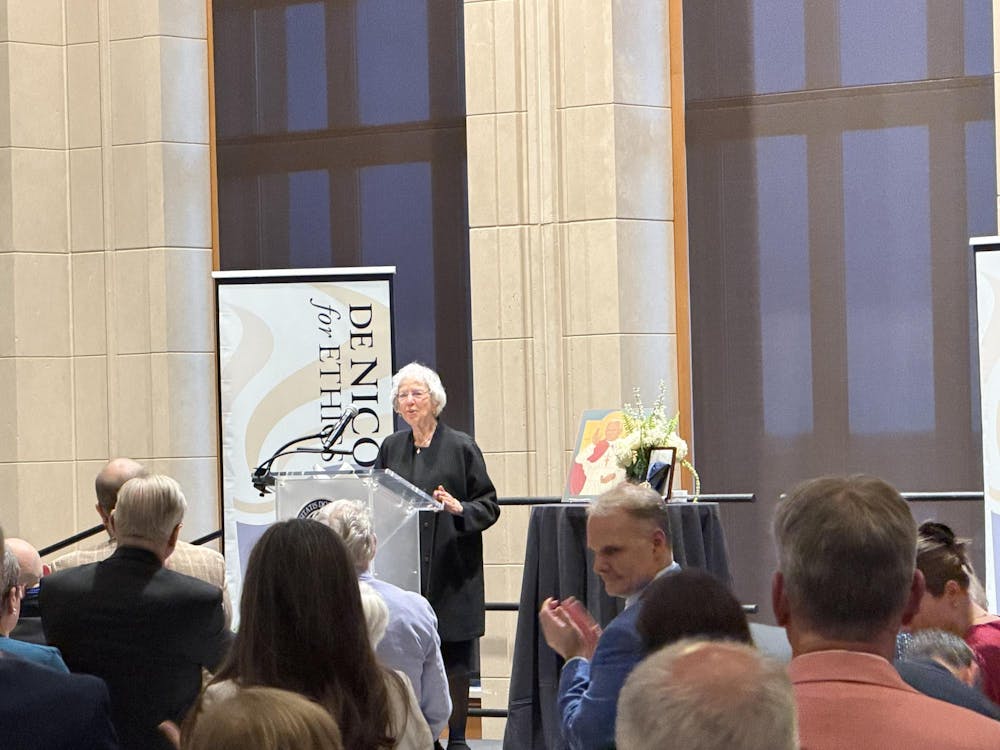
Mary Louise Solomon then walked onto the stage to receive the award and citation before giving brief remarks, thanking the center for this award.
She began reflecting on her life with Solomon, with the theme of whether various events leading up to this day were “fortuitous, blessed or miraculous.”
The first event she began with occurred in 1965, when Solomon met her future husband as a graduate student in the philosophy department at the University of Texas at Austin. Meeting in an elevator, David introduced himself before inviting her to go out with him and his friends.
She recounted the stories as each met the others’ parents, their Greek Orthodox wedding in Washington D.C. and how he met Fr. Ernan McMullin, a professor of philosophy at the University, which ultimately led to his position here.
Her final story was after Solomon finished his doctoral dissertation and kept the only finished copy in his briefcase. Leaving his briefcase in the library lounge during a colloquium, he returned to find it had been stolen. Later that evening, campus police’s headlights “caught a tiny glint” of his briefcase in a bush by the lake.
Concluding this section of her speech, she noted that while all of these events may have been fortuitous or a blessing, she believes they were all miracles. She also shared that the births of their children were what instilled their involvement in the pro-life movement.
“It was crystal clear that a baby was a baby with a nanosecond of becoming pregnant,” she said.
Several years later, after her husband did not receive tenure at the University, she said he received a position working in medical ethics at Boston University, where he worked on his book, “Abortion: New Directions for Policy Studies.” He returned to the Department of Philosophy at the University and began teaching the subject, which expanded into a weeklong medical ethics conference. She then turned to mention their faith and conversion to Catholicism in their later years.
“I think David started becoming Catholic almost as soon as we arrived here. Anyone on this campus breathes in this faith. It is the reaction to that Catholic air that matters. David, who loved being here and learning everything, soaked it in,” she stated.
Concluding her sentiment, she said, “I’m sorry that I’m standing here instead of David, but I am quite sure that he is here with us now. I’m sure that we will all agree that our being here this evening is a fortuity and a blessing and, certainly for me, a miracle.”
Philosophy professor John O’Callaghan then offered a reflection on the life of Solomon, calling him “a fighter” who fought for all causes of life.
He reflected that the essential question for Solomon was not, “What would you fight for?” but rather “What would you live for?” He noted that what one lives for is what they fight for, referencing the Book of Genesis and the idea of “giving one’s life to one another.”
O’Callaghan called Solomon “an apostle of friendship.” He continued to discuss philosopher Josef Pieper and the philosophy of love, friendship and being together with one another, noting that celebrating the award is to celebrate the “good news of life.”
He recalled one of the last conversations that he had with Solomon before his death, where he told O’Callaghan that he hoped he was a Thomist. Speaking of this conversation, O’Callaghan said that, having known some of the greatest Thomists of the 21st century, “David was certainly their equal.”
He encouraged the audience to reflect on encounters and conversations with Solomon and the way he would speak to every person about anything. While O’Callaghan said these were small moments, he continued that Solomon has done many great things for family, friends and for O’Callaghan himself.
He concluded by describing the home which David and Mary Louise Solomon created, welcoming all people and saying that this award belonged to Mary Louise as much as to David, noting their devotion to children and unborn children.
Martin returned to give brief thanks to the staff of the center, who organized the event, before inviting Fr. Christopher Justin Brophy, senior vice president of mission and ministry at Providence College and a former student of Solomon, to give the final Benediction.
“Let us always choose life that we may live, and may you, through your grace, ever draw us more closely to you,” Brophy stated to end the evening.
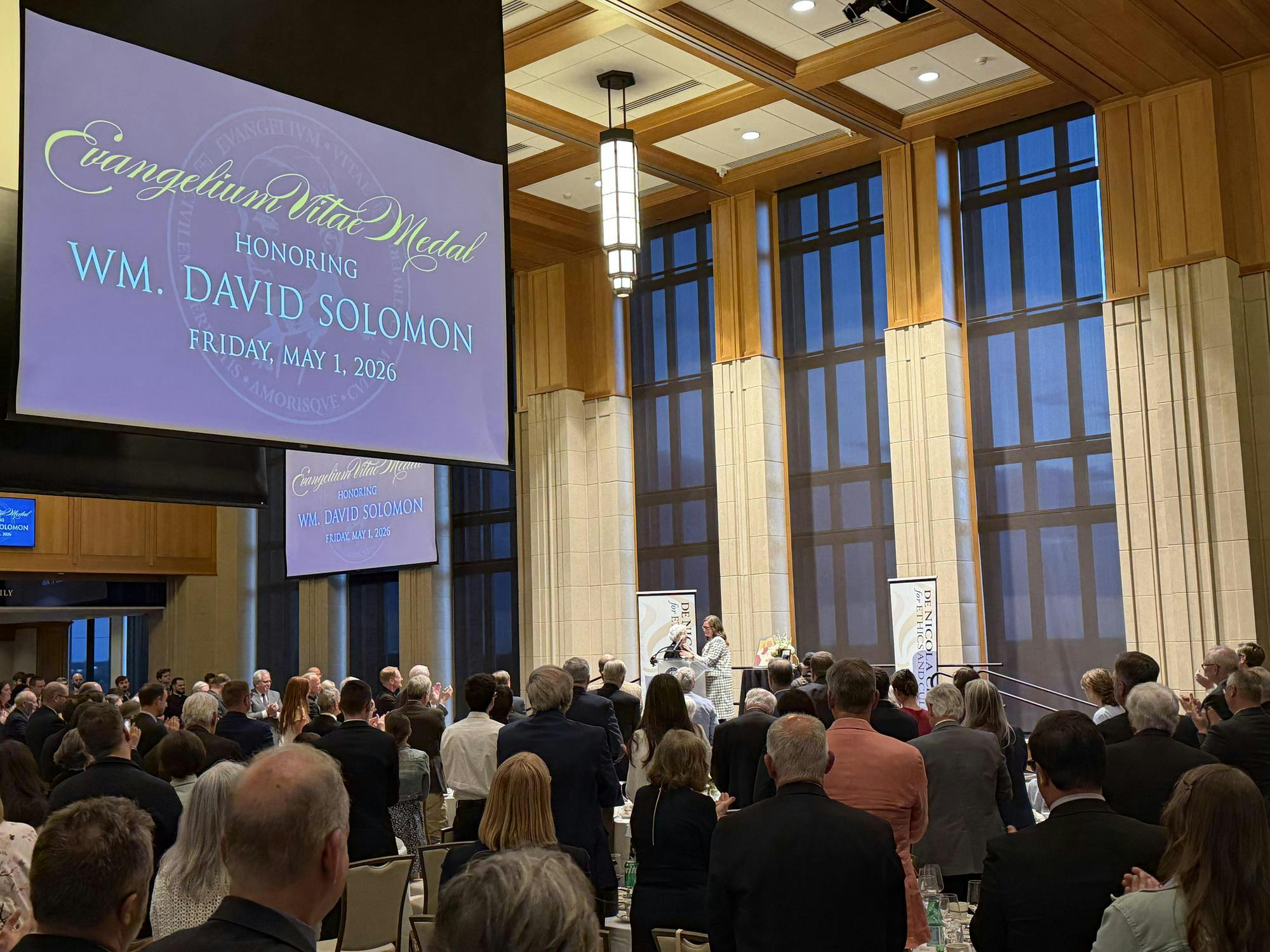
The 2026 Evangelium Vitae ceremony honored the late founding director of the de Nicola Center for Ethics and Culture, W. David Solomon