
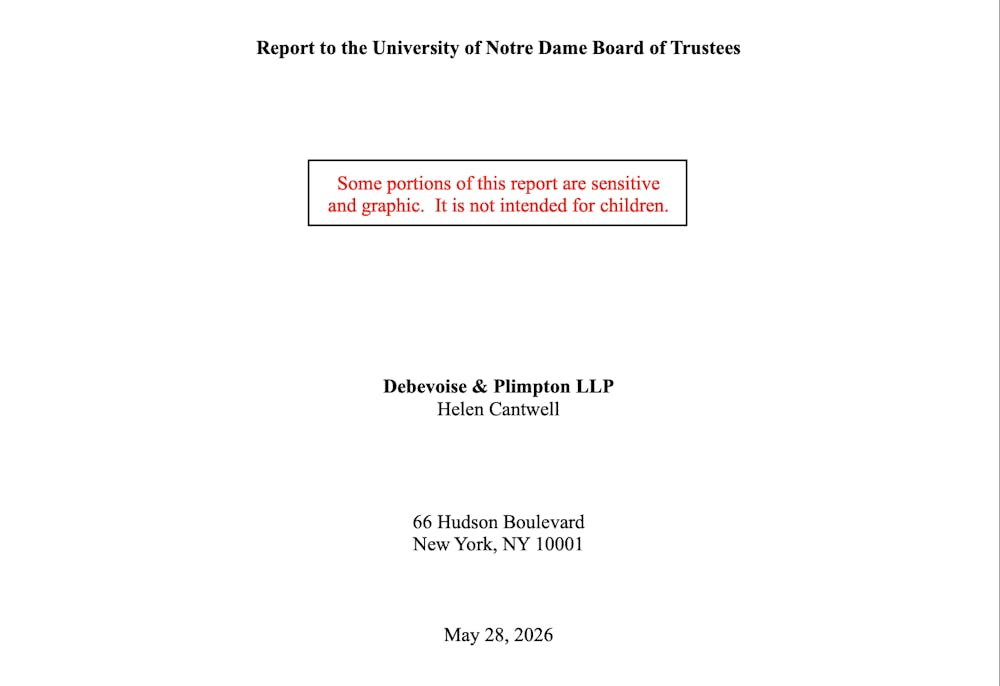
I am a 1987 ND and Zahm alum. I was disturbed to read the May 28, 2026 “Report to the University of Notre Dame Board of Trustees.” The report lists a decades-long pattern of horrible acts of sexual abuse of vulnerable people at the hands of purported spiritual and academic mentors. But worse, it ignores basic evidence, fails to follow obvious leads and then unjustifiably excuses the University for failing to address and report these crimes.
The report confirms that the University was aware of and failed to properly act on credible allegations of sexual abuse against King in the 1990s. It also confirms that the only reason those facts have now come to light is because a courageous alum — known as the the “2018 Reporter” — reported his own abuse and then fought for years to get the University to address the abuse he and many others suffered. The 2018 Reporter gathered more evidence and witnesses on his own and then forced the University’s hand by presenting that voluminous evidence.
These are just some of other failures of the University and the report.
The University was on notice no later than 1997 and did nothing
The report states on pages 9 and 10 that the University cannot definitively confirm why King resigned as rector in 1997.
• “Records indicate that he resigned as rector of Zahm in 1997, and there is evidence that his departure from Notre Dame was not linked to any reports of misconduct.”
• “The then VP of Student Affairs, who signed Fr. King’s termination form, did not recall the details or timing of his departure in 1997. She explained that if there had been a complaint about Fr. King at the time, the reason for his departure would have been recorded differently on the termination form.”
But several pages later, the investigator reveals that — apparently coincidentally, also in 1997 — a student and his Dad reported King’s “weighing scheme.”
And while no records exist of these in-person meetings, “The then VP of Student Affairs had a vague recollection of discussing Fr. King weighing students at the Rockne, but she did not remember when, with whom, or where this conversation occurred.”
There is no explanation why the University has not held these University officials accountable for, at the very least, their failure to document and investigate these allegations in 1997. If they had, King’s abuse could have been prosecuted at that time. At least 20 years of additional abuse at Holy Cross College, where King resigned in 2007, and St. Mark Parish, where King was “removed for health reasons” in 2019, could have been prevented.
The University has no explanation for its retention, re-hiring and transfers of the abusers
The summary of Porterfield’s and King’s retention and rehiring — at both the University and Holy Cross College — and ultimate transfers to neighboring dioceses is not surprising to those who have observed the broader Church’s failures to address widespread sexual abuse by clergy. The report confirms that the University failed to document abuse and rehired Porterfield. The University and the Order failed to coordinate their supervision of these abusers. The University and the Order apparently never gave notice of this abuse as they allowed these abusers to transfer to positions of power in parishes full of more vulnerable people.
The report documents this familiar shell game but again fails to hold any of the parties who were responsible for failing to report the abuse to each other, to the dioceses and to law enforcement accountable. This pattern also raises doubts about whether the lack of record keeping about these allegations was just negligent.
The report’s ultimate justification for the University not acting sooner is nonsensical
The report confirms that King admitted to the conduct described by the 2018 Reporter and that he “intimated that he had resigned from teaching at Holy Cross College because of similar accusations.” Even with these admissions, the report states that, as late as 2018, the University either couldn’t or wouldn’t accept that what King was doing was sexual abuse.
On Page 1 of the Report, it states, “with respect to allegations concerning Fr. King raised since 2018, the University did not recognize the reported conduct to be at a minimum boundary crossing and, more seriously, grooming behavior because the weighing scheme was not properly understood as sexual and did not include touching or specific sexual assault. This limited opportunities for Notre Dame to learn the full extent of Fr. King’s past sexual abuse earlier.”
What reasonable Catholic religious organization, or any organization, could credibly claim in 2018, after hearing what King was accused of and King’s own admissions, that it “did not recognize” that behavior as sexual? What reasonable employer could then consciously choose not to investigate that behavior? The Report does not explain how that purported “lack of recognition” of a crime excuses the University from learning “the full extent of King’s sexual abuse earlier.”
This report denies the survivors the closure they deserve and deeply damages the University’s credibility.
Steve VanDerhoef
Class of 1987


