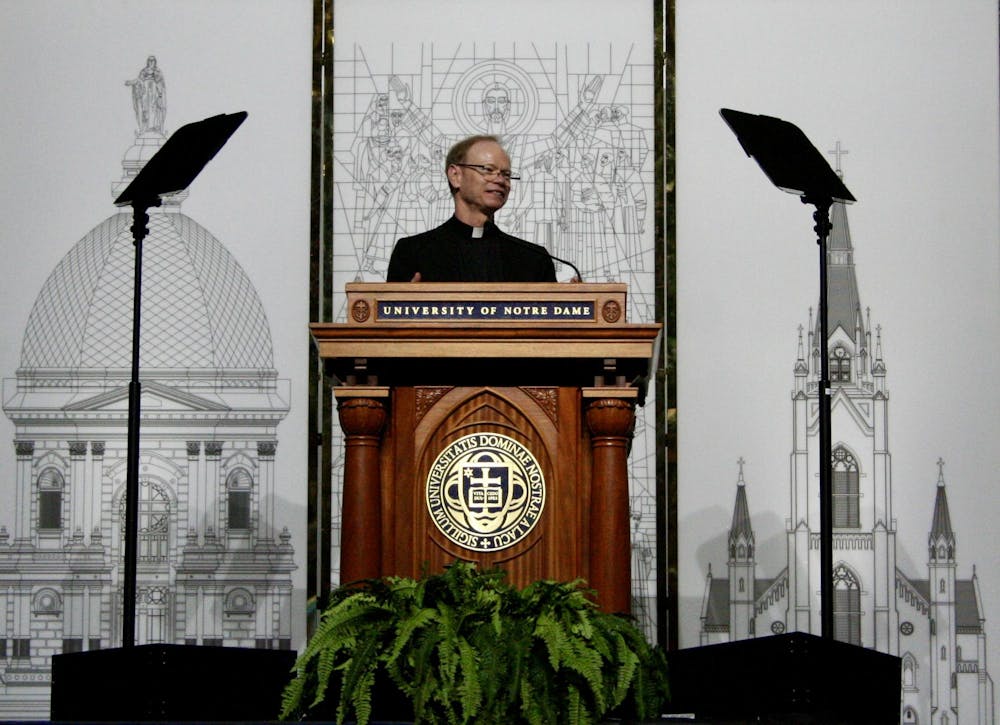
In an opinion essay published Thursday by America Magazine, University President Fr. Robert Dowd argued for the importance of the humanities in higher education and emphasized the need for human discernment and moral decision-making amid the rise of artificial intelligence.
The op-ed was framed as a reflection on Pope Leo XIV’s AI-focused encyclical “Magnifica Humanitas” and neither denounced nor heralded the technology.
“The pope does not condemn A.I. Instead, he promotes an appreciation of A.I. as a tool that, like any tool, can be used for good or for ill. We can use this tool in ways that help us to think more creatively and critically, or less so; to solve problems, or make them worse; to unite us, or divide us; to enhance life, or destroy it,” Dowd wrote.
Dowd used the essay to stress the importance of the humanities. The effect of AI on the humanities has sparked a flurry of commentary in the last several years.
“All academic disciplines, from finance to biology to chemical engineering, develop important capacities for analysis and understanding, and they play critical roles in advancing human knowledge. At the same time, it is essential to study the humanities—philosophy, theology, literature, history and the arts—for the rich wisdom they offer on the most fundamental questions: what it means to be human, why there is suffering in the world and how to pursue truth,” he wrote.
He also called upon leaders in Catholic higher education institutions to strengthen their support for the humanities.
“We must encourage them to cultivate curiosity, creativity, critical thinking, moral courage and compassion through their study of the humanities. These qualities cannot be replaced by artificial intelligence, and they are precisely the competencies our future leaders will need in order to navigate a world that grows ever more complex,” Dowd wrote.
While shying away from specific policy recommendations, Dowd warned that AI lacked multiple qualities for making good decisions in complex situations.
“Perhaps most important, A.I. is not capable of recognizing injustice and exerting the moral courage needed to address it,” Dowd wrote.
Dowd added that interdisciplinary research would be needed to grapple with the rise of artificial intelligence.
The University of Notre Dame has moved quickly to ramp up AI research and scholarship in recent years. The University’s Data, AI, and Computing Initiative, established in 2025, coordinates research across colleges, centers and disciplines at Notre Dame. The DAC Initiative houses several AI-focused laboratories, including the AI Trust and Reliability Lab, the Foundation Models and Applications Lab, and the Human-Centered Responsible AI Lab.
Notre Dame’s Institute for Ethics and the Common Good has also engaged in prominent work in AI through the creation of its DELTA Framework, a faith-based model for ethical AI development and use, rooted in the values of “Dignity, Embodiment, Love, Transcendence, and Agency” via its website.
The University received a $50 million grant last year to further develop and promote the DELTA framework.
Notre Dame also supports a project focused on the intersection of the humanities and AI, called the Program on AI and the Development of Ethics in Agents, or ND-PAIDEIA.
According to its website, the program encompasses “a humanities research center at Notre Dame that takes up a parallel task of forming ethical agents in a new era of artificial intelligence systems, attending both to human users and designers of these systems and to the systems themselves.”
Dowd’s essay appears in the September 2026 print issue of America Magazine, a Catholic publication founded by the Jesuit order.