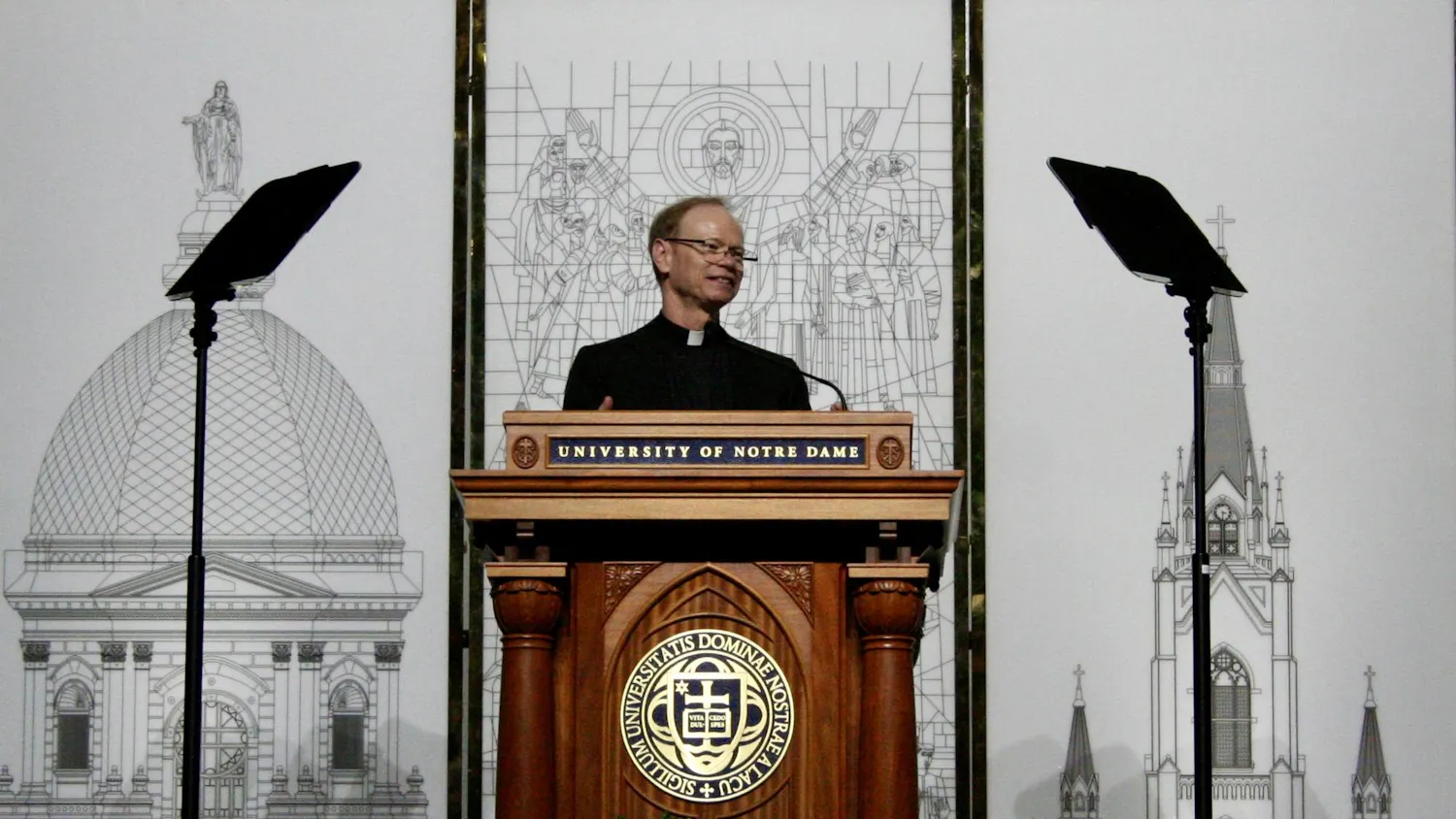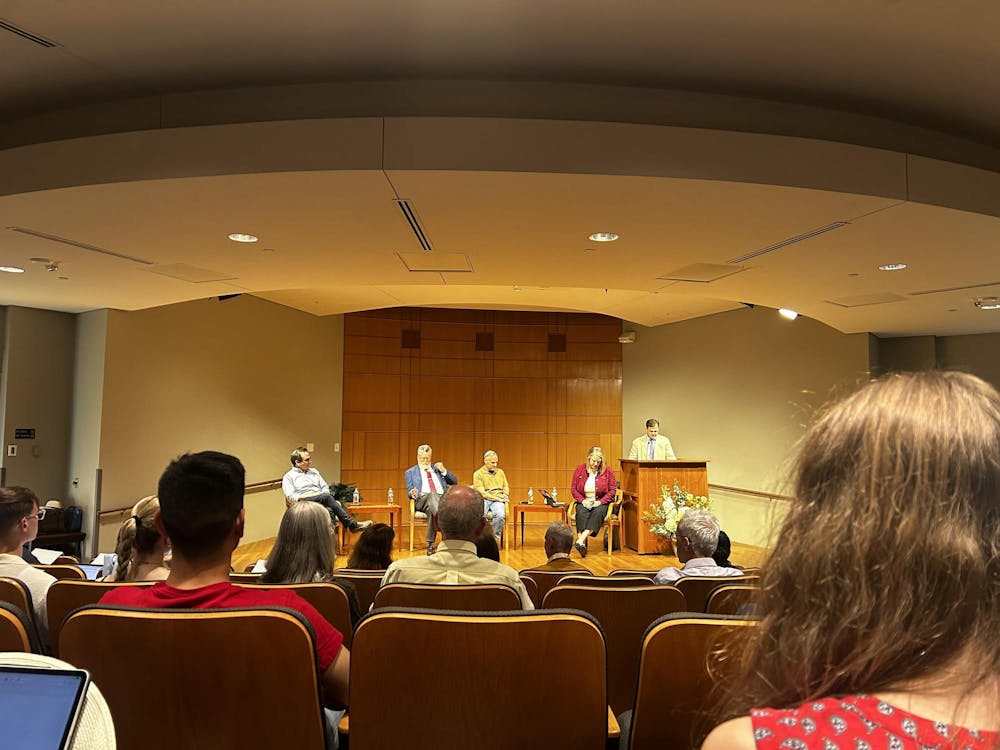
Professors Matthew Hall, Christina Wolbrecht, Aníbal Pérez-Liñán and Michael Desch gathered Monday evening in Hesburgh Auditorium to discuss the first 100 days of Donald Trump’s presidency. At the panel, hosted by the Notre Dame Democracy Initiative, each professor contributed a unique area of expertise ranging from constitutional studies to international security.
Wolbrecht moderated the panel and began by posing a question about the extraordinary nature of Trump’s term so far.
Pérez-Liñán answered first, speaking on the decline of American exceptionalism by comparing the United States to Latin American countries. “For me, what is extraordinary about the Trump administration is how ordinary the US has become … what people thought about the foundation of American exceptionalism was the strength of the American political system and the implication that you have a very strong judiciary and Congress,” he said.
Aníbal Pérez-Liñán continued, “By contrast, the president is relatively weak politically … when you think about the way democracy was used to describe the way presidents ruled in Brazil, in Argentina in the 1990s, in Peru, it sounds very much like the first 100 days of [Trump’s presidency] in the sense that it’s an administration that rules unilaterally.”
Desch argued that the extraordinary feeling of the Trump administration was due in large part to rhetoric and style.
“I think what’s extraordinary for me is how President Trump has managed to take issues that are serious and that I think could be topics of serious debate, and make them seem crazy, frankly,” he said, citing Trump’s aim of ending Russia’s war on Ukraine as an example of an area of reasonable disagreement.
He encouraged the audience to reconsider these issues from the perspective of Catholic just war theory. “One of the tenets [of just war theory] we don’t talk about but which is very important is the reasonable prospect of success. There has not been a reasonable prospect of success that Ukraine is going to win, defined in terms of re-establishing the 1991 borders. To its discredit, the West and especially the U.S. have ignored this fact and continue to pump weapons and money into a war that’s just killing people now,” Desch said.
Hall had a different perspective. “What’s extraordinary about Trump’s first 99 days is that he has systematically attacked what it means to be an American,” he said.
He continued by identifying exactly what it means to be an American as defined in Section 1 of the 14th amendment.
He explained that by taking away naturalization and attacking birthright citizenship, Trump is undermining the Constitution and threatening due process for immigrants who are deported without a trial. “The law applies to everyone equally, regardless of what group we can assign you to, regardless … if you’re here legally or not legally … it doesn’t matter,” Hall said.
After their initial answers, Wolbrecht asked the panelists to highlight a few consequences of Trump’s presidency thus far.
Pérez-Liñán spoke on the example Trump is setting for executives worldwide. “Trump is a very powerful figure who produces a very strong demonstration effect across the world, and I think that he is legitimizing a kind of strong politics. I can imagine how in many other countries presidents now want to be like Trump,” he explained.
Amid conversation about the failure of American institutions, Hall thinks we are asking the wrong questions. Instead of concern for institutions, Hall expressed anxiety about worsening of democratic attitudes and erosion of civic virtue. He referenced an idea from U.S. Court of Appeals Judge Learned Hand, saying, “When liberty dies in the hearts of men and women, no Constitution, no law, no court can save it. It’s safe when it lives in the hearts of men and women. It needs no constitution, no court and no law to save it.”
Wolbrecht asked Desch about “Signalgate,” during which Trump’s national security advisor Michael Waltz accidentally shared plans about an attack on Houthi fighters in Yemen with Atlantic editor Jeffrey Goldberg. Desch said that “it only matters to a certain extent because you can think of cases in our political system where sensible people in our political system have done very crazy things.” He pointed to examples of the Vietnam War and former president Joe Biden’s policy toward Gaza.
The panel concluded with a question and answer session. Students asked the panelists questions about a wide variety of topics, ranging from Congress’s power over Trump to increasing xenophobia in the United States.