Following Pope Francis' passing Monday at the age of 88, Notre Dame has hosted a series of events to honor him and his legacy in the Catholic Church, including a rosary and a memorial mass.
The rosary was held Tuesday at the Grotto. Fr. Brian Ching began the rosary by reflecting on Francis’ 12 year tenure as pope. Francis was elected Pope in 2013, following Pope Benedict XVI’s resignation.
Ching noted that Pope Francis called people to go to the peripheries and serve those in the greatest need. John Cavadini, a professor of theology at Notre Dame and the director of the McGrath Institute for Church Life, echoed Ching’s sentiments in a written statement to The Observer, which was also published by Notre Dame News. Cavadini reflected upon well-known images of Francis, noting his interactions with prisoners and people considered outcasts by society.
“He left us so many memorable images to help us understand what he meant: images of him breaking protocol at a general audience to reach out to the severely disabled, who could never have even thought of approaching him; images of him hugging a Down's Syndrome child; images of him consoling the disaster-stricken on site, the refugee and the homeless,” he wrote.
Cavadini, who was appointed by Benedict in 2009 to serve a five year term on the International Theological Commission, also edited a book about Francis, “Pope Francis and the event of Encounter.”
Ching said the Grotto was chosen as the site for the prayer because of Francis’ devotion to Mary and his frequent visits to the Basilica of Saint Mary Major in Rome. The Basilica of Saint Mary Major is also where Francis will be buried. Francis has said that throughout his life, he has always entrusted himself to the Virgin Mary.
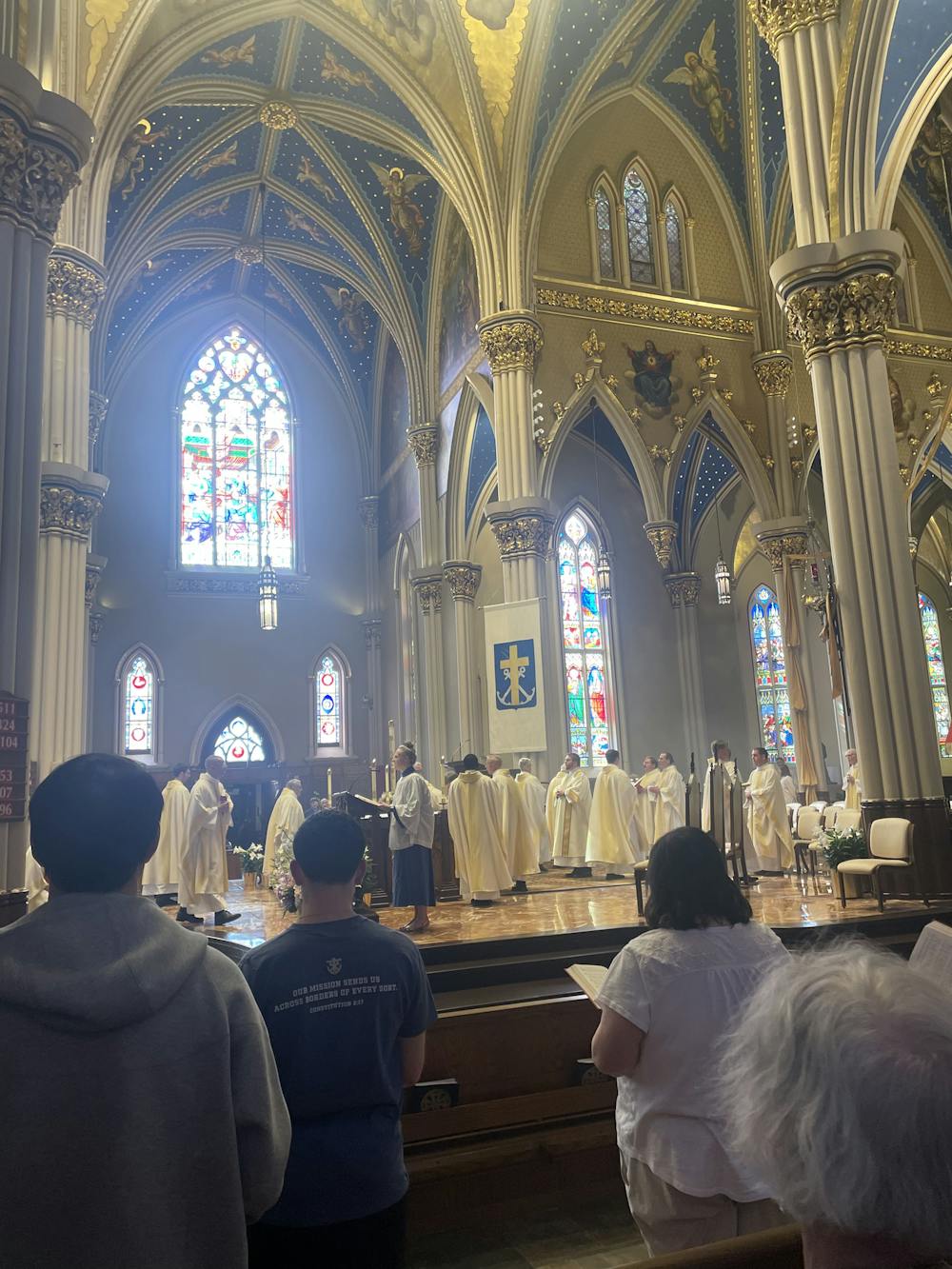
University President Fr. Robert Dowd presided over the memorial mass, which was held in the Basilica of the Sacred Heart Tuesday afternoon.
In his sermon, he quoted Francis' 2025 autobiography, “Hope.”
“I prefer a church that is broken, wounded and dirty for having gone out in the streets than a church that is feeble and sick for holding itself up, clinging comfortably to its own safety,” Dowd said, quoting Francis‘ words.
Dowd said that he doesn’t think Francis had patience for pious platitudes, and that for him, living in the light of the resurrection meant leaving our comfort zones.
Freshman Aurelia Smolen said she hoped that people remember Francis’ words about helping the poor.
“He always says that our work is never done for the poor and for those in need here in our church community and outside of it,” she said. “I think what people should take away from his passing is that we have the opportunity and we can be empowered to continue what his work was.”
Smolen said that since Francis’ death, she has been admiring all he did in his life.
“It does not have to be just something we put in a museum and admire from afar,” she said. “We can continue it and keep his memory alive by doing those sorts of things in our own lives.”
Francis’ death has led several people at Notre Dame to reflect on their encounters with the pope. At the mass, Dowd spoke about a 2024 meeting he and Notre Dame's board of trustees had with the pope.
He said that Francis encouraged Notre Dame to do everything possible to ensure that the University integrated head, heart and hands.
Dowd also spoke at the end of the rosary service about the first time the two met.
“The first time I met him, I actually tried to impress him with my Spanish, and I decided I’d try to greet him in Spanish, but my Spanish is pretty bad,” he said. “He immediately broke out in English and said thank you, pray for me.”
Smolen shared she had the chance to sing for the Alma Mater for Francis in January during the Magnificat Choir's tour of Rome. The choir visited four major basilicas to celebrate the jubilee year.
Smolen said the choir sang at a high mass at Saint Peter’s Basilica and also attended a papal audience.
“It was kind of surreal because it's very different from a high mass in St Peter's, but it was just kind of a celebration of the pope connecting with the people directly,” she said.
The homily given by the pope was translated into four languages, a translation Smolen labeled as a representation of the Catholic Church's universality.
After the papal audience, Smolen said the choir waited for Francis, who took the time to greet most of the people who came to see him. He gave blessings to couples who had just been married and to pregnant women.
When he came up to the Notre Dame choir, they were planning on asking him for a blessing, but he asked them to sing a song for them. Smolen said that when the choir receives a request to sing a song, they usually sing the Alma Mater.
“He looked me in the eyes and I'll never forget that,” she said. “Then he gave us a little thumbs up at the end too, which was really fun.”
While she didn’t personally have the chance to talk with him, she still considered her experience seeing him just a few months before his death a true blessing.
“I do know that he is a pope of the people in special ways compared to others,” she said. “And I think that was just such a great example of how he didn't just leave after the audience.”