Pope Francis, the first Jesuit and first Latin American pontiff, died on Monday of a stroke and heart failure in his apartment at Casa Santa Marta, a guesthouse in Vatican City. He was 88. Cardinal Kevin Farrell announced his death and said Francis had died at 7:35 a.m. in Rome.
Francis, who became pope in 2013, brought special attention to the social teachings of the Catholic Church and pushed for reforms in the governance of the Vatican. His pontificate focused heavily on the marginalized and vulnerable in society, and his empathetic and pastoral approach won sympathy from across the world.
He frequently lamented politicians’ lack of care for migrants, including at a 2015 address to Congress. The pope’s first official trip was the island of Lampedusa in the Mediterranean that was a major landing point for refugees and asylum seekers fleeing from Africa to Europe. His frequent refrain to “build bridges, not walls” has been adopted by University President Fr. Robert Dowd, who echoed his words in his inaugural address last year. More pointedly, Francis decried the Trump administration’s program of mass deportations, arguing that the administration’s policies violated human dignity.
Francis, who turned down some of the more regal trappings of the papacy in favor of simplicity, was also an outspoken advocate for the poor. He condemned rising economic inequality, urged governments to tax billionaires, emphasized the need for dignified wages for workers and called for the forgiveness of developing nations’ debts. He said at the beginning of his pontificate that he sought a “poor Church for the poor.”
Francis’s encyclical “Laudato Si,” which influenced the UN climate summit that approved the Paris Agreement, called for swift action to combat climate change. He referred to care for the environment as a moral imperative. He urged wealthier nations to reduce their greenhouse gas emissions and to assist poorer countries suffering most from the effects of climate change.
The pope also spoke out strongly on issues pertaining to life and human dignity. He denounced abortion as an attack on life, vociferously opposed euthanasia and condemned the death penalty, changing the Catechism of the Catholic Church to say that the death penalty is “inadmissible” in all cases. He decried what he referred to as a modern utilitarian “throw away culture,” which he said treated the lives of the elderly, the impoverished and the unborn as disposable.
Francis also extended the Vatican’s ecumenical efforts and interreligious dialogues. He had close ties with the Ecumenical Patriarch Bartholomew of Constantinople, the spiritual center of the Eastern Orthodox Church, and also with the former Archbishop of Canterbury Justin Welby, head of the Anglican Communion. In 2016, he asked forgiveness for past Catholic persecution of other Christians. He also engaged in dialogue with Muslim leaders, signing the Document on Human Fraternity in 2019 with the Grand Imam of Al-Azhar Sheikh Ahmed el-Tayeb. He also maintained close relationships with Jewish leaders and repeatedly condemned antisemitism.
The pontiff was known for his pastoral approach toward LGBTQ+ people. He met with transgender people in a number of audiences and said that transgender people could be baptized in certain situations. He approved a Vatican document allowing informal, spontaneous blessings for same-sex couples, supported civil unions for same-sex couples and called laws that criminalize homosexuality unjust. He did not change Church doctrine on sexuality, however, and reaffirmed the Church’s teaching on gender.
Francis also opened the Church to new roles for women, allowing women to lead major Vatican offices for the first time. He selected a nun as the first woman to serve as the prefect of a dicastery and appointed three women to the Vatican’s Dicastery for Bishops. However, he said no to ordaining women as either deacons or priests.
The pope governed the Church amid a difficult period in which the institution grappled with a sexual abuse crisis. He apologized for the Church’s protection of priests who had sexually abused children and promised reform and “zero tolerance” for abuse. In 2019, he issued “Vos estis lux mundi,” which established policies to investigate bishops who were accused of covering up abuse. He also established the Pontifical Commission for the Protection of Minors to advise the pope on how to protect children and vulnerable adults from sexual abuse. However, many criticized Francis for not moving quickly enough on the issue, treating accused clergy too leniently and not providing sufficient transparency.
Francis entered his papacy with a mandate to reform the Curia, the governing body of the Vatican, and to address the Vatican financial scandals which had broken under his predecessor, Pope Benedict XVI. He overhauled the bureaucracy of the Vatican with the issuance of a new constitution. He also instituted financial reforms, which centralized the Vatican’s finances and aligned them with international standards. However, the Vatican’s financial state remains precarious, with a yawning deficit and unfunded pension liabilities.
Francis was elected pope on March 13, 2023 at age 76. He was born Jorge Mario Bergoglio on December 17 1936 in Buenos Aires, Argentina to a family of Italian descent. He was ordained as a Jesuit priest in 1969, became archbishop of Buenos Aires in 1998, and was named a cardinal in 2001.
Prior to his death, Pope Francis had undergone a weeks-long hospitalization during which he was treated for a respiratory infection and pneumonia. He was discharged from the hospital on March 23 and was undergoing a period of recovery at the Vatican before he died. He made a public appearance at St. Peter’s Square the day prior to his death for an Easter Sunday blessing.
His death leaves 1.4 billion Catholics without a shepherd for the time being. The Church is now in a formal period of mourning which spans nine days. Exact details of the timing of his funeral have not yet been announced by the Vatican. Francis made it known before his death that he wished to be buried in Rome in the Papal Basilica of St. Mary Major, rather than St. Peter’s Basilica.
A conclave to elect the next pope will be held 15–20 days after his death. Cardinals must select the new pope by a two-thirds majority. There are 135 cardinals currently eligible to vote in a conclave, 80% of which have been appointed by Francis. The conclave will be more representative of the global Church than the conclave which elected Francis, with more cardinals from Asia and Africa and fewer from Europe.
Two events at Notre Dame that were set to take place this week were affected by the pope’s passing. “10 Years After ‘Laudato si’: Faith, Anthropocene, and Justice in the Global South,” part of the Notre Dame Forum 2024-25, was cancelled as the death of the pontiff prevents the two speakers, Cardinal Pedro Ricardo Barreto Jimeno and Cardinal Peter Kodwo Appiah Turkson, from traveling to campus. The Keely Vatican Symposium on “The Catholic Church and the Anthropocene: Science, History, Hope,” also with Cardinal Turkson has been postponed, but the event has not yet been rescheduled.
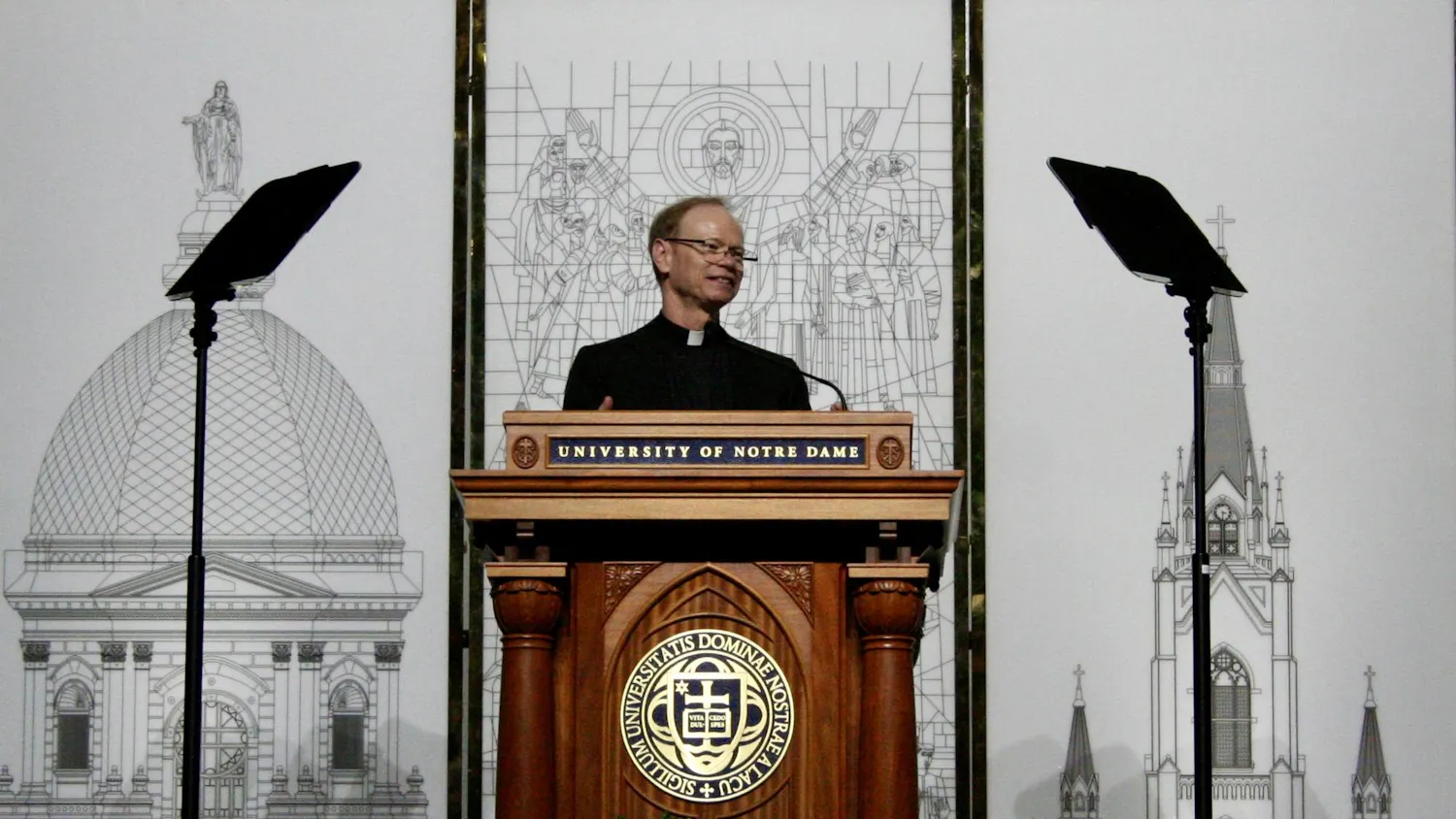
Dowd released a statement on Monday following the pope’s death.
“The Notre Dame community joins with the Church and the world in mourning the passing of Pope Francis,” Dowd said. “Through his heroic and prophetic ministry, he has inspired and challenged us to respect the God-given dignity of all people and the integrity of creation. The Holy Father’s life and witness call us to awaken from indifference to the suffering of others, to embrace our responsibilities to one another and to be agents of faith, hope and love for a world in need. As Pope Francis often reminded us, no one is far from God’s merciful love, and the Church must be a ‘field hospital’ to warm hearts, heal wounds and open doors.”
Francis met with Dowd and Notre Dame’s Board of Trustees in February 2024. During the audience, Francis thanked the group for “assisting Notre Dame to remain ever faithful to its unique character and identity as a Catholic institution of higher learning.”
Dowd concluded the statement asking for the intercession of the deceased pope. “We pray in thanksgiving for Pope Francis’ extraordinary leadership and ministry. As we seek to follow his example, we hope Pope Francis will pray for us from Heaven,” he said.
Holy Cross College President Marco Clark issued a written statement after the pontiff's passing.
“I join with the Church and the world in mourning the passing of Pope Francis. His papacy was a remarkable witness to compassion, humility, and the joy of the Gospel. For many of our students, Pope Francis has been a constant voice throughout their lives, calling them to be joyful disciples and to find Christ in the face of every person. He invited the world to embrace a culture of encounter, encouraging us to dialogue, and walk with those on the margins with courage and tenderness … As we give thanks for the extraordinary life and ministry of Pope Francis, may we honor him by being joyful and benevolent agents of encounter and hope — shining a light in the darkness and walking boldly in the footsteps of Christ,” Clark wrote.
Saint Mary’s College President Katie Conboy likewise released a statement Monday morning.
“With profound sorrow, we reflect upon the news of the passing of His Holiness Pope Francis. A shepherd of compassion, humility, and unwavering faith, Pope Francis dedicated his life to serving the Church and the world, inspiring countless people with his message of love, mercy, and justice,” she said.
In her statement, Conboy also said that the Center for Faith, Action and Ministry would be sharing prayer opportunities with students.
The Basilica of the Sacred Heart and Notre Dame Campus Ministry said in a social media post that Pope Francis “will be remembered at Masses in the Basilica of the Sacred Heart, where doors will be draped in black bunting and a photo of Pope Francis will be placed in the sanctuary.”