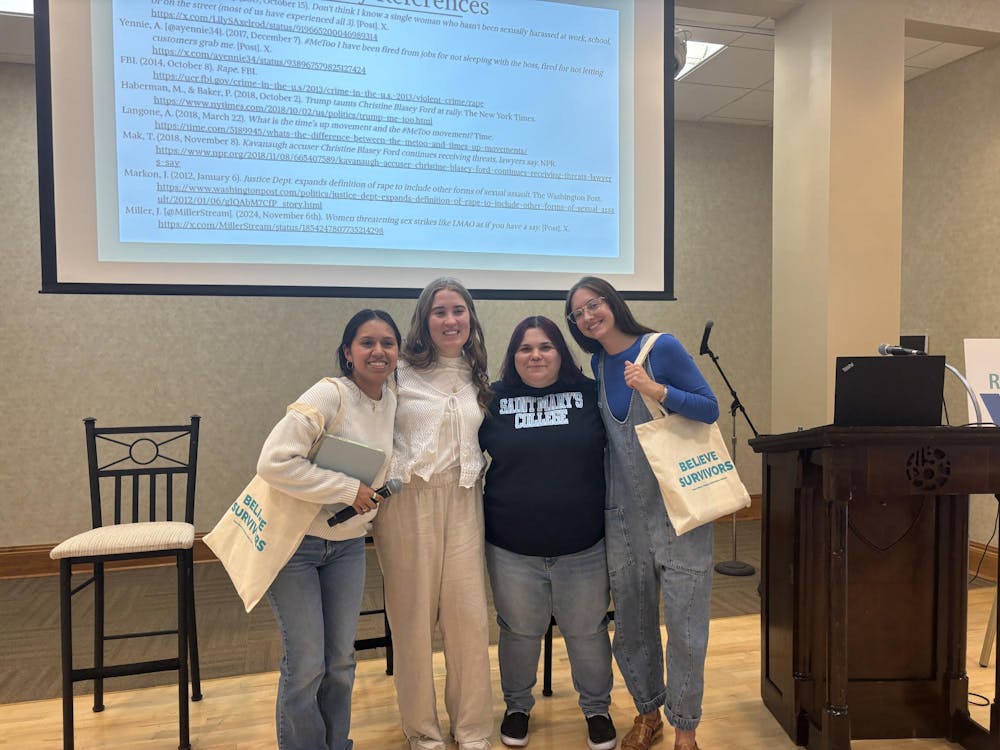
On Monday, the Title IX Office and Department of Gender and Women’s Studies at Saint Mary's organized their annual Student Research Panel as part of the Raise Your Voice series. The panel featured three Saint Mary’s students: senior Kaitlyn Magoonaugh, junior Giselle Martinez and senior Phoenix McClellan. The students’ research focused on online activism and gender issues within digital spaces.
Before the panel, junior Kayli Zelinske-Mader recited her poem “Oh, To Be a Woman,” which explored the contradictions women face, including how their clothing is judged.
“I am a tomboy because I wear boy clothes. I am a slut because I wore a crop top to class,” Zelinske-Mader read from her poem.
McClellan opened by presenting her research on sexually explicit and beauty-related online content. Her thesis argued that this content can perpetuate misogyny and pressure women to conform to narrow beauty standards.
“It is also possible for both sets of content to act as catalysts for one another,” McClellan said. “My argument was supported by a number of different sources but the ones that I consider the most valuable are the nine interviews that I personally conducted with a variety of students from the tri-campus community.”
She interviewed nine participants aged 18 to 22 who had been exposed to these issues growing up. One interviewee, under the pseudonym Ophelia, described witnessing widespread misogyny online.
“Ophelia has noticed several women being harassed on social media platforms … In her understanding, it seems that beauty is often considered synonymous with being sexually available and consenting to sexualization in online spaces,” McClellan said.
To illustrate harassment, McClellan cited a tweet from X user Nicholas Fuentes: “Your body, my choice. Forever.”
“The tweet that I’ve chosen to include on this slide serves as an example of the type of harassment and entitlement to women’s bodies present in online spaces,” she stated.
She added that viral phrases like “repeal the 19th,” referring to the 19th Amendment of the Constitution, reflect growing online extremism towards women.
“Similar phrases ... have become popular as the attitudes of consumers become more extreme in their opinions about women,” McClellan said.
Her recommendations included education and media literacy as well as open conversation.
“My primary recommendation is to foster more safe spaces for people to discuss these highly sensitive topics without the fear of being judged for what they may or may not consume online,” she said. “Even if the only thing we can do about it is talk, that will still be a step in the right direction.”
Martinez then presented her research on digital activism and feminist responses to sexual violence, focusing on the MeToo movement and its evolution online.
“Digital activism transforms feminist actions and discourse, especially when addressing violence against women … While digital platforms amplify the voices and experiences of marginalized individuals, they can also oversimplify these experiences and limit the diversity and complexity of feminist responses,” Martinez said.
Using Kimberlé Crenshaw’s intersectionality framework, Martinez emphasized the need for more inclusive activism.
“Intersectionality challenges feminism to move beyond a one-size-fits-all understanding of oppression,” she said.
She traced MeToo back to founder Tarana Burke’s goal of empowering marginalized survivors, particularly women of color.
“Burke’s original vision was to create a space for marginalized survivors of sexual violence, particularly women of color, where they could share their stories and find solidarity with each other,” Martinez said.
When the movement went mainstream in 2017, Martinez shared, “The focus of the movement moved towards the experiences of white women in Hollywood,” she said.
Martinez noted the gains made, but also the limits of digital platforms.
“Digital activism has transformed feminist action by providing a platform to amplify the voices of women affected by violence,” she said. “But movements like #MeToo have also exposed the limitations of digital platforms — particularly when it comes to oversimplifying complex struggles and reinforcing dominant, exclusionary narratives.”
She urged creating a broader feminist space.
“This means creating a space for voices from different racial, socioeconomic, cultural, sexual and gender identities,” she said.
Magoonaugh followed with research on how profit-driven culture limits MeToo’s impact.
“While MeToo has empowered survivors and created conversation, its impact is limited by a culture where businesses can profit off of sexual assault and society is built upon distrust and a general contempt for women,” Magoonaugh said.
She cited overlooked cases and branding campaigns that prioritized image over change.
“The MeToo movement has done a substantial job of bringing attention to issues of sexual harassment and assault,” she said. “But practices such as victim blaming are continually holding back its progress.”
Magoonaugh challenged the idea that false accusations frequently ruin men’s lives, saying, “Society believes the word of men more often than not.”
She criticized how commodification hinders long-term reform.
“While MeToo has empowered survivors and initiated dialogue, the underlying profit-driven motives in our culture continue to undermine sustained, meaningful change,” she said.
Still, she acknowledged the movement’s significance.
“The MeToo movement has sparked conversations about sexual harassment, assault and rape culture, challenging systemic inequalities and social norms,” Magoonaugh said. “Despite dealing with backlash and commodification, the MeToo movement still remains today. Although the election of leaders accused of sexual misconduct highlights society’s dismissal of sexual violence, showing just how slow moving real change can be.”
During time for questions, an audience member asked how the students took care of their well-being while researching heavy topics. Martinez said community and hope were key.
“I think just remembering that people are fighting to combat these issues helped me when I was doing my analysis,” she said.