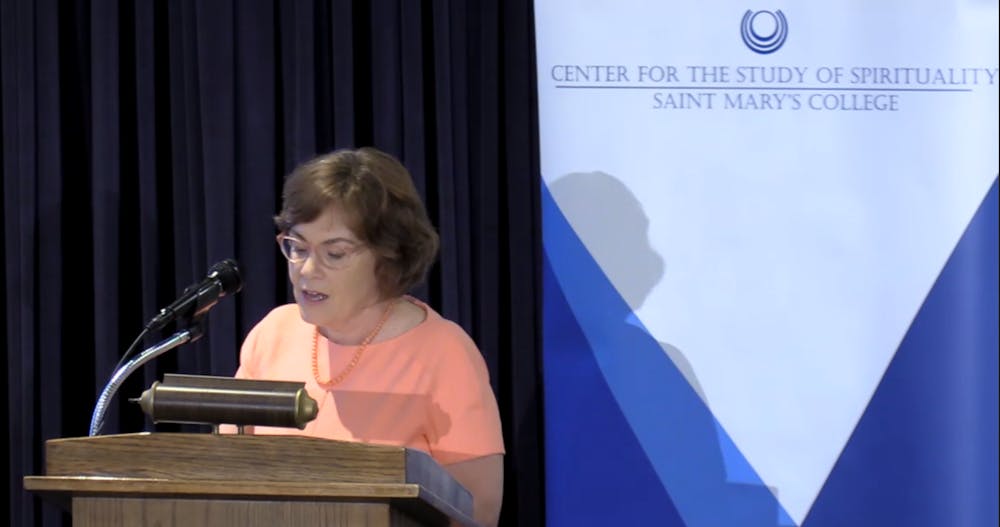
Last Thursday at 7 p.m., Saint Mary’s College hosted the annual 2025 Madeleva Lecture, "Holy Women Making History," presented by Kathleen Sprows Cummings, the Rev. John A. O'Brien collegiate professor of American studies and history at the University of Notre Dame. The lecture focused on the historically underrepresented work of sisters and women of the Catholic Church.
Since 1985, the Madeleva Lecture Series is an annual event where scholars are invited to lecture in honor of Sister Madeleva Wolff. Wolff was the third president of Saint Mary's College from 1934 to 1961 who established the first school to provide a postgraduate program in theology to women.
The lecture began with an introduction from Daniel Horan, director of the Center for the Study of Spirituality. He discussed the history of the center, the Madeleva Lecture and the passing of Keith Egan, the previous founding director.
"It's a bittersweet conclusion because we have 40 years of a tremendous legacy [with] this lecture being one of the most important keystones of that history. But bitter as well because in January we lost, in this earthly experience of community, the founding director Dr. Keith Egan, as he entered eternal life," Horan said.
President Katie Conboy then delivered a speech, commenting on the lecture as, "one of the most prestigious events on our campus each year."
Horan invited Cummings to the stage after a summary of her current work.
"Professor Cummings is currently working on two very exciting projects. The first is a study of the sex abuse crisis in America, tentatively titled 'Spotlight on American Catholicism: Historical Perspectives on Clerical Sex Abuse in Boston and Beyond,' and the second 'Pope Francis and All the Saints,' which is a history of the globalization and modernization of the canonization process,'" Horan stated.
She then began her lecture with an invitation for the audience to "join in thinking like a historian about the era in which Madeleva Lecture [was] inaugurated."
"We try, in other words, to craft a good story," Cummings said. "Tonight's story explores how the implementation of Vatican II converged with American [society and] reshaped public sisters, relationships of the past between the mid 1970s and the early 1990s, the founding era of the Madeleva Lecture, if you will."
Cummings explored the history of many organizations of women in the church, including the "Conference of Major Superiors of Women" which was later controversially named "Leadership Conference of Women Religious (LCWR)."
"The [LCWR] created a task force dedicated to raising awareness that sisters had been leading the Church and American society since the colonial period. [They were] providing education, healthcare, social services [and] all of God's people," Cummings said.
Cummings touched on the events of specific sisters throughout history, including the resignation of Detroit's Sister of Mercy, Agnes Mary Mansour, the efforts of Sister Margaret Ellen Traxler, Sister Ritamary Bradley and other pioneers in their work.
Throughout the last half of the lecture, Cummings put emphasis on Sister Catherine Mulkerrin, part of the Sisters of St. Joseph of Boston.
"When recording the oral history by Sister Rosen to explain why so many sisters left the community in a single year, Mulkerrin refused to generalize. She had conversations with all of them and she said 40 people had shared 40 stories. The distinctiveness of Mulkerrin's story is the second reason I'm sharing it with you tonight and the main reason I've spent so much time with it over the last couple of years," Cummings said.
Cummings discussed Mulkerrin's role in uncovering sexual abuse cases ridden in the Church.
"As [Mulkerrin] explained, her job was to listen to survivor stories and arrange therapy for them to assist in creating a new archdiocesan policy, to establish a review board comprised of lay people and, ultimately, to help survivors move beyond embarrassment, fear or shame in the search for the truth," Cummings said.
Cummings further discussed Mulkerrin's perspective in relation to historical research.
"It is poignant and provocative to reread Mulkerrin's oral history under spotlight's glare. Surely, her fond memories of teaching math at St. Teresa of Avila were troubled by learning that three students, including one of her own, had been abused by two parish priests during her time there," Cummings said.
After concluding the Mulkerrin's story, Cummings ended the lecture with a question for the audience.
"As you reflect on the imagination, witness and leadership of [the] American Catholic sisters, what will you make of the history that they made?" Cummings asked.