I am somewhat known for having a short temper. Although I would like to consider myself patient and measured, I don’t think anyone would draw likeness between me and Mother Teresa, whose organization I worked at this summer. I spent eight weeks living in Kolkata, India, through an Institute for Social Concerns fellowship working with the Missionaries of Charity at their Kalighat Home for the Dying and Destitute. Kalighat served functionally as a hospice center for those living on the streets and in the slums, ideally offering a place to die with dignity. Icons and emblems of Mother Teresa were all over the walls, in every enclave and corner, serving as a constant symbol of peace and calm, and yet my short temper still prevailed.
I like to think my temper is so explosive because I care so deeply. Although I am still working on quelling my rage at the impossibly slow walkers in DeBart hallways, more often than not I find myself completely fired up over my convictions. Usually, this serves me well. I am a decent socratic seminar participant, a good interviewee and an interesting dinner party attendant. On a more serious level, the ability to vocalize and put into words the depth of emotion I feel over these sorts of topics has ultimately led me to positions such as this — writing an opinion column for The Observer. It also allows me to be a fierce advocate for those who have been silenced, and gives me the responsibility of using my privilege as a white, upper-middle-class student at a prestigious university, to do some sort of good in this world.
My summer in Kolkata was a masterclass in modulating my temper. Every day I was faced with what felt like insurmountable scales of injustice and suffering, and acting on my temper and overwhelming sense of moral injury was not sustainable. Moral injury, or the psychological and spiritual condition where one’s deeply held beliefs are violated through their witnessing of others undermining said beliefs, was my near constant state of being. Each day felt like a perpetual test of my willpower and of my ability to bite my tongue.
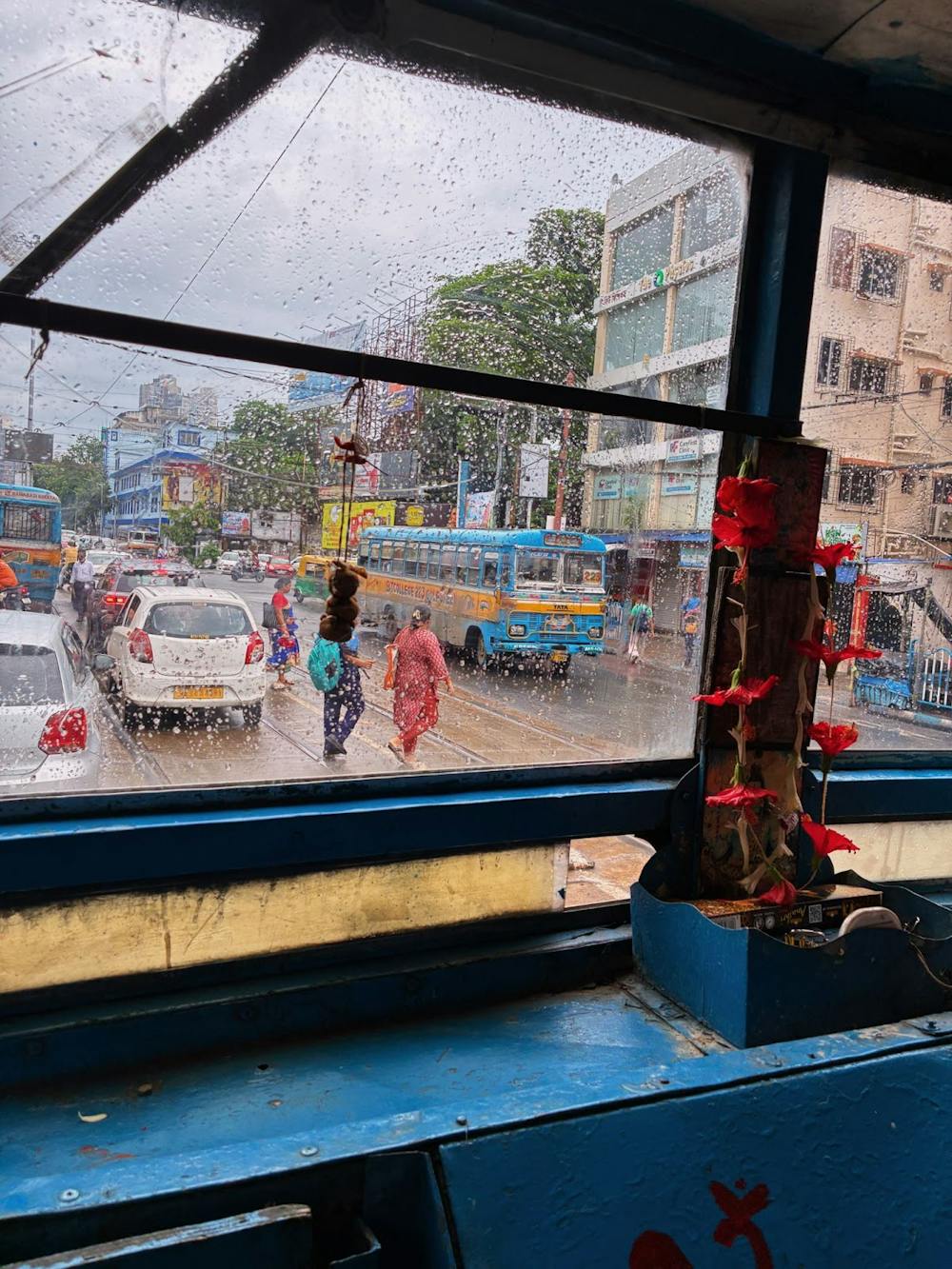
The largest testament to my self-control came from my interactions with my fellow American volunteers. In particular, a group of brothers from Denver, Colorado seemed to make their daily vocation a living testament to my short fuse. As we rode the crowded, humid and colorful open air buses half an hour to work every morning, at least two brothers would pile in across from me (as women and men must be separated on public transportation) and badger me with questions about my personal faith and how I viewed my work in India. I was able to successfully pop my AirPods in, turn up some Japanese Breakfast and ignore them most mornings, but there were several occasions when even the wall of indie soft pop and the constant clamor of the Kolkata streets weren’t enough to save me from my own anger.
“Why don’t you ever treat the patients in the home?” Brother Anthony poked my shoulder and yelled over the drowning horns and marketplaces. “Sorry?” I yelled, weaving my head between two large straw baskets and the bus conductor. “I mean, you’re pre-med, right? Why don’t you ever help treat the patients? Do their wound care? Stuff like that?” Brother Anthony gesticulated at me, a rosary in one hand and a liter water bottle in the other. “I just don’t feel comfortable doing medical treatment when I’ve never been formally trained. Emphasis on the PRE-med.” I blinked and tried to turn away, hoping our conversation would be smothered by the sounds of the bus driver screaming at pedestrians as we flew by. “You don’t need training. None of us have training! That’s why we are in India — they just have different standards of care here. You just wouldn’t get it … it’s cultural!” He smiled at me, clearly unaware of the deep-seated conviction he just lit in me.
This will forever be one of my biggest misgivings about international volunteering; incredibly wealthy, privileged and naive people from the Global North have decided, from the cushy pedestals of their well-funded universities with near pristine standards of healthcare, what should and should not be expected for the care of the impoverished of the Global South. This post-colonial notion of “cultural difference” is a thinly veiled excuse to perpetuate racism and structural violence with subpar levels of care.
Oppression has been so normalized and romanticized through the lens of “voluntourism;” the parameters of a net good have long been blurred at the expense of medical experience for resumes or “working through God.” The brothers, despite having no formal medical training or experience, routinely donned gloves to assist in full tissue debridement and minor toe amputations on patients with severely infected wounds. Were they working through God as their lack of medical knowledge left one patient with a lifelong limp?
I felt my face heat up and my eyes begin to water. The brothers continued claiming that “some care is better than nothing” and that “if you don’t do it, no one will!” ignoring my arguments and calls to ethics. And yet, the emotion I felt more strongly than rage was sadness. I felt my usual pang of insufficiency, of not being able to do enough for those I felt so passionately about serving. I couldn’t help but wonder: was my temper really from anger? Or was I just so distraught by the constant stream of persecutions to my convictions?
Throughout my summer, I blurred the line between temper and conscience, seemingly as a way to survive. Instead of reckoning with the injustice I saw in my everyday work, I maladapted and turned the criticism inward, blaming myself for being so reactive with such a short fuse. Although I still need to work on my patience navigating the halls of DeBart, I finally recognized that there is nothing to apologize for in emotion that arises at the injustice of others.
Ivy Clark is a senior pre-med studying neuroscience and behavior with a minor in global health and the Glynn Program. Despite living in the midwest her entire life, she has visited 11 countries and is excited to share her most recent endeavors working with the Missionaries of Charity in Kolkata, India. If Ivy could get dinner with any historical figure, it would be Paul Farmer or Samantha Power, whose memoir inspired her column name. You can reach her at iclark@nd.edu.