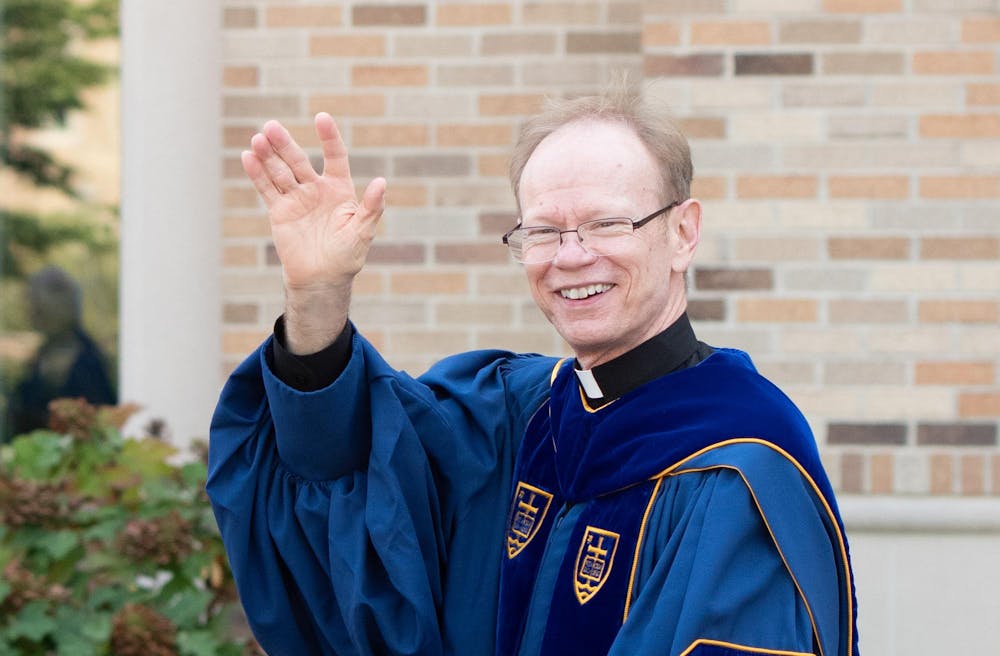
A year ago this weekend, Notre Dame President Fr. Robert Dowd was inaugurated, ushering in a new era for the University after 19 years of Fr. John Jenkins as president. Upon his inauguration, Dowd outlined a clear vision for his presidency and announced key priorities for his administration. As Dowd himself referred to his first year as his freshman year, we thought it fitting to look back and give him a report card for the first year of his presidency.
One of the key initiatives Dowd introduced during his inaugural address was Pathways to Notre Dame, a commitment to go loan-free and need-blind for both domestic and international students. He also committed to giving healthcare coverage to graduate students and their families.
On this point, despite a tax increase on the University’s endowment, Dowd has seen these efforts through to their successful conclusion. According to vice president for undergraduate enrollment Micki Kidder, the class of 2029 has greater socioeconomic diversity than all prior classes. Over half of the class is receiving need-based financial aid.
Although made possible in part by efforts preceding the Dowd presidency, his key initiative has shown definitive results and reflects the University’s Catholic values. As Dowd himself said in his inauguration speech, increasing opportunities for less financially well-off students to attend Notre Dame is a “great way to serve the Church.”
What Dowd likely did not foresee upon assuming office was the turmoil that would engulf higher education under President Donald Trump. Since his inauguration, elite institutions of higher education have faced reduced federal funding, barriers to enrolling international students and fines for allegedly permitting antisemitism on campuses.
In this hostile environment, while not entirely avoiding the ire of state and federal governments, Dowd has proven a competent crisis manager. When the Trump administration has taken particularly egregious actions, Dowd has joined other colleges in denouncing them. Ultimately, Dowd has chosen to act pragmatically, as when the University urged lawmakers to provide an exemption to religious institutions from the endowment tax. While that exception was ultimately removed from the bill by the Senate parliamentarian, we commend Dowd for standing up to attacks on higher education, while putting Notre Dame’s interests first and avoiding drawing unnecessary attention to the University.
While some of the University’s initiatives benefit from keeping a low profile, others were realized all too silently. This is most evident with renaming the Center for Diversity, Equity and Inclusion without any immediate explanation or press release. While perhaps an understandable choice as the University is investigated for its diversity programs, the change should have been explained upfront to students and faculty. If the University is really moving away from its diversity initiatives, then Dowd ought to take responsibility for that decision and explain why. If, however, the University’s priorities are unchanged, then the move represents a sly slight of hand. Either way, Dowd ought to stand for greater transparency in decision making.
Similarly, Dowd could do better on his promise to foster political discourse on campus, which he articulated in his inaugural address, where he declared that Notre Dame must not be afraid “to tackle the contested issues of the day.”
In April, an abrupt disinvitation of Eman Abdelhadi, a pro-Palestine speaker slated to deliver the keynote address at the Kroc Institute’s annual student-led peace conference, sparked allegations of censorship from Abdelhadi as well as students and faculty who signed a letter calling for Abdelhadi to be allowed to speak. Provost John McGreevy and Keough School dean Mary Gallagher cited security concerns as the reason for the disinvitation. While security concerns are valid, a school with the endowment the size of Notre Dame should have the resources to ensure proper security at events like this, even on short notice. And although Dowd may not have made the decision himself, he should take accountability for decisions of this magnitude made by others. An honest commitment to free discussion necessitates allowing controversial figures to speak and have their ideas heard.
Ultimately, despite some shortcomings, Dowd’s first year in office has been a strong one, especially given the circumstances. He has guided the University through a time of financial and political crisis with a steady hand, focusing first and foremost on the interests of the institution and its students. While more could be done on the issues of transparency and free speech, the University appears to be in good hands with Dowd at the helm. Overall, we give him a letter grade of an A- for his first year.