Since fall 2024, campus visitors for Notre Dame football games have also stopped by the University’s College of Arts and Letters home game Friday programming: Crash Course. At 2:30 p.m. in DeBartolo Hall, a professor from the College presents an hourlong lecture on numerous courses available to students. Attendees of the Crash Course include alumni, parents and prospective students who are interested in experiencing what a class at Notre Dame is like.
Some courses given this year include: “Sport and Society in the Ancient World,” “Economics and the Seven Deadly Sins” and “Space Ethics.” Nathaniel Myers, an associate teaching professor in the University Writing Program, gave a lecture on the course, “Writing in the Age of AI,” on Friday before the game against Purdue.
Myers began his lecture with what he hoped a typical student taking this course would receive in five basic takeaways: writing is relational, conventional and a thinking exercise, while AI is informational and rhetorical. His goal was to help students understand how those ideas correlate in a relationship between AI and writing.
“I would like to begin with a question and a scenario to share with you all and we’ll go ahead and use some generative AI momentarily,” Myers said.
The scenario described a college student writing an apology text to his family for not calling them and being as responsive as he should be. Myers plugged the synopsis into ChatGPT and the generative AI prompter provided a paragraph-long response using family details and ‘apologetic’ language. The audience shared their thoughts in pairs and next as a group, including James Alban ‘80, a pre-med graduate who shared his reaction to using AI to communicate relationally as humans.
“I think maybe in writing a letter to your parents, you’re gonna explore your own emotions ... Here you’re delegating to ‘something’ else to do that, so really you’re selling yourself,” Alban said.
While many agreed with his notion of losing yourself to the delegation of writing, some audience members cast differing opinions. Elise, the mother of a University freshman, expressed a different perspective on using AI as a writing tool.
“I look at it, kind of in this particular instance, humorously. Like at least my son took the time to know that he hadn’t called. I’ll take that awareness,” she said.
Myers continued this discussion with another scenario, a University political science student using Google Gemini to create a cover letter for a job interview at the Pew Research Center. The audience and professor agreed that the finished product was detailed and included many specifics on the position and what they were looking for, but the AI also came up with points that were not cohesive to the cover letter.
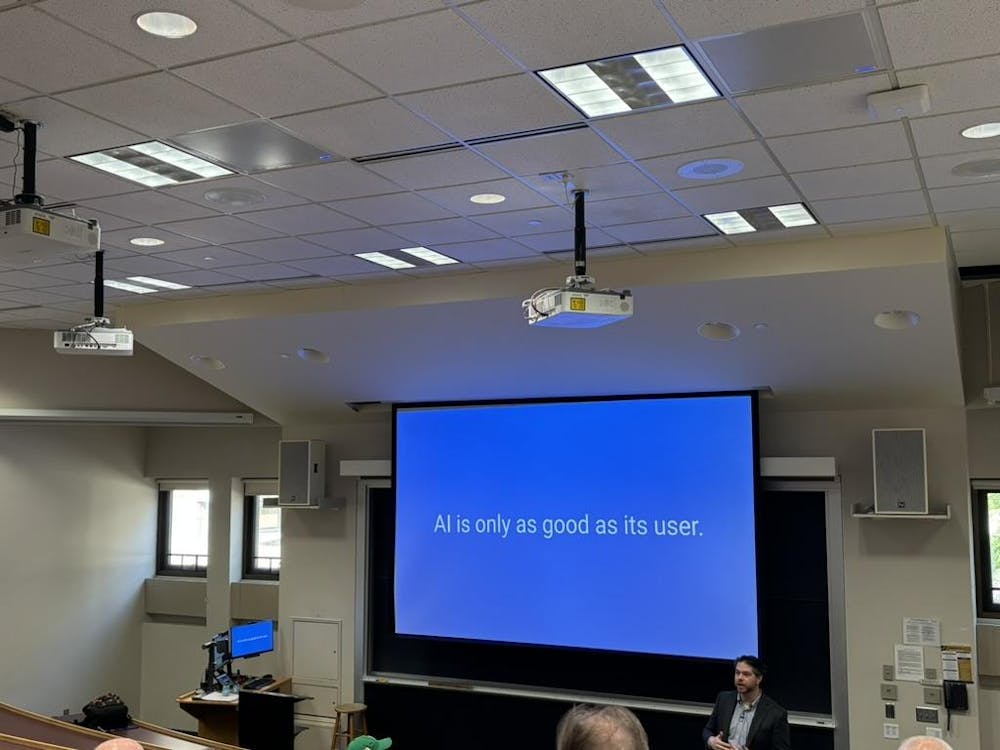
He discussed the potential benefits of using generative AI, noting that while it can be a valuable tool, it does not need to complete all of the work for an individual. To illustrate this point, he presented a statement on the board: “AI is only as good as its user.”
As the lecture began to wrap up, Myers took the time to restate his main points. While summing up those key aspects, he added the importance of knowing your intent for AI and executing on it.
“You can use AI to support your learning, but not replace your learning,” Myers said.
By the end of the lecture, Myers reiterated that generative AI is most effective when used intentionally and in moderation. His message to the audience emphasized balance with AI to not replace critical thinking and personal voice in the writing process.