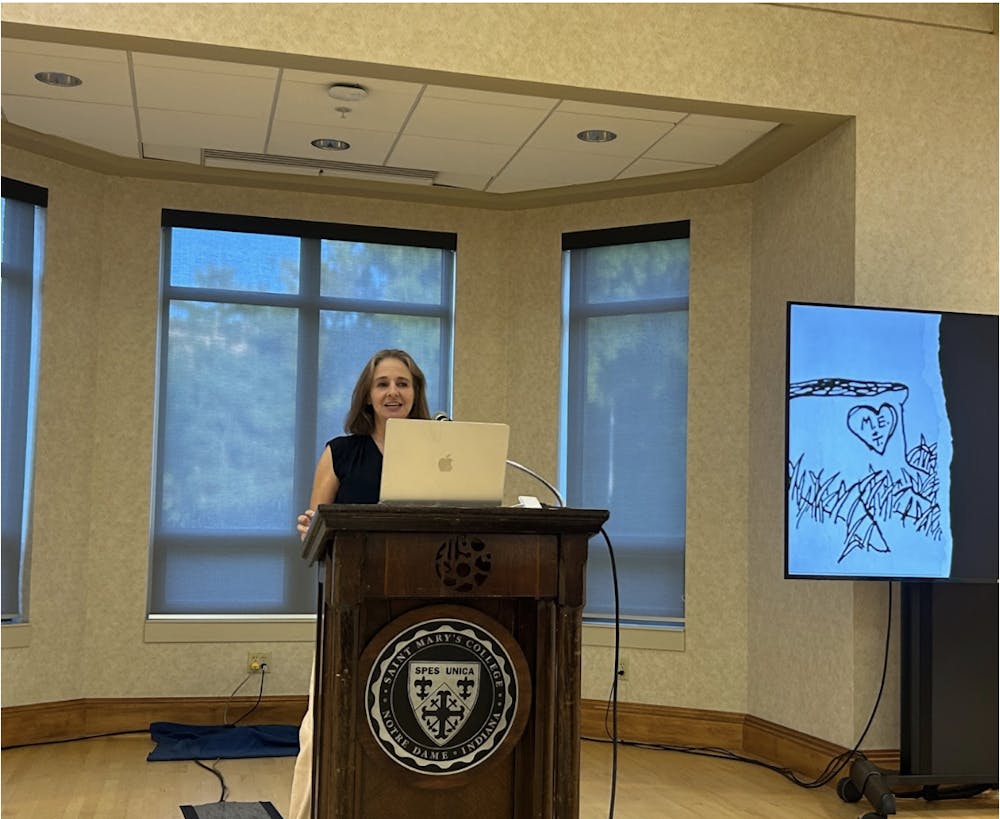
Saint Mary’s hosted their annual McMahon Aquinas Lecture Wednesday, featuring Angela Knobel and her discussion, “Motherhood and the Meaning of Self-Gift: Reflections on 'The Giving Tree’”. Knobel is a philosophy professor at the University of Dallas.
Her lecture centered upon the principle of giving and what distinguishes good maternal care from bad through an analysis of Shel Silverstein’s “The Giving Tree.”
“The Giving Tree”is a story of a tree who provides for a boy, giving him all he might need to achieve happiness in his life. In the beginning, this is apples to eat and shade to bask in. As the boy grows, he asks for more and more of the tree, who responds until she has nothing else to give but a stump for the boy to rest on.
Knobel explained that while Silverstein’s story is initially one of kind generosity, it develops into one which she views as far more unsettling and strange. She identified a controversy in whether the book’s message is one that is truly good, or that warns of the dangers of giving too much of oneself away. She noted that many scholars have come to reject the book altogether.
In her lecture, she argued that the book does not to be wrestled into either side. Rather, she claimed that it is better read in two parts with recognition of a shift in narrator as the tree, the maternal figure of the story, goes from giving herself in a healthy way to the boy she cares for to giving far too much of herself, to a dangerous point of not being able to give anymore.
Knobel claimed that ”The Giving Tree” is but a single example of the challenge of finding balance as a mother that she shared. Mothers, throughout history, she said, have been depicted as figures that are known to give a great deal for the sake of their children. While in many cases this can be a good thing, Knobel also pointed out multiple instances where this type of giving does not necessarily fulfill the lives of the children or the mother. She compared such giving to the kind of St. Monica for her son St. Augustine.
She shared that in this Biblical story, what St. Monica desires so desperately for her son is all of what she perceives to be success in life. Yet, in her desperation to give this to him, she pushes him away. It is only when she steps away that St. Augustine is able to discover the happiness St. Monica intended for him, and for their relationship to strengthen.
Knobel asserted that a gift is ultimately appreciated in its need and not in what is physically provided. “If we think about the things that others have given us that have proven to be the most important in our lives, we will very likely find that they are intangible,” Knobel said. Instead, she asserted that the most powerful gifts are those which inspire further giving in others, a “passing along” of sorts. According to her, is in this gift of teaching that the most goodness can spring forth.
As for “The Giving Tree,” Knobel reminded the audience importance lies in its ambiguit, resembling the complex role of mothers in the lives of their children.