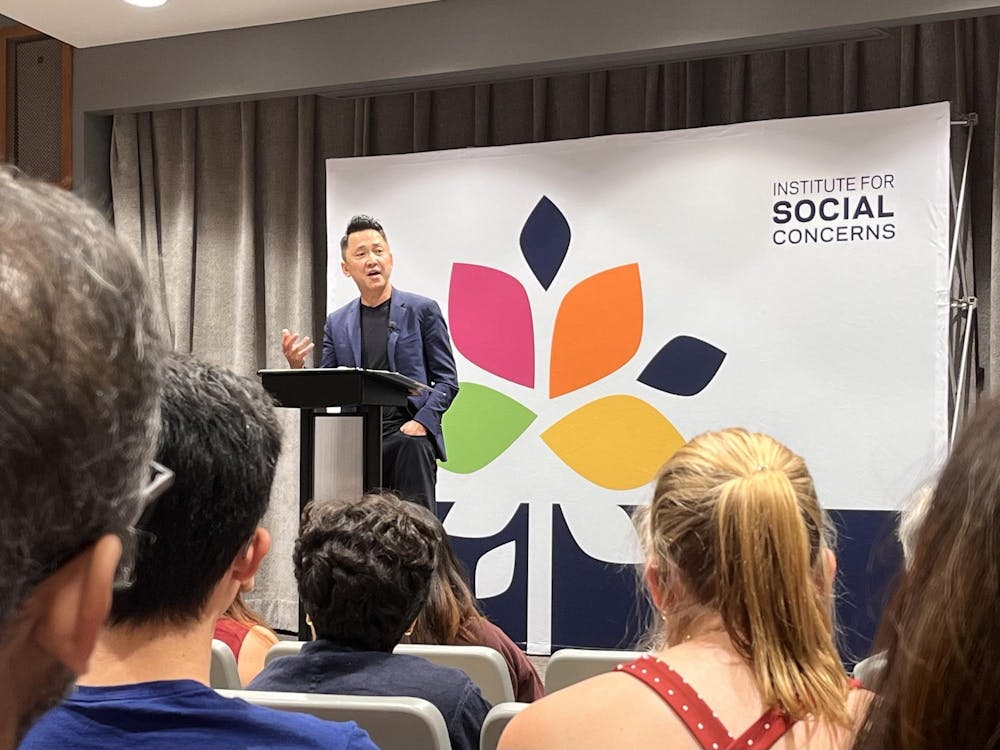
This past Friday, the Institute for Social Concerns welcomed Pulitzer Prize-winner Viet Thanh Nguyen, a professor of English and American Studies and Ethnicity at the University of Southern California, to campus to discuss his new book, “To Save and to Destroy: Writing as an Other.”
The lecture was the institute’s first MVP Friday of the season. As a part of this series, the institute invites speakers with writing and leadership experience to expand on the series’ acronym: meaning, values and purpose.
During the lecture, Nguyen immediately delved into the duality of what it means to grow up as an “other” in a country defined by a majority group. He remarked that the first time he came face to face with this discrepancy was when he watched the American-made Vietnam War film, “Apocalypse Now.”
“As I watched ‘Apocalypse Now,’ I identified with American soldiers up until the moment where they massacred Vietnamese civilians. And at that point, I was split in two. Was I the American doing the killing, or was I the Vietnamese being killed?” Nguyen said.
In 1975, Nguyen came to the United States as a refugee, an experience he reflected on in his lecture, drawing upon his perspective as an eyewitness to his parents’ suffering. He explained how this suffering was the norm for Vietnamese refugees, perpetuated by their place in the American system. Quoting his book, “The Sympathizer,” Nguyen outlined immigrants’ systemic otherness in America.
“‘[They] were hobbled by their structural function in the American Dream, which was to be so unhappy as to make other Americans grateful for their happiness.’ I don’t think anything’s changed since I wrote those lines,” Nguyen said. “We’re still at a time when people who are not refugees and not immigrants might be kind of happy to not be refugees or immigrants in our political and cultural climate today.”
Nguyen shared that the reason he became a writer, contrary to a stereotypical ‘model minority’ occupation, was because he realized the experiences and culture of Asian Americans were almost completely absent in mainstream media. Nguyen argued that this lack of representation isn’t only unjust but also dangerous, as stories shape the narrative of public perception, and in turn, people’s real-world interactions.
“Narrative scarcity is when … almost none of the stories are about you, [so] those stories bear the burden of representation, and therefore you can never say it’s just a story, because, you know, it’s not just a story, it’s life and death. And if you have ever said … it’s just a story, it means you live in narrative plenitude, where almost all the stories are about you. When almost all the stories are about you, you can just walk away,” Nguyen said.
For Nguyen, such stories are vital, not just for representation, but for recognizing the way in which minorities are systematically marginalized in America. Drawing upon James Baldwin and Martin Luther King Jr. to support his argument, Nguyen pointed out how very few members of the audience had even heard about their works on the Vietnam War. In these works, Baldwin and King drew parallels between the treatment of Black people and the Vietnamese as both contributions were quietly overlooked by the public, Nguyen noted. Nguyen called attention to these largely forgotten works.
“I believe this is a country of both beauty and brutality. You can’t have one without the other. We’ve not had one without the other,” he said. “There is the beauty of democracy and liberty, equality and rights and so on that we all know, but that beauty was made possible by the brutality of genocide, enslavement, colonization and perpetual war.”
Nguyen next emphasized the importance of acknowledging the nuance and inconsistencies within American history, noting that, while difficult, it remains crucial for Americans to confront this uncomfortable past given its historical and modern-day consequences.
“That’s a challenge we confront as Americans, being able to fully recognize the complexities and the contradictions of our history, because they haven’t gone away,” Nguyen said. “What we’re witnessing today is a repetition of a contradiction that has been cyclical throughout American history, American culture and American politics, and in many ways … it’s discouraging to think that they’ve happened before. But I think it’s also encouraging to know that if we understand that this contradiction has existed, we know how to fight back, because previous generations, previous communities, have always fought back.”
Azareen Van der Vliet Oloomi, a creative writing professor at Notre Dame and author of “Call Me Zebra,” highlighted the power of Nguyen’s work in shining light on histories that continue to resonate in society today.
“Nguyen is one of our great writers, because alongside his clarity, sonority and defiance, he is also an exquisite listener to the layers of silence that bloom in the face of annihilating histories,” Oloomi said. “He carries these ghosts of the past with tenderness and respect and speaks out when he sees other so-called minorities, being turned into the ghosts of our present.”