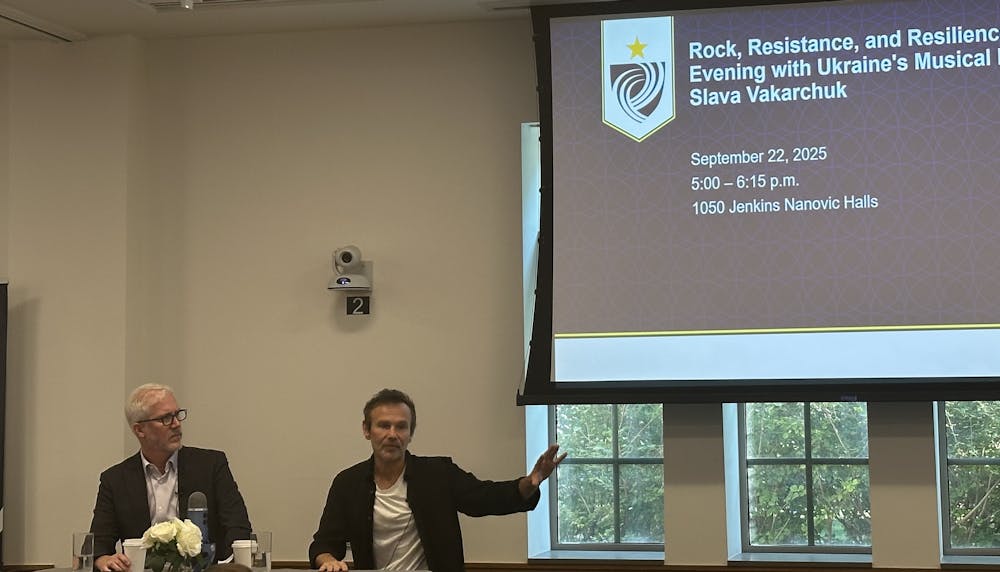
Slava Vakarchuk, a Ukrainian rock musician and frontman of the band Okean Elzy, spoke on Monday evening about the role of music, civic activism and resilience in Ukraine’s ongoing fight against Russian invasion. This event, held in Jenkins Nanovic Halls, was hosted by the Nanovic Institute for European Studies and coordinated through the Ukrainian Studies Hub.
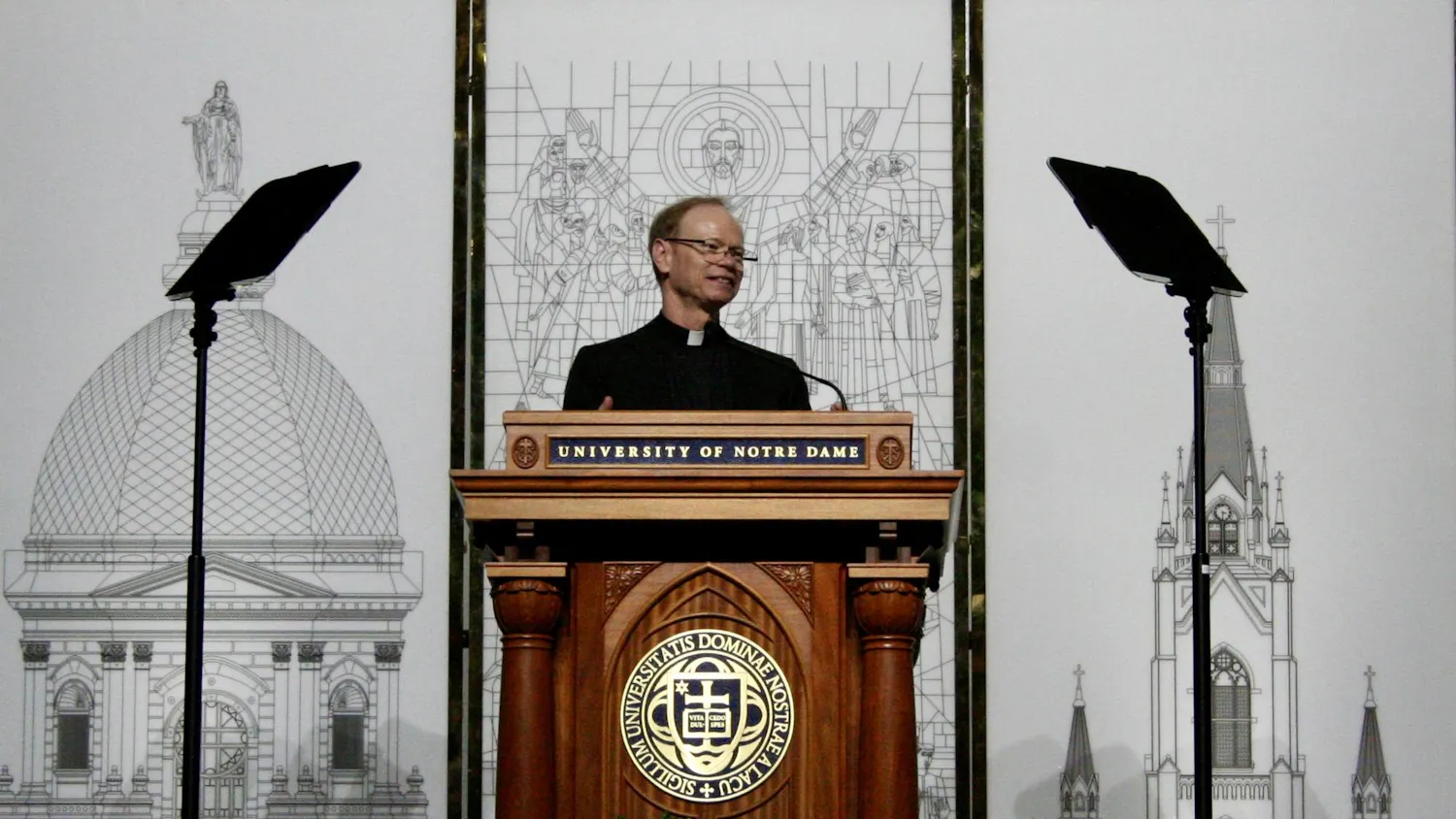
Professor Clemens Sedmak, director of the Nanovic Institute, welcomed the audience and emphasized Notre Dame’s continued relationship with Ukraine. “The University of Notre Dame has shown special solidarity with Ukraine ever since the full-scale invasion on Feb. 24, 2022,” Sedmak said. “We are especially honored to have our founding benefactor, Robert Nanovic, present in the audience tonight.” He also pointed to Notre Dame’s partnerships with the Ukrainian Catholic University, its participation in the global coalition of Ukrainian studies and University leaders visiting Ukraine as examples of this ongoing support.
Vakarchuk, who holds a doctorate in theoretical physics, has spent the last three years balancing his career as a musician with his service in Ukraine’s armed forces. In the earliest days of the war, he signed a contract with the military and began performing for soldiers and civilians near the front lines. Since then, he has given “more than 300 small concerts in villages, shelters and military bases across Ukraine.”
“When I go to the front line, I don’t know who needs these meetings more — me or the soldiers,” Vakarchuk said. “Sometimes it feels like psychotherapy. Even half an hour of music can bring people back to life, if only for a moment.”
The event was moderated by Rory Finnin, a professor of Ukrainian Studies at the University of Cambridge and a visiting scholar at Notre Dame. Finnin said Vakarchuk’s impact reaches beyond his music. “Slava brings the gift of the Ukrainian language to so many places around the world,” Finnin said. “He is not only a musician, but also a civic leader who has made extraordinary contributions to Ukraine’s democratic struggle.”
Vakarchuk described the emotional experience of performing for soldiers immediately after battle, recalling one instance when he sang for a platoon that had just lost two comrades. “At first, they were broken, they couldn’t even look at me,” he said. “But after 20 minutes, their eyes changed. We sang together, and I saw them smile. It wasn’t that they forgot what happened, but they felt alive again.”
Beyond music, Vakarchuk has been heavily involved in humanitarian work. Through his foundation and concert fundraising, he has helped raise more than $4 million toward supporting the Ukrainian efforts.
“Volunteers are a crucial part of every resistance. Millions of Ukrainians joined small and large organizations to support the front,” he said, stressing the importance of Ukraine’s volunteer movement. “Le Monde” reports that these volunteers handle everything from delivering supplies to coordinating logistics near combat zones, demonstrating the role of civil society in sustaining Ukraine’s defense.
Vakarchuk concluded his lecture by performing a song for the audience and affirming his commitment to continue performing for soldiers and supporting Ukraine’s defense. “I promise I will be with them as long as it takes and as much as necessary,” he said.