
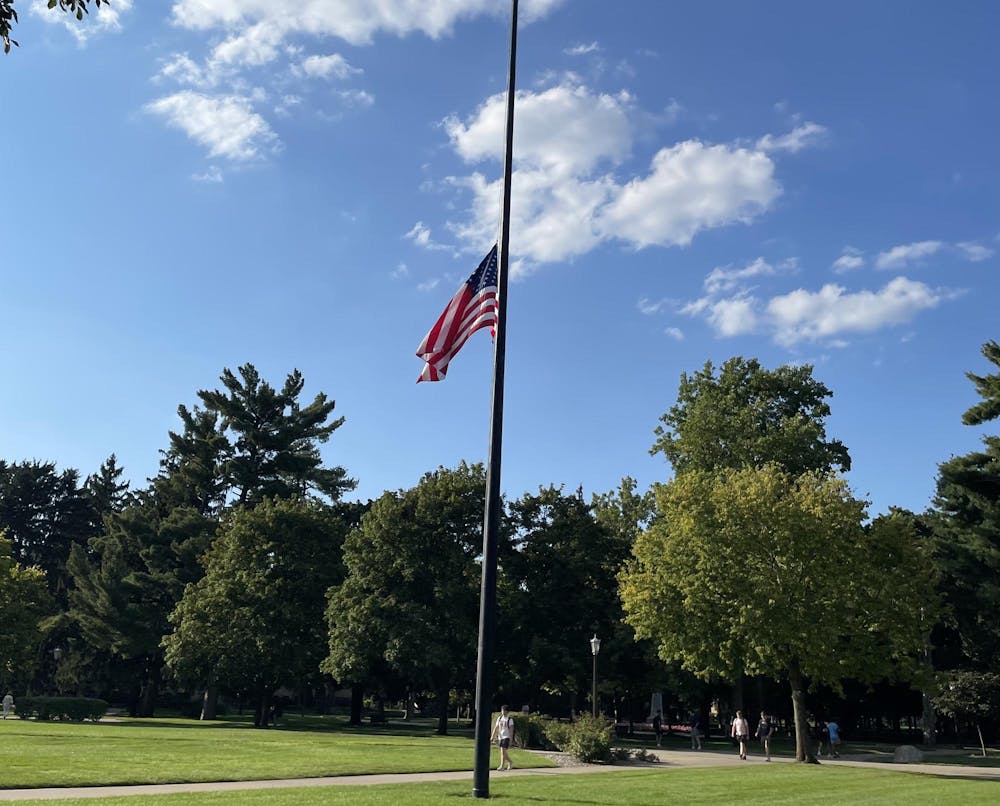
On Wednesday afternoon at 12:23 p.m., conservative political activist and organizer Charlie Kirk was shot dead at Utah Valley University.
The shock and senselessness of the event naturally moved the country to horror. This man was struck down in the prime of his political career at the young age of 31, leaving behind a loving wife and two young children.
Love him or hate him, Kirk had been a driving force of a political and cultural revolution which saw young people shift dramatically to the right in the past 10 years. His organization, Turning Point USA, and his own outspoken style were credited by many in bringing over this crucial young vote to President Donald Trump in the last election. In his short life, never having held elected office, Kirk had accomplished more than many elder statesmen do in their entire careers.
The media fervor in the coming days will inevitably focus on the killer, who is still at large. Regardless of what specific madness drove that monster to pull the trigger on Wednesday afternoon in Utah, his goal, accomplished in such a brutal manner, was to stop Kirk from speaking. It was not merely an attack on Kirk’s political beliefs — it was an attack on the basic conviction that citizens in a democracy should settle their differences through debate and not through violence.
The killing is all the more shocking in that it took place on a college campus. While he may have been a prolific campaign fundraiser, Kirk’s primary mission was to affirm the principle of open debate and free expression on college campuses. He recognized that while many institutions may claim to espouse liberal principles, in reality, there is widespread opposition to free speech at many colleges. The Foundation for Individual Rights and Expression’s (FIRE) 2026 College Free Speech Rankings report similarly noted a “chilling” atmosphere for free speech on campuses in which students and administrations are increasingly eager to cancel speaking engagements of those whose views they deem too controversial.
Kirk stood against this dogmatic opposition to free speech, arriving on college campuses across the country to face hostile crowds and try to convince them of his views. Although sometimes fiery in his rhetoric, he endeavored to treat all who debated him with respect, forcing them to engage with his ideas seriously, instead of belittling or shunning them.
As Kirk himself said, “When people stop talking, really bad stuff starts … When you stop having a human connection with the people you disagree with, it becomes a lot easier to want to commit violence against that group.”
While the nation has rightly been horrified at Kirk’s killing, and political leaders on both sides of the aisle have denounced the tragedy, support for political violence in America is unfortunately much higher than it ought to be. FIRE’s report shockingly found that 34% of college students support the use of violence to stop a campus speech they disagree with, up from 20% in 2022.
The ideal of free speech that Kirk fought for, so essential to the democratic process, is in real danger. To lose this norm is to jettison a basic premise of democracy — that citizens should settle their differences with the ballot, not the bullet.
This virtue of tolerance for views we disagree with or even abhor, like all virtues in democracy, requires constant maintenance by a nation’s citizens. As a university, Notre Dame should strive harder to uphold the ideal of free speech that Kirk fought for, especially given that the University was given an “F” ranking and placed at No. 238 in FIRE’s ranking. And as a student newspaper, we should be dedicated to the same belief that college campuses ought to be a place where reasonable students of good will can share their opinions and debate the most controversial topics of their day.
To let free speech wither on college campuses is to let the shooter who took Kirk’s life have the final word. It is to lose a virtue essential to the functioning of democracy. Instead, let Kirk’s life and death remind us that we should defend free speech, even and especially when it is difficult or uncomfortable.
Liam Kelly, Editor-in-Chief Emeritus, is a senior from Westport, Connecticut studying history and political science. He served as Editor-in-Chief for the 2025-26 term. Contact Liam at lkelly8@nd.edu.


