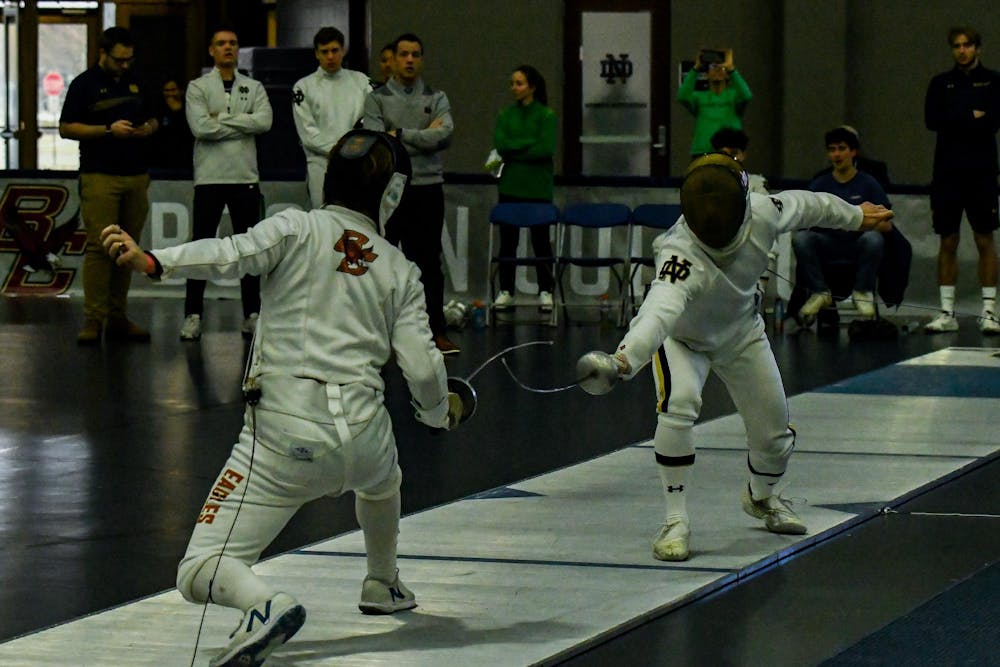
The first time I picked up a fencing sword, I was 10 years old. It felt awkward; as a soccer player, I didn’t have much coordination with my arms. But the moment the bout began, I was hooked. Every movement demanded focus, precision and heart. It provided the deep thinking of a chess match in a physical environment. Fencing quickly became more than a sport for me — it became a lifeline. It kept me active, grounded and connected to a community that understood me in a way few others did.
So when I came to Notre Dame, I assumed I’d keep fencing. After all, it’s home to the best varsity fencing team in the nation. But when I arrived, I learned something that didn’t make sense: There was no fencing club for regular students. None.
It felt like a punch to the gut. How could a school that celebrated fencing greatness not have space for those of us who simply loved the sport? I remember sitting on my dorm bed, wondering if this was really it — if I’d have to let go of the sport that had shaped me for the past decade.
Then came the spark.
If the club didn’t exist, why couldn’t I create it?
Starting something from nothing sounds romantic until you try it. I was a pre-med and studio art double major already running on no sleep and adrenaline. But I couldn’t shake the idea.
A few months later, my friend Katie Nguyen reached out to me. She had fenced in high school and wanted to know what she could do to help with the fencing club. Suddenly, I wasn’t doing this alone. The summer between freshman and sophomore year, we became obsessed. We mapped out logistics, studied how to form a club and drafted a plan so detailed it could have doubled as a thesis.
When we got back to campus, we met with SAO’s Cody Ballinger, who told us the process usually took an entire semester. The deadline? One week away.
That week was chaos — the kind that runs on caffeine, hope and sheer stubbornness. We wrote a constitution, created a budget, designed an events plan, found an advisor and gathered signatures. When we finally hit “submit,” we had 219 signatures — 219 people who wanted to see fencing come alive at Notre Dame again.
Finding an advisor was its own small miracle. Katie reached out to professor Molly Walsh, who said yes without hesitation. Only later did we discover that her two sons had fenced growing up. She understood what the sport meant. She believed in us.
Everything seemed to be falling into place — until we hit RecSports.
Despite the varsity team practicing on campus, RecSports told us fencing swords were considered “weapons” under university policy. I stared at the email in disbelief. Fencing — one of the safest Olympic sports — was banned for safety reasons? In over 10 years, the worst injury I’d ever seen was a bruise. And to top things off, the varsity team practiced on campus.
They told us to find an off-campus facility if we wanted club approval. We found a local fencing club, but the 30-minute drive and $100 individual monthly membership fees didn’t seem plausible for college students. Not that the coach gave it a single thought anyway, saying it “just wasn’t possible, given the gym being used 24/7.” It was crushing. Our vision was slipping away, one policy at a time.
Then came a message that changed everything.
A student named Isabela Oseguera emailed me out of the blue. She told me she had walked into the SAO office to ask about joining the Fencing Club and was just handed my email. Over dinner, she shared her story: After a serious ankle injury, her coach had trained her to become an armorer — someone who repairs and inspects fencing gear. That single detail could have been our golden ticket, since we had discovered RecSports allowed the varsity team to practice on campus because they had a certified armorer.
We updated our constitution, added new safety measures and submitted everything again, noting the addition of an armorer to match the varsity team’s guidelines. RecSports still said, “No.”
That’s when Isa turned to me and said, “What if we start it through Holy Cross College instead?”
The room went silent. Then everything started to click.
Holy Cross welcomed us like family. They were more than happy to help us, and honestly, it made me wish we had originally gone to Holy Cross. And finally, on October 3, 2025, after more than a year of fighting, the Fencing Club of Holy Cross College officially came to life.
That moment — seeing our club name in the official email — was surreal. All the frustration, all the late nights and all the “no’s” had led to this.
Our biggest challenge now is funding. Fencing isn’t cheap. Masks, foils, jackets — they add up fast. But thanks to the incredible generosity of fencing coaches and donors Alan Blakeborough and Kevin Byrd, who provided some used equipment and “weapons,” we’re hopeful we’ll soon be able to open practices to even beginner fencers. Because that’s the dream: making fencing accessible to anyone who wants to try.
We also plan to reapply for dual recognition through Notre Dame to expand our resources and reach more students. But RecSports recently announced a hiring freeze. No new clubs — for now.
Still, that doesn’t stop us.
To anyone who’s ever tried to start something new on campus, I see you. It’s hard. You’ll hear “no” more times than you can count. But that’s what makes the “yes” worth fighting for.
The Fencing Club exists because of the grit and heart of my fellow officers — Katie Nguyen, Jessica Zhang, Charles Jiang and Isa Oseguera — and the constant encouragement of SAO’s Cody Ballinger.
This journey has reminded me of why I fell in love with fencing in the first place. It’s not just about who scores the last touch or who wins the match. It’s about resilience. It’s about community. It’s about standing your ground even when you’re losing 5 points to 14 points.
And if I’ve learned anything from this experience, it’s that sometimes the greatest victories don’t happen on the strip. They happen when you refuse to give up, pick up your sword again and keep fighting anyway.
Carolina Dille
Class of 2027
Fencing Club President
Oct. 29