
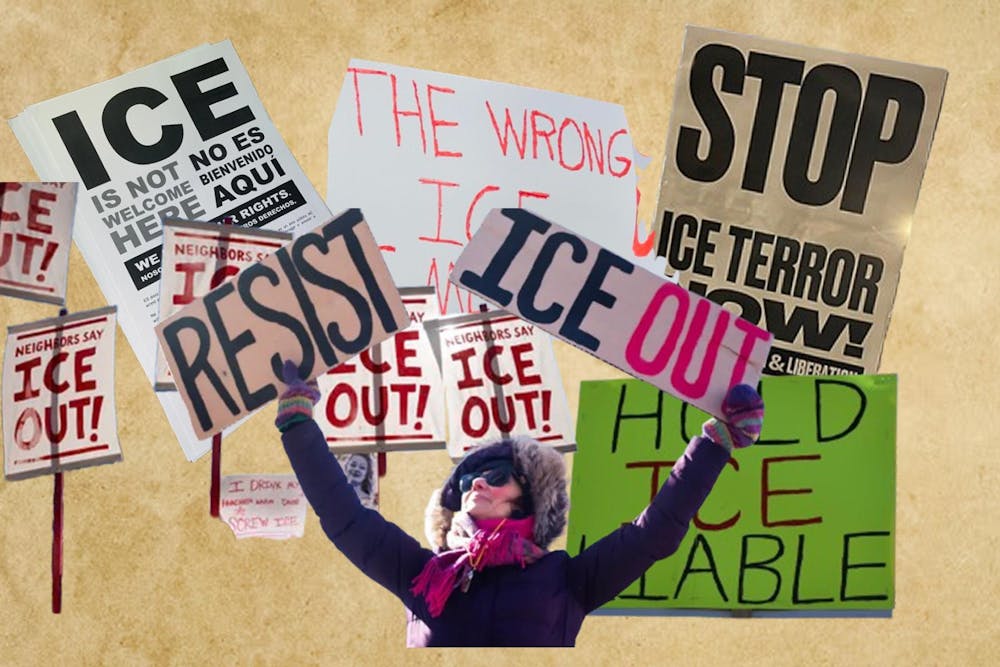
It would be difficult to miss the nationwide demonstrations protesting the actions of the current administration. People of all ages are exercising their First Amendment rights to peacefully protest immigration enforcement policies that many feel have torn apart their communities.
Last semester, I wrote an article detailing Indiana’s cooperation with the Department of Homeland Security and ICE. While there have yet to be major ICE operations in Indiana, many wonder if their city could be next. During the second Trump administration, international students, visa-holders, naturalized immigrants and undocumented immigrants have watched with concern as enforcement actions have disrupted cities nationwide.
While there are rumors that Indianapolis is next, they have yet to be confirmed. Even so, Indiana’s government has begun to prepare policies that would require local governments and public schools to comply with ICE operations if they occur. A new Indiana State Senate bill (SB 76) has passed to the house. SB 76 would require public schools to provide the records of students upon ICE’s requests, permit the governor to withhold grant funding from institutions who do not comply and require local law enforcement to act as an extension of ICE.
This could look like local police temporarily holding alleged undocumented immigrants until ICE assumes responsibility. Many have questioned the legality of SB 76’s resolutions. Despite the pushback, this bill is expected to pass the Republican-controlled house. This may feel like another discouraging headline in an already polluted new cycle, but that is not my intention for this article.
Hoosiers across Indiana came together on Jan. 20 to participate in the nationwide walkout. One of the participating institutions was my alma mater, Carmel High School. Carmel’s Young Progressives Club, led by junior Maaike Mora and sophomore Jack McNally, mobilized hundreds of students to walk to Carmel City Hall in protest of violent and inhuman immigration enforcement.
I have known Mora since high school through show choir and she has always been a focused and motivated student. Needless to say, I was not surprised to see her at the forefront of this effort. Earlier this week, I spoke with Mora about the walkout and what it meant to her. When asked why she co-organized the event, Mora responded, “It only takes 3% of the population to start a fight toward a better, more just future for all people … It’s important for those marginalized to know that we hear them and will not rest.”
Mora is a descendent of formerly undocumented immigrants, which made the issue especially personal for her.
Given recent reports of protests escalating in parts of the country, I asked Mora whether she felt nervous about participating in a public protest.
“While I felt a sense of pride for the diverse group of students that participated … I felt a smidge of fear for everyone’s physical safety, myself included,” she said. “Being part of the Hispanic community, recent events occurring with ICE in Minneapolis were worrying to see, but safety was our first priority as well.” Fear and uncertainty appear to be shared by many Americans at this moment. Public protest has always carried risks, but tensions have reached a fever pitch across the nation.
When I first heard about Carmel’s walkout, I remembered how universities were unsupportive of students who protested the war in Gaza. As an alumna, I know Carmel’s administration aims to support their students, but would that support end when it came to skipping school and protesting? Mora spoke candidly about Carmel High School’s support.
“Surprisingly, the school was very supportive and did not prevent this event from taking place. In fact, they helped us in finding a way to avoid negative [attendance] consequences for our absence. However, this did not diminish the opposition in our student body. An attempt to create a counter walkout, verbal abuse and other issues arose.”
Speaking with Mora reminded me that students have been at the center of political movements in America for years. In the Birmingham Children's Crusade in 1963, over 1,000 students skipped school and marched to downtown Birmingham to protest racial segregation. Their protests were met with intense police brutality, but they persisted. In the late 1960s, thousands of students protested the Vietnam War by wearing black arm bands to school. This protest ended up warranting a Supreme Court decision, Tinker v Des Moines, which ruled students have the right to freely express themselves in school.
This history reflects a broader American tradition. The Constitution protects the right to protest especially when citizens believe their government is falling short. Many immigrants, documented and undocumented, are unable to speak openly out of fear of detention. This is why it is so important to voice your concerns. You have the privilege others do not.
If you feel comfortable, attend a protest. If not, call your senators and representatives to vote against the upcoming DHS funding bill that would expand ICE’s budget. If you are from Indiana, call your local representatives and tell them to vote NO to SB 76. The second we allow ourselves to be hopeless is the second we give up the greatness this country can achieve.
Thea Bendaly is a freshman from Carmel, Ind. living in McGlinn Hall. She studies political science and romance languages and is a member of the Glynn Family Honors Program. In her free time, you will find Thea crocheting in her dorm, singing with Halftime A Cappella or hanging around with friends. Please feel free to contact Thea at tbendaly@nd.edu as she looks forward to hearing your thoughts (good or bad) about the column.


