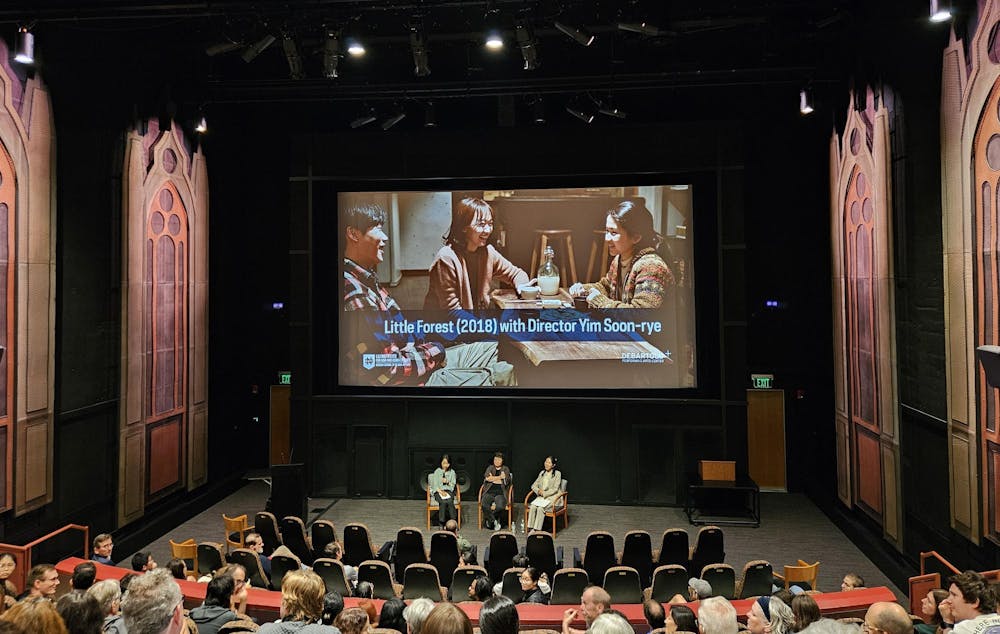
Last Thursday, the Debartolo Performing Arts Center screened the 2018 film “Little Forest” and hosted director Yim Soon-rye for a question and answer session. Yim also visited select film classes for intimate conversations. Film, television and theatre professor Cecilia Kim moderated the talk while a translator relayed Yim’s answers.
Yim is among South Korea’s most prominent female directors and a key figure in the country’s New Wave cinema. The screening was a rare opportunity for the University to host an acclaimed international filmmaker.
“Little Forest” follows a young woman, Hye-won, played by Korean actress Kim Tae-ri, who leaves behind her urban lifestyle for one of farming in the countryside. Through farming and cooking, Hye-won heals her inner conflicts and rediscovers comfort in a simple life.
Yim communicated that her goal in making the film was not to convince young people that a rural life was the answer to urban struggles, but rather encourage them to consider alternative ways of living. She hopes young people reflect on their true needs and values, resolving internal conflicts through a deep connection with and appreciation of the natural world.
“I want the young people [of Korea] to think about ... what they really need, what they really want and really get in touch [with] their inner selves to find out,” Yim said. ]
Yim noted that she was surprised by the film’s success among foreign audiences. When she adapted the Japanese original, she only considered how it would resonate with a Korean audience. She credits the success of the film to its overarching message, especially among her younger audience.
“I wanted to tell the young audience in Korea that there is an alternative life. You know, you don’t always have to leave. You don’t [always] have to be in overdrive and ... in competition, but take it easy and slow down,” Yim said. “I think that message really resonated with my young audience.”
Yim’s visit was coordinated by Kim, who teaches a course on East Asian cinema. According to Kim, she hoped the event would draw attention to underrepresented voices in cinema and broaden Notre Dame’s appreciation of Asian culture through art and entertainment.
Kim’s course covers the cinema of East Asia, which she admits is quite a large geographical region for one semester. Kim noted she carefully samples films that would provide valuable access points for students to explore further. In addition, she selects films that situate cinema within the countries’ political and social contexts.
“I select the films based on the relationship between the film and its kind of political, socio cultural context, and give [the students] the context of how this film was made, and also why it’s significant for us to look at it from this kind of like Western educational standpoint,” Kim said.
According to Kim, class discussions highlight assumptions foreign audiences may make on aspects of a film such as narrative and character representation, and how “to realize the differences of the kind of assumptions that we make on the narrative, or the assumptions that we make on character representation,” Kim said.
Kim was motivated to feature “Little Forest” and invite Yim to Notre Dame when she and her previous students realized her course syllabus lacked the works of female directors. Kim noted that her syllabus reflected the broader underrepresentation of women in the film industry.
“[Yim] is one of the so-few female directors at her time, there were no female directors in the industry six years before she went in and four more years after she was there. So like, close to 10 years that she was in the industry, there were no other women,” Kim said.
In her course, Kim also aimed to share a culture of slow-cinema, which is commonly appreciated and studied in Asia and contrasts with the action-packed and narrative-driven nature of Western Hollywood cinema. Kim first reached out to Yim almost two years ago and noted that it was initially “tricky” to contact the prominent figure and arrange the visit in between her busy filming schedule.
Recounting the process, Kim said “given that I didn’t have any personal connections with the director, she was really open to the idea of visiting campus.”
Due to the smaller size of Kim’s class on East Asian cinema, students were able to share intimate discourse with the director over lunch and in their class. Leah Rose Benny, a senior business analytics and film, television and theatre major, noted that she and her classmates were eager to engage with Yim despite language differences.
When asked why she believed the film was so successful among global foreign audiences, Benny highlighted the film’s theme of burnout, and how “despite cultural barriers, [the film] resonates with a lot of people, especially in today’s fast-paced world.”
Benny also noted how the process of making and enjoying food, which was demonstrated in “Little Forest,” can transcend tradition and taste, connecting people of different backgrounds.
“I feel like [food] is something that automatically connects people ... being able to see her make these delicious meals, and be able to see her eat them so deliciously, you feel connected to the protagonist in that way,” Benny said.
Kim added that she believed the director to be “very humorous” and expressed slight regret that Yim’s amusing demeanor may be lost in translation. Similarly, Kim noted how some of the linguistic and cultural nuances, such as jokes and dish names, were misrepresented in the subtitles of the film, something Yim said she had no control over.
“I think they could have just maybe used the [original] names [of the dishes], but instead they were kind of translated to easily digestible Western explanations ... I think that was maybe unnecessary,” Kim said. “Because what if someone watched a film, and they went to Korea, and they wanted to try it out, then you [wouldn’t] know what it’s called.”
During the question and answer session, many audience members praised the deliberately paced film and expressed discontentment with recent industry trends of commercial cinema. Audience members also found the featured dishes of the film appetizing and enjoyed the film’s absence of technology.
Senior psychology and sociology major Sandy Kang, who attended the screening for leisure, was impressed with how seamlessly the director adjusted highly specific social and emotional elements from the original adaptation to account for distinct cultural differences between Japan and Korea, with Kang being Korean American herself.
“I didn’t know that one small decision would make such a big difference,” Kang said, referring to an adjusted dynamic between two characters. “I never really thought about how much the emotional [effect] would linger throughout the film.”
Although she acknowledges students’ busy schedules, Kim hopes that students can set aside time to watch films that demonstrate new perspectives and cultures.
“Films require so much care and labor,” Kim said. “Whatever it is, there’s always something to learn from a film that you might not be able to learn in your everyday life.”