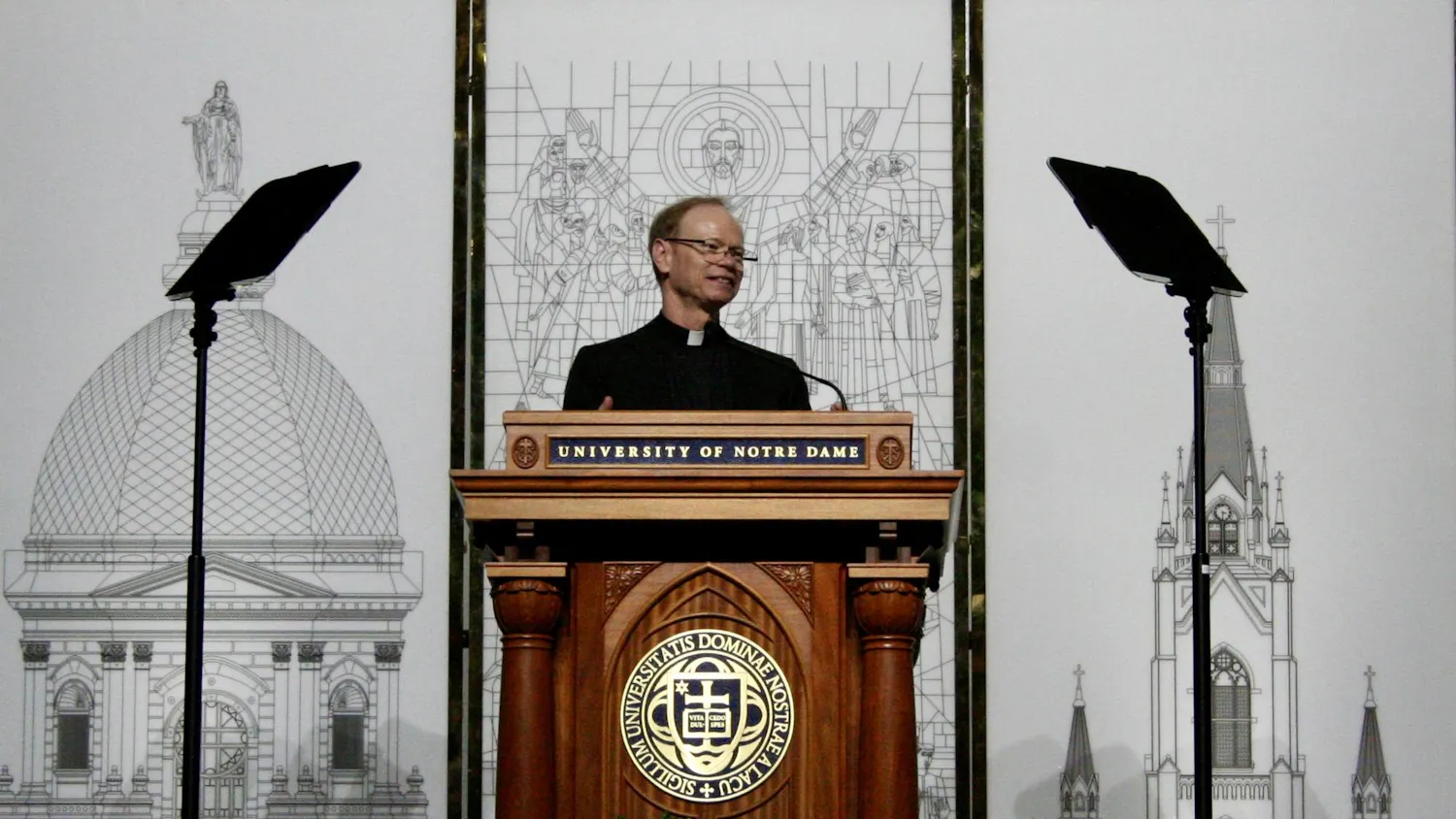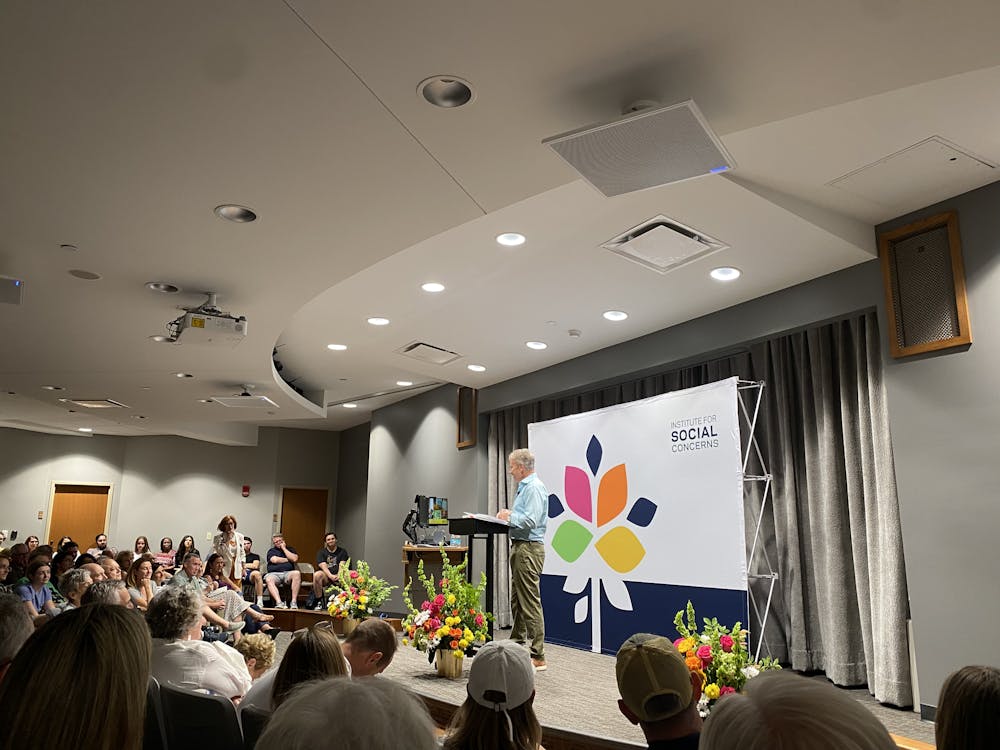
Timothy Egan, Pulitzer Prize-winning reporter and author, said it had been one of his dreams to come to the University of Notre Dame.
“I grew up in Spokane, Washington, and like a lot of kids, my dream in life, and I truly thought it was going to happen, was to play football for Notre Dame,” Egan said to an eruption of laughter across Andrews Auditorium in Geddes Hall.
Although not a football player, Egan’s wish became a reality on Friday evening when he visited the campus as speaker for the Institute for Social Concerns “MVP Fridays” lecture series. It seeks to address questions of meaning, values and purpose with talks from public intellectuals.
He is an author of 11 national award-winning books, a former New York Times reporter and has authored a New York Times bestseller, “A Fever in the Heartland: The Ku Klux Klan's Plot to Take Over America, and the Woman Who Stopped Them,” where he led his talk on.
His book centers around the Ku Klux Klan’s overtaking of Indiana in the 1920s, their “Grand Dragon” leader D.C. Stephenson and Madge Oberholtzer, who Egan identifies as the woman who finally put an end to the terror.
The true object of his book, Egan said, was to determine “how ordinary people can learn to hate their fellow citizens.”
“The clan of Indiana was not a bunch of hicks and brutes as they’re characterized now, right?” Egan said. “They were coaches, they were bankers, they were teachers, they were cops, they were judges, they were people who held their community together.”
While investigating his core question of how good people learn to hate in this way, Egan focused on Stephenson and how he bribed Methodist churches and manipulated “americanisms” to popularize the Klan agenda and weave the group into the very fiber of everyday society.
“There was a Klan baseball team that traveled the state with a KKK written over their woolen uniforms. There were lemonade stands,” Egan said, demonstrating the normality of their presence.
According to Egan, the Klan did everything it could to isolate their enemies. Even prohibition was a Klan initiative aimed at preventing their Irish Catholic enemies from meeting in their sacred places: bars and taverns.
“Stephenson famously said to anyone who would listen, 'I am the law. Not your constitution, not your state rules, I am the law,’” Egan stated. “And he acted that way.”
The rivalry between the Klan and the Catholic Church was a main point of discussion in his talk, and he read a chapter from his book about a specific incident between the Klan and Notre Dame students in 1924.
“D.C. Stephenson decided to make a move on Notre Dame,” Egan said. “He called for a three-stage show of Klan strength in South Bend in the spring of 1924. The Grand Dragon felt it was vital to crush the remaining pockets of resistance.”
Egan said that Fr. Matthew Walsh, the University President at the time, had told the kids not to leave campus during the rally and to stay safe within their dorms.
“But Catholics had put up with years of abuse,” Egan said. “They’d been called un-American. They’ve been told they didn’t belong in this country and they’ve been told they didn’t belong in the state of Indiana.”
When the KKK demonstration commenced, a storm of Notre Dame students cut through the crowd and chased them into their town headquarters, which was decorated by a large cross studded with light bulbs.
“The students purchased two bushels of potatoes as weapons. They threw the spuds at the window, trying to break the glass or to put out the lights of the Klan symbol,” Egan said. “It was said by those in the crowd that Notre Dame’s star quarterback, one of the vaunted four horsemen, lobbed a perfect strike of a potato upward, scoring a direct hit on the bulbs that lit up.”
Egan claimed the victorious moment for the Irish Catholics against Stephenson’s hateful mob is how Notre Dame gained its name, the “Fighting Irish."
Nonetheless, the University’s student potato ambush was not the end of the KKK’s terror across Indiana. Egan said the death knell for the organization came in the aftermath of an incident with Madge Oberholtzer, who was raped and murdered by Stephenson. For 24 days, she lingered on her death bed.
“Before she dies, she decides to do something that no other victim (of Stephenson’s) had done,” Egan said. “She writes out a 10-page death bed declaration.”
The crime committed was so atrocious that “Stephenson’s state” could not overlook it.
“Madge’s words beyond the grave brought this guy down,” Egan said. “People saw the depravity of this man. The curtain was pulled back and they see this monster.”
Egan said that following this incident, the Klan pretty much fell apart after that.
“This is an important story, and there's a great debate we’re having right now,” Egan said. “Do we tell the American narratives that don’t cast the best light on us? Well, I could cite one of my heroes, Abraham Lincoln, who said, ‘you cannot escape history.’”
The talk concluded on a note of reflection about the role of Catholics in America today, in response to the years of oppression they experienced at the hands of groups like the KKK.
“As Catholics, we should not forget what we came for,” Egan said.