
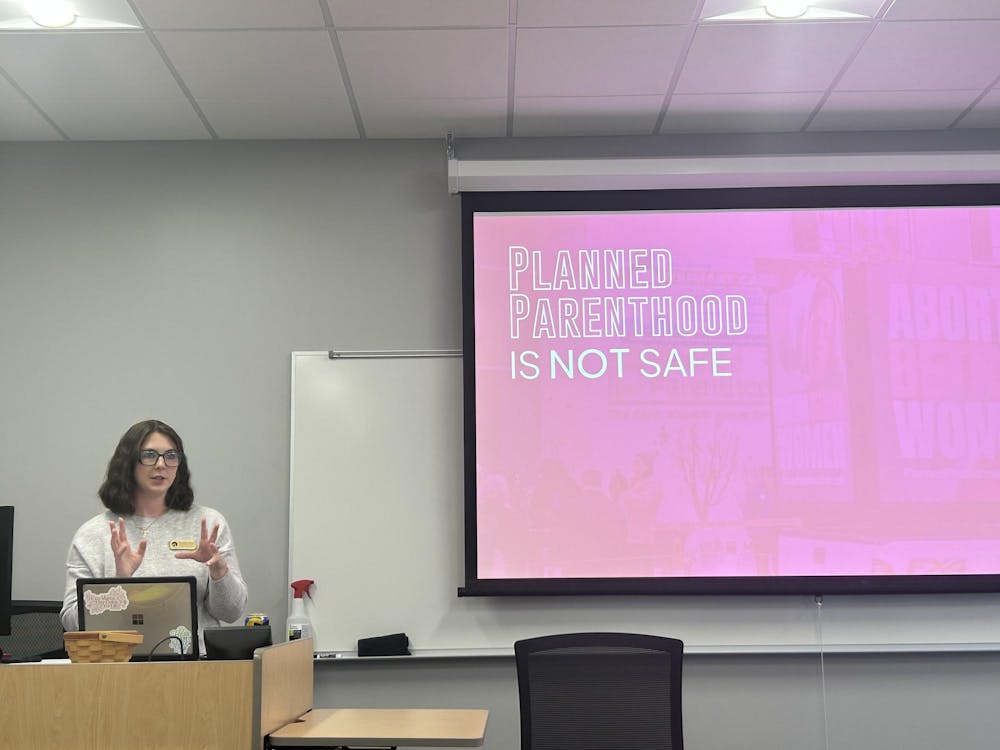
On Tuesday, Saint Mary’s anti-abortion organization, Belles for Life, hosted anti-abortion activist Maddie Green for a lecture titled “Planned Parenthood’s Abortion Business.” The lecture aimed to share information about the company’s inner workings, while also discussing alternatives to Planned Parenthood for obstetric and gynecologic care. The leaders of Belles for Life hoped the lecture would be a source of education for the Saint Mary’s community.
Green has been an anti-abortion activist for some time. She said that working against Planned Parenthood has been a huge part of her work.
“I got involved in the pro-life movement was by being a sidewalk advocate in front of Planned Parenthood,” Green said. ”Being a sidewalk advocate in Indiana in front of a Planned Parenthood is very unique, because you guys might know abortion isn’t actually fully legal here.”
Abortion is a prevalent topic in today’s political landscape. According to the Pew Research Center, public opinion on the subject has fluctuated throughout the last 30 years. According to recent polling, about 63% of Americans believe it should be legalized in all or most cases while 36% stand against its legalization in all or most cases.
“Abortion is never the best or a good option for women in crisis, and Planned Parenthood really capitalizes on that, making money off these poor women who don’t know their options,” Lydia Poe, pregnancy outreach and education chair for the club, said.
The issue holds a complex place in American society. Anti-abortion activists believe that the unborn have a right to be born through a “human right to life”, as reported by the Americans United for Life mission statement. On the other side, abortion-rights rhetoric is built on the idea of bodily autonomy for women, as stated in EBSCO.
Green said that the abortion debate was extremely relevant at Saint Mary’s, despite the College’s Catholic character.
“Just because you’re at a religious school or a private school doesn’t mean abortion isn’t still affecting this campus and this university,” Green said.
Jayda Millspaugh, the spirituality director of Belles for Life, said she thinks some women feel like the anti-abortion movement doesn’t take concerns of bodily autonomy into account.
“I think that the hatred that [women] feel is normally from the misunderstanding and the lack of education that they have about the pro-life movement,“ Millspaugh said. “So I really hope that … they come to know the resources that we offer and the love that we have for them.”
Planned Parenthood has long been entrenched in the battle between the pro-life and pro-choice movement. It takes on political battles with its activism branch, Planned Parenthood Action. Meanwhile, Planned Parenthood clinics provide reproductive care services, with the goal of serving all people, regardless of social status. Its mission statement includes “advocation for public policies that protect and expand reproductive rights and access to a full range of sexual and reproductive health care services, including abortion.”
Planned Parenthood offers many services, including manual breast exams, birth control, UTI inspections, STD testing and treatment, PAP/HPV testing, pelvic exams, colonoscopies, well-woman exams, hormone treatments and abortions.
According to their 2023-2024 annual report, abortions make up about 4% of its total services. 97% of services provided to pregnant women, though, are abortions, Green said.
“[Planned Parenthood is] America’s number one abortion vendor. So you know, when we talk about abortion, especially as pro-lifers, I think a lot of us just automatically think of Planned Parenthood,” Green said.
One of the greatest arguments for Planned Parenthood, Green said, is that minority communities would lose access to valuable reproductive resources without it. According to the report, the non-profit serves 2.08 million patients, including many members of underserved communities. In contrast, Green explained throughout her lecture that these facilities are not the most important clinic or resource for pregnant women or underprivileged communities.
“Federally Qualified Health Centers are all across the nation, and there’s way more, thousands more of them than there are Planned Parenthoods,“ Green said. “They’re for low-income [communities]. They’re on a sliding fee scale.”
Federally Qualified Health Centers are able to provide more services than Planned Parenthood, including preventative health services such as cancer screenings, dental services, mental health and substance abuse services, transportation services to facilities and hospital and specialty care, according to FQHC Associates. A large variety of resources exist for women in need of reproductive care and families that may not have access to traditional medical services.
The centers are available to underserved communities and individuals who qualify for assistance under Section 330 of the Public Health Service Act, according to the Health Resources and Services Administration. These health centers serve 30 million people, Green said.
“If every single [Planned Parenthood] closed tomorrow, [Federally Qualified Health Centers] would only need to take on approximately two new patients a week to absorb clients at each clinic … to absorb Planned Parenthood’s clients” Green said.
Poe said Belles for Life hopes conferences like this one are able to spread that message to the Saint Mary’s community.
“[It’s] really important for us to let Saint Mary's Belles know that they have options,“ Poe said. “Having a baby is a beautiful gift, and though it will change your life, it will be a good change. And we want to be able to get those women those resources that they need and create resources that they don't have yet.”


