
The U.S. federal government officially shut down last week after Congress failed to reach a budget agreement to fund operations for the fiscal year. Triggered by disputes over the status of government healthcare subsidies, the impasse marks the first government shutdown since 2018.
During a shutdown, funding for all “non-essential” government functions is suspended until an appropriations bill is approved. As a result, many services at National Parks, payments to certain federal employees and — notably for universities such as Notre Dame — grants for new research projects are temporarily paused.
However, as professor Geoffrey Layman, chair of the Notre Dame political science department, explained, not all parts of the government cease to operate during a shutdown.
“Essential things like the U.S. military, they’re still running. The president and the White House staff are still working. Some essential government offices are running, and they make federal civil servants who work in those offices work without pay,” he said. “If you are somebody who is dependent on a check from the federal government, it may be a hardship for you, but it’s not like the interstate highway system is going to close down. It’s not like if we’re attacked by a foreign power, we won’t respond.”
Although essential government functions continue during a shutdown, these budgetary crises remain disruptive. According to James Curry, a political science professor, the longer a shutdown drags on, the more its effects will be felt, especially among “non-essential” federal workers whose paychecks are delayed as a result of the budgetary crisis. Over time, this can inhibit the efficiency of the federal government.
“It feels no different for the first couple of weeks. If you’re a federal employee, you’re not getting paid. But then, when the next payday shows up and there’s no pay stub, you may not go to work,” Curry said. “So really, the practical effects start to get felt as the money isn’t there after one week, two weeks, three weeks, four weeks. It’s a slow rollout, which is why most federal shutdowns have been less than five days.”
As of Oct. 10, the shutdown will have entered its tenth day. Republicans hope to pass a continuing budget resolution, while Democrats have raised concerns about expiring Affordable Care Act tax credits for health insurance and are pushing to reverse cuts to Medicaid. Though a compromise appears unlikely for now, political science professor and director of the Notre Dame Democracy Initiative David Campbell warned that both parties face political costs due to the standoff, but expressed some uncertainty over which will feel greater pressure to resume negotiations.
“The polling suggests that … by a slight margin, the public is more inclined to blame the Republicans than the Democrats. But I don’t want to overstate that, because the difference is not enormous,” he said. “The longer this goes on, the harder it is, frankly, for both parties to carry it on … Think of it as being a strained marriage. At some point, you have to figure out how to get things right.”
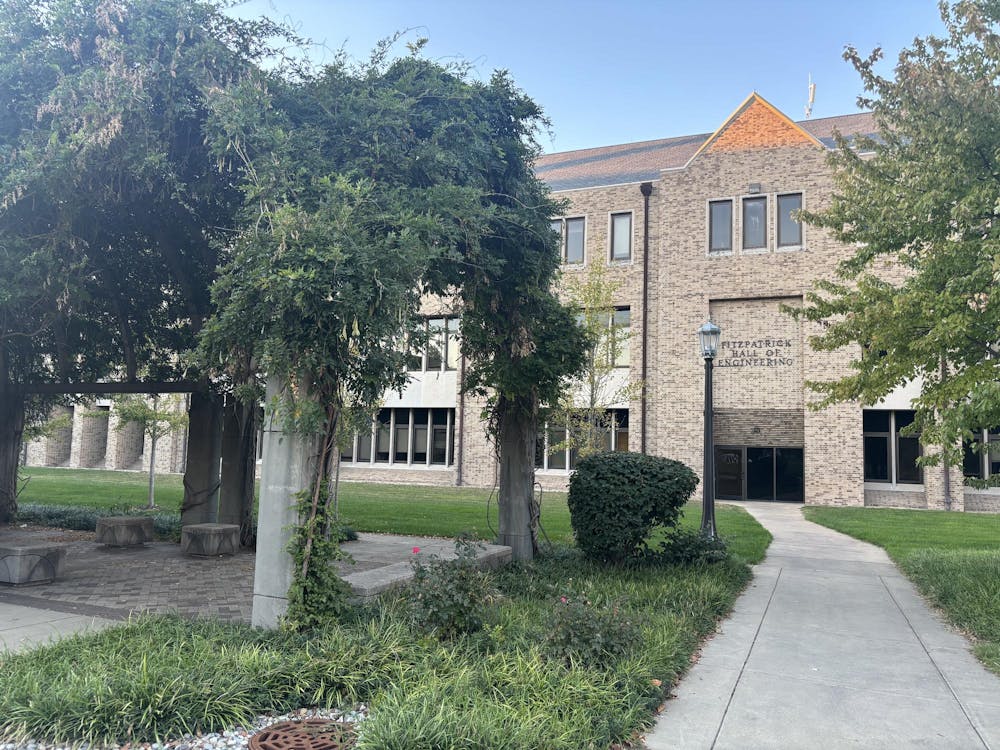
Given what has so far been a protracted dispute, Notre Dame’s administration has already begun bracing for its effects. On Monday, Oct. 6, a notice was sent to community members subscribed to Notre Dame Research emails by vice president for research Jeffrey Rhoads recommending that federally funded researchers visit their new webpage for shutdown guidance and advising them to reach out to pre-award and post-award grants managers. The University added that while research proposals can still be submitted, they will not be processed, and that no new or incremental federal funding is expected during the shutdown.
Some of the most impacted disciplines will be those in science and engineering, which are “very dependent on federal funding,” according to Campbell.
In Layman’s view, while Notre Dame has dealt with similar situations in the past, the broader cuts the University has faced in recent months change the dynamics of the current shutdown. “The difference this time is that so much federal funding has already been cut … So in some ways, my feeling is that this affects us less than it would have in the past,” he said. “On the other hand, the University has already made significant cuts, and so we may be on a razor’s edge for a lot of different projects. But my instinct is that we’re already absorbing enormous cuts in federal funding.”
In a statement to The Observer, University spokesperson Erin Blasko said Notre Dame is monitoring the shutdown.
“With respect to the government shutdown, we continue to monitor the situation in coordination with our Washington Office, and will seek to minimize its impact on our faculty, staff, and students in order to maintain continuity of support for our research activities,” Blasko wrote. “While these types of shutdowns have become common in recent decades, ongoing changes to the federal landscape add a new layer of complexity this time around. Especially during this complicated time, we stand in solidarity with our many dedicated faculty, staff, and students who continue to advance research, scholarship, and creative endeavor in support of our mission to be a ‘powerful means for doing good’ in the world.”
It is unclear how long the congressional standoff will last or what the outcome will be. Regardless of the result, the implications of a prolonged shutdown worry Campbell.
“One of the measures of whether or not a democratic system is working is whether or not the government can stay open and whether budgets can be brought in on time. The very fact that, in the United States today, we collectively have difficulty keeping the government open, keeping it funded, getting a budget done on time, that is itself a pretty telling indictment of our current political system,” he said. “This cannot continue, and as a nation, we need to figure out a better way for things to get done in Washington. This is not a left or right thing. I’m not casting aspersions on either Republicans or Democrats — or maybe I am on both together. The system itself is broken, and something needs to change.”


