For their beautifully innocent personas and coruscating vulnerability, many young actresses are dubbed ingenues at the start of their careers. This image, of course, fades as audiences grow familiar with it; an actress must succeed in proving herself more than just a Hollywood archetype to be deemed worthy of longevity on our screens. Diane Keaton, who died on Saturday at the age of 79, took every element of her conventionality and turned it on its head — while she greeted us with beloved vulnerability and sweetness, it was not the kind fragile enough to conform to industry ideals. From the start, Keaton created her own kind of femininity, relatability and humorous charm, which never had the chance to wane from our minds.
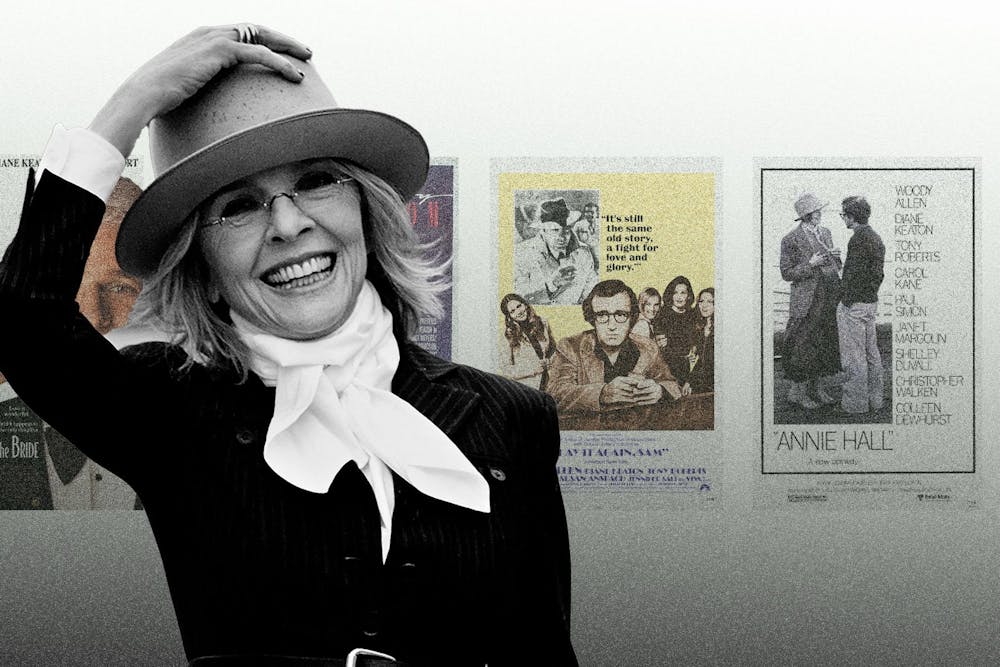
Keaton began her career on stage, most notably appearing in “Play It Again, Sam,” Woody Allen’s romantic comedy that earned her a Tony nomination and ignited a decades-long partnership with Allen. After a few films alongside him, Allen wrote his magnum opus, “Annie Hall” (1977), with Keaton in mind; the film established her quirky, wry humor and iconic androgynous style (which was greatly inspired by Katharine Hepburn). It also earned her an Academy Award. Moreover, while Keaton certainly shone in comedies — with subsequent roles in “Baby Boom” (1987), “Father of the Bride” (1991) and “Something’s Gotta Give” (2003) — she balanced her dramatic talent with appearances in films like “Reds” (1981), “Marvin’s Room” (1996) and “The Godfather” saga.
Keaton’s light never ceased to shine when standing beside other stars. In large part, this can be attributed to the unique transparency she granted each of her characters. Though also seen in the relatability of Louise in “Reds” and Erica in “Something’s Gotta Give,” her portrayal of Kay in “The Godfather” (1972) is a testament to this. Although hers may not be the first performance to come to mind when discussing Francis Ford Coppola’s masterpiece, the emotion she brought to Michael Corleone’s gentle and trusting wife was crucial to the film’s punch. In the wake of the Corleone family’s brutal morality, Kay serves as an intermediary between the audience and the family’s callous lifestyle; through Keaton’s natural sympathy and utterly expressive eyes, she serves as a reminder of Michael’s humanity. That is why the final shot (probably the most well-known of the entire saga), in which the door to Michael’s office is closed upon her, is focused on her desperate expression.
Similarly, Keaton maintained an authenticity that persistently drew audiences towards her. From the outset, Keaton seemed to understand the ingenue persona’s shallowness regarding reliance on beauty and femininity. Thus, through her roles, she honed a captivating originality and independence — sure, she possessed the standard loveliness of a romantic lead, but she was never held down by the man playing opposite her. Take, for example, stories like “Something’s Gotta Give,” which, in a rare case, placed an older woman at the forefront of a romantic comedy. The lines on Keaton’s face did not matter; the film worked because she brought her authenticity to the project, as she always had. In whatever she did throughout her career, she held on to elements of the genuine, alluring oddball that we initially met in “Annie Hall,” and did not need any help from others when it came to channeling that genuine nature.
Diane Keaton will often be referred to as the monumental actress, director and author, notable for films like “Annie Hall” and “Reds.” Yet, it is hard to distill the work of someone who was so nonconformist; Keaton paved the way for a new kind of femininity — one that unapologetically favors humor and emotionality over glamour, despite Keaton herself being undisputedly beautiful. She was one of those unique actresses able to command both comedy and tragedy, reflecting the hearts and minds of her audience.