
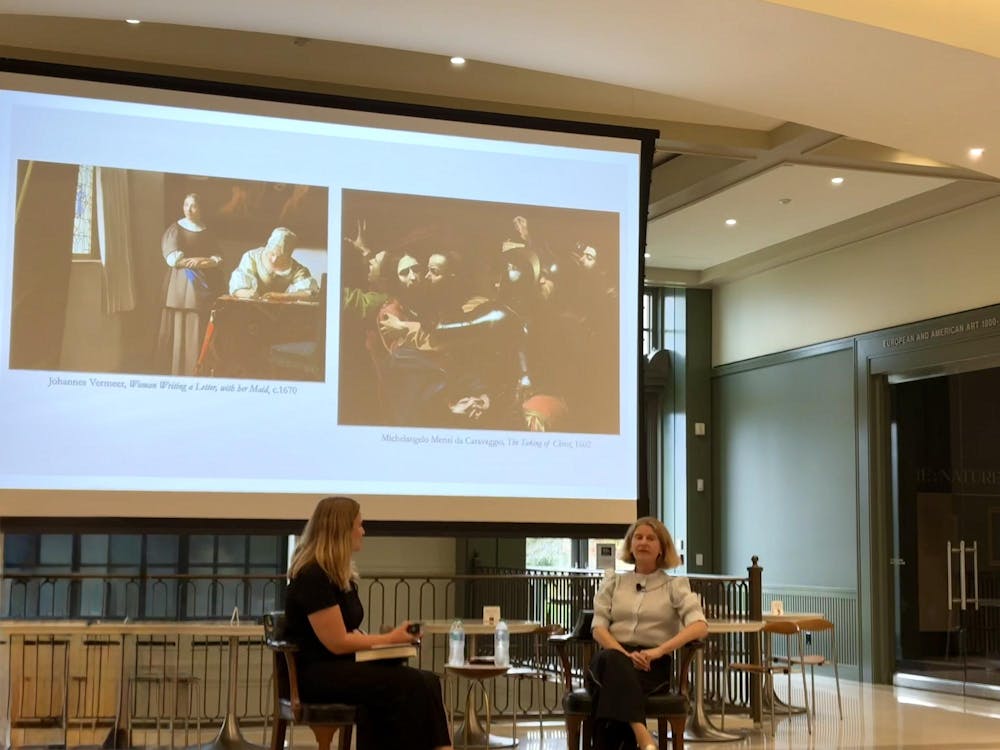
On Wednesday evening, director of the National Gallery of Ireland Caroline Campbell visited Notre Dame’s Raclin Murphy Museum for a conversation with postdoctoral research associate Dr. Judith Stapleton.
Campbell has held this role since November of 2022. Born and raised in Belfast, Campbell studied modern art at University College Oxford and earned an MA and PhD from the Courtauld Institute of Art in London. Previously, she worked as director of collections and research at the Nation Gallery, London. She has also published writings on European art from the Middle Ages to the mid-20th century, and she recently released a new book, “The Power of Art.”
She began the conversation, which was hosted by the Keough-Naughton Institute for Irish Studies, by describing the collections of the National Gallery of Ireland. “It’s the only place in the world where you can see Irish art from the 1600s to the 21st century with objects of the highest quality,” Campbell said.
She discussed how the gallery was founded in 1854 in the wake of the Irish Potato Famine as an effort to rebuild Irish culture and recover from the financially and politically traumatic crisis. Last year, Campbell said, the gallery saw over 1 million visitors.
Campbell then detailed what she believes are two of the most important pieces in the gallery, Johannes Vermeer’s “Woman Writing a Letter, with Her Maid” (1670) and Michelangelo Merisi da Caravaggio’s “The Taking of Christ” (1602), pictured above. “‘The Taking of the Christ’ is made famous because of the moment of drama that is depicted here. What I love is Christ himself’s resignation on his face, as well as Caravaggio himself, who has popped up here holding the lantern,” Campbell said.
She emphasized that the details and emotions in the image, which are similarly reflected in “Woman Writing a Letter, with her Maid,” make both paintings significant to the gallery, as both of them work to make the viewer enter into that experience.
Campbell went on to describe upcoming plans for renovation of the gallery. In 2017, the gallery was reopened after major refurbishments, and in 2027, they plan to expand by adding a new building which will serve as a learning and conservation center. “Before we complete these renovations, we are reconsidering the collection at the 10th year of the refurbishments, giving us the opportunity to really think about how we present our collections,” Campbell said.
Campbell noted the gaps in the gallery’s collections. The gallery is currently focusing on obtaining more 20th-century pieces. Campbell believes they need a strong collection in order to be revered as a central visualization of Irish history.
When asked about how the gallery has such a robust acquisition profile, Campbell shared that the gallery recently acquired two new pieces, Jack B. Yeats’ “Singing ‘The Dark Rosaleen’” (1921) and Roderic O’Connor’s “Flower, Bottle, and Two Jugs” (1892). “Jack B. Yeats would be the Irish artist who people most know, and in Dublin, he is the artist who people swim up the River Liffey for every autumn,” Campbell said. Swimming in the river commemorates Yeats’ painting “The Liffey Swim.”
The conversation then shifted to a discussion of Campbell’s personal accomplishments. Campbell is the first female director of the National Gallery of Ireland.
One of her primary messages to the audience was that art can serve as a space where important conversations can take place. She believes in the importance of sharing knowledge, expertise and identities in the context of art, especially as a woman who was raised in Northern Ireland during a politically turbulent era.
“As somebody who grew up in Northern Ireland and lived through The Troubles, I am a great respecter of people’s personal points of view and people’s differences, but I think understanding others and thinking about them in the context of your own life is what we really need to do,” Campbell said.


