There is a stigma that animation is merely meant for children. If you happen to agree with this belief, I urge you to watch “Grave of the Fireflies.”
Directed by Isao Takahata, “Grave of the Fireflies” is a 1988 Japanese animated war film produced by Studio Ghibli. It was screened at the DeBartolo Performing Arts Center on Oct. 2 as part of the “Learning Beyond the Classics: Voicing Intergenerational Trauma in Postwar Korea and Japan through Contemporary Cinema” program.
Studio Ghibli’s portfolio includes beloved films such as “Howl’s Moving Castle,” “Spirited Away” and “My Neighbor Totoro.” Yet, unlike these works, which embrace fantasy and spiritualism, “Grave of the Fireflies” remains unflinchingly grounded in human suffering during war.
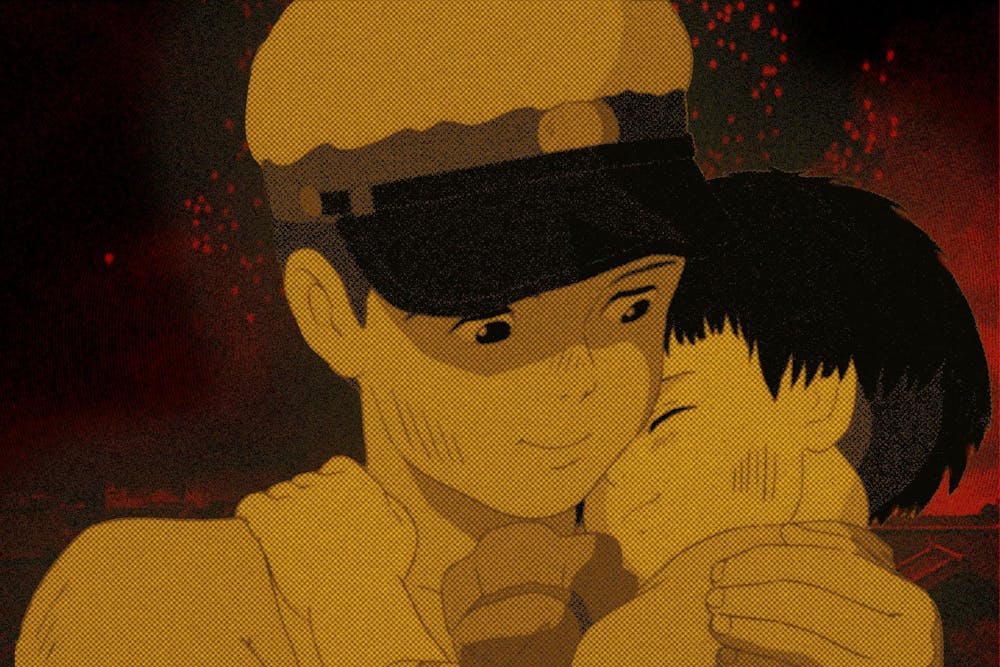
The film centers on Seita, 14, and his toddler sister, Setsuko, children of an Imperial Japanese navy captain. When American bombers devastate their city during the days of the Pacific War, the pair are orphaned and thrust into a brutal new reality. We follow their desperate struggle to survive as helpless civilians trapped within war.
The animation itself becomes a devastating contradiction: The signature beauty of Studio Ghibli is seen through the film’s meticulous attention to light filtering through trees and the delicate rendering of fireflies dancing in summer darkness. However, we learn that such scenes serve to heighten rather than soften the tragedy. These moments of breathtaking artistry make the horror more visceral. We watch young Setsuko play innocently with fireflies, creating temporary magic in the abandoned shelter she and her brother call home, unaware of the grim symbolism these creatures will later represent.
Unlike the sweeping orchestral scores that often accompany other Studio Ghibli films, “Grave of the Fireflies” uses sound as a weapon of emotional restraint. The first half of the film unfolds in haunting silence, broken by the cries of children and echoing with unbearable clarity. The silence that dominates many scenes is not empty but weighted with absence as though the very air has been robbed of joy, music and the rhythm of everyday life. When music does surface, it mimics the wail of air raid sirens, forcing audiences to confront the unvarnished horror war inflicted upon the innocent. This also amplifies the innocence of Setsuko through highlighting her laughter, humming or cries as the “musical” moments of the film. This contrasts heavily against the oppressive stillness of the world around her. Takahata reframes her voice as the true score of the film, emphasizing a reminder that war impacts human life of the innocents.
Director Takahata has resisted labeling the film as anti-war, arguing that his true focus lay in exploring the stubbornness and pride of Seita rather than issuing a direct condemnation of war.
Yet, from my perspective as a viewer, I find it difficult to separate the film from its war-torn setting. The devastation of conflict is not just a backdrop, but a force that shapes the tragedy Seita and Setsuko endure. Their hunger, isolation and ultimate decline are inseparable from the collapse of society brought on by war. The film emphasizes the impact that war has over the lives of the powerless and innocent.
“Grave of the Fireflies” demonstrates the profound capacity of animation to be able to capture the rawest dimensions of human suffering. It delivers a sobering reminder of how war devastates not only nations but the most vulnerable lives within them. Whether one interprets it as a meditation on pride or an implicit anti-war statement, its power lies in forcing us to confront uncomfortable truths about loss, survival and the human cost of conflict.
Such themes remain profoundly relevant today, as I reflect on nations in the midst of war and recognize that, time and time again, it is innocent families and children who bear the heaviest burden.
To diminish animation as a childish art form is to overlook works such as these: works that deserve to be remembered, not only as cinema, but also as testimony.