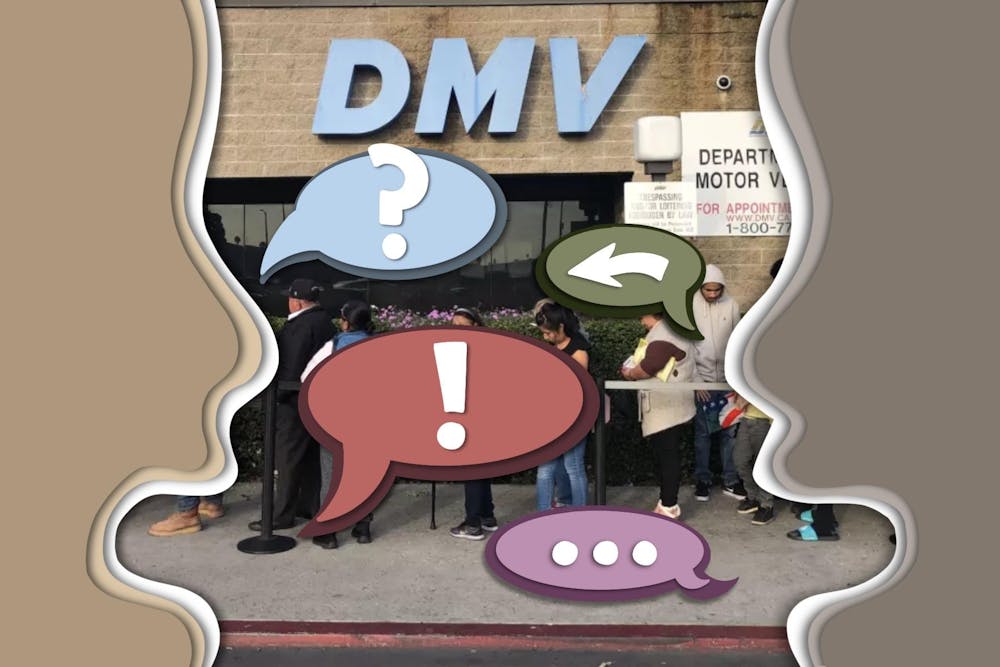
Recently, Joe Rudolph published an Observer article titled “The DMV: Humanity’s greatest crime against itself”. In his article, Rudolph unleashes a hazardous tirade of unsubstantiated claims against the Department of Motor Vehicles. He claims that the DMV is not just a bureaucratic office that supports a vital aspect of American society and commerce but rather a shadowy syndicate hellbent on manipulating human behavior and reshaping civilization through regulation and fear.
On the one hand, it is not productive at all to publish a satirical article of this nature at such an important inflection point in this country’s history. There are so many other more relevant, better arguments to make in terms of public discourse, such as political opinion articles. On the other hand, Rudolph does not provide any evidence at all to support his claims. He could have made his argument at least 1% (rather than 0%) convincing if he offered statistics or references from mainstream news outlets. Moreover, this article will serve as an evaluation of the claims of Rudolph and suggest that the DMV is not as maligned as Rudolph suggests.
Rudolph’s first claim is that the DMV is waging a war on masculinity by banning loud engines, strong handshakes and facial hair. On one level, it is no longer appropriate or applicable to map these so-called traditionally masculine things onto what constitutes masculinity now. What it means to be a man is largely governed by social norms, which continue to change throughout history. Not every man wishes to be attached to these traditionally masculine qualities and things, and they are completely within their right to do so. Moreover, there is clearly public order and decorum considerations that motivate these DMV policies — this is something Rudolph overlooks.
His next move is to suggest that the non-housed population is being weaponized as agents of control to suppress dissent. This is absolutely absurd. This sort of rhetoric further reinforces negative stereotypes on a marginalized group of people. There is nothing in this statement that shows solidarity or a preferential treatment for the poor, which our Catholic faith informs us to express.
Rudolph, even in other articles, touts himself as a massive proponent of alcohol. He defends alcohol culture and its benefits of joy, rebellion and camaraderie, which the DMV allegedly seeks to eliminate. Science informs us that alcohol is categorically unhealthy and toxic to the human body. Personal experience informs me that alcohol leads to reckless behavior and dangerous situations. Our Catholic faith places God as the central source of joy and happiness in the human heart, and it would be sinful for us to allow alcohol to become a golden calf, guaranteeing us a false, temporal sense of joy.
There is an argument about how child leashing laws are aimed at producing obedient citizens. Implicitly, Rudolph is partial to what, in my opinion, can be called a Catholic revolutionary spirit. Again and again, he opposes authority and supports the destruction of order and reason, the logos, of a society by misusing his religion to justify his arguments. There is nothing wrong with obedience among citizens; this is what leads to social cohesion and a happier society.
Finally, Rudolph makes the most ridiculous claim thus far by arguing that the DMV falsely imprisons. This is so categorically untrue that it is not worth my time to rebut.
Overall, Rudolph concludes his piece with a fiery condemnation of the DMV as a bureaucratic plague that seeks not just control, but total cultural annihilation, erasing beauty, courage and freedom through regulation and fear. I appreciate his hyperbolic, comedic language; it is amusing, at times. But Rudolph seems to make the case through the course of his argument that the DMV could be a metaphor for authoritarian overreach. That is to say, one could switch the word DMV out for another three-letter agency and the argument would stand. This is simply unfounded, untrue and unoriginal. Not everything is done in malice. Could these misunderstandings just be a case of occasional incompetence by the DMV, rather than malice?
My plea to Rudolph is to be more charitable and open to other organizations, ideas and people. It is not productive to be the anarchist herald, who spouts out misinformation, disinformation and malinformation. The world needs more productive social and political discourse that is marked by competence, poise and good intention. I encourage my audience to do as I have done: to call out dangerous, false ideas and confront them with calculated speech.
Jonah Tran is a senior at Notre Dame studying finance and classics. He prides himself on sarcasm and never surrendering. You can file complaints to Jonah by email at jtran5@nd.edu.