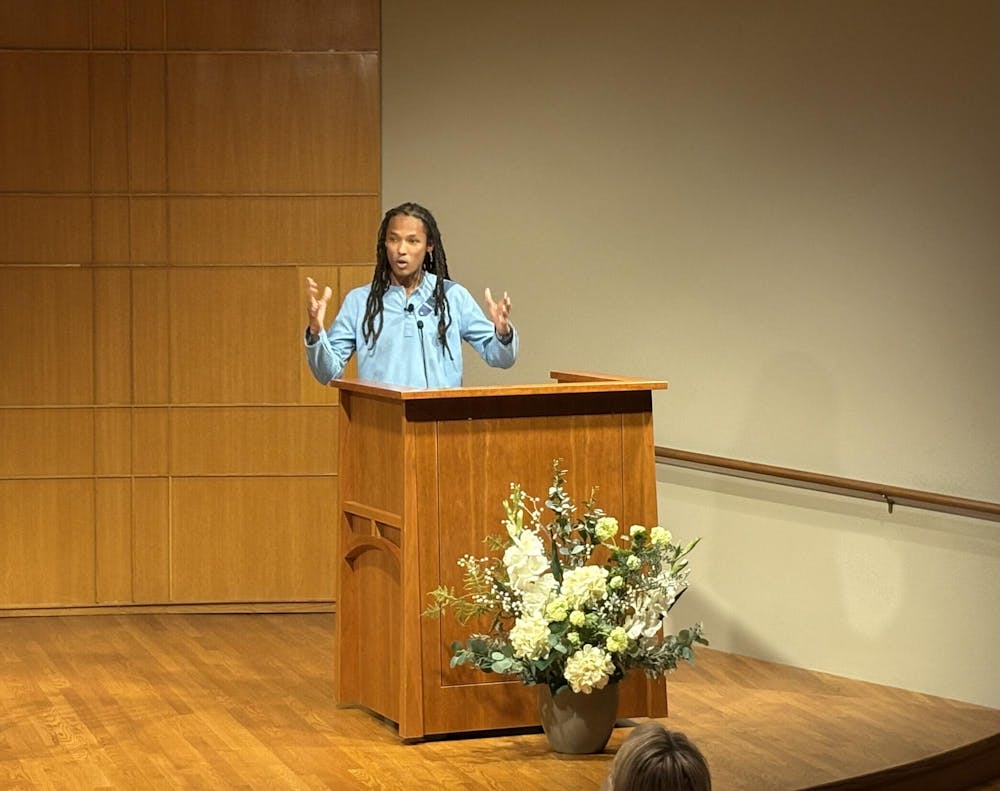
On Thursday afternoon, the Klau Institute for Civil and Human Rights hosted New York Times Johannesburg bureau chief John Eligon to speak on the racial situation of South Africa post-apartheid. Coincidentally, the pre-planned lecture was given on the same day that President Donald Trump announced a 7,500-person refugee admissions quota, emphasizing that Afrikaners and white Dutch descendants living in South Africa, will receive priority.
In his work at the New York Times, Eligon has covered race and political upheaval in post-apartheid South Africa.
Accepting Afrikaner refugees has long been of interest to the Trump administration. “A group of 59 white Afrikaners who have been given refugee status by the Trump administration arrived at Dulles airport outside Washington, D.C., on Monday on a charter flight paid for by the U.S. government,” NPR reported on May 12. “The South Africans will now have a pathway to U.S. citizenship and be eligible for government benefits.”
Eligon said, “This executive order said again that Afrikaners were the victims of racial persecution and that Trump was creating a special pathway for them to get refugee status in the US. This sort of blew me away, because we had seen from the first day of this administration, Trump had put on pause all sorts of refugee admissions of the country.”
Eligon went on to explain that this support for Afrikaners is potentially misplaced, as he says race is not a determining factor in who is struggling in South Africa.
“After 1994 when democracy began, it really fashioned itself as being this rainbow nation, this nation where people of all races live alongside each other. There is a very big emphasis when you are here among people to say that we are non racial,” Eligon said. ”We do not think about each other in those terms, because during apartheid, race was something that was put on your identity documents. It was used to define who you are.”
Eligon also spoke on how apartheid affected the nation after its dissolution 30 years prior.
“People say the rhetoric is that we want to move past that, but the reality is that the legacy of apartheid and the racial classification system is still very much baked into the reality of life in South Africa.”
Instead of race, Eligon suggests that economics is the encompassing factor of who is worst off, describing harrowing conditions of townships with violence in rural and urban communities.
“Trauma does not discriminate based on wealth. I think that is something South Africans in these rural communities actually understand,” Eligon said.
Eligon went on to add that the stories that are being shared are coming from those in power, potentially sharing a warped view of the struggle.
He agreed with Trump that land disputes are a major factor, but that it really boils down to wealth. This is because the efforts the government is presently designed to redistribute land have provided impoverished people with property, but without resources needed to cultivate such land rendering it practically useless.
When asked in the Q&A section about how to resolve the land disputes, Eligon posed the questions that must be answered to move forward productively.
“How can you do it in a way that does not kill South Africa’ s chance of benefiting off of this land now and you do not kill the agricultural industry?” Eligon asked.