
This year, Notre Dame’s McDonald Center for Student Well-Being launched its pilot Peer Listening Program. The program, funded by a SAMHSA (Substance Abuse and Mental Health Services Administration) grant for three years, aims to provide peer-to-peer support for students in a confidential and non-judgmental space, offered by trained student listeners.
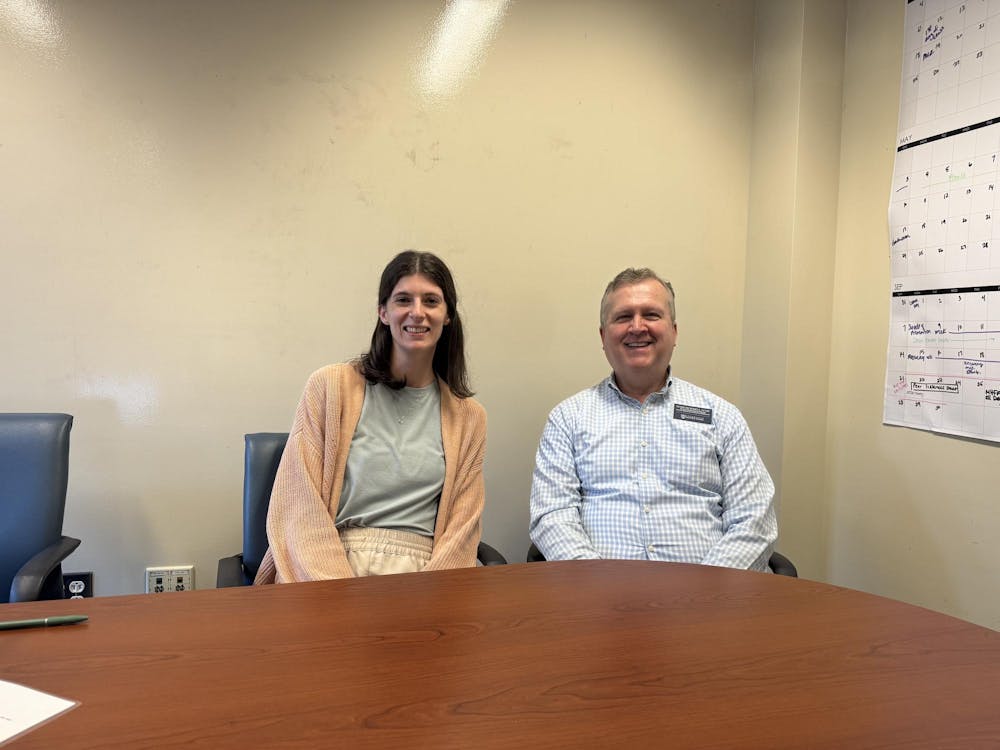
Program directors Camille McDonald, assistant director for student leadership and community engagement at the McDonald Center and Mark Hummell, a behavioral health clinical case manager with the University Counseling Center (UCC), talked about the creation of the pilot program.
Hummell explained that after the University received the SAMHSA grant, administrators at the UCC looked at students’ screenings from University Health Services, along with similar programs at other institutions such as Johns Hopkins University, Duke University and the University of Michigan, to determine what type of program would be a good fit to pilot at Notre Dame. This ultimately led to the creation of the pilot Peer Listening Program for undergraduate students, with a cohort of nine student listeners.
McDonald said that the program has three main goals: “listen, validate and refer.”
Elaborating upon these goals, she said, “We really want these student leaders to just be someone that can listen to these students, whether they have any complaints, whether they are upset or excited about something … and then validate their concerns [to] make sure they feel like they’re heard.” She added that peer listeners might refer students to further resources.
She also emphasized the preparedness of the student listeners. She said, “Our peer listeners are really knowledgeable about the various campus resources. We really focused on that in our training.” She specifically mentioned that the peer listeners are aware of the University Counseling Center, University Health Services, Multicultural Student Programs and Services, The Gender Relations Center, and the Center for Student Support and Care.
McDonald made the distinction that the student peer listeners are not counselors or members of the University Counseling Center since they don’t have the corresponding training or education. However, she said, “There’s an advantage to having peer-to-peer support, because, you know, sometimes it’s a little harder to talk to someone that’s maybe older than you, or in a different position than you, like a therapist. So we really want to emphasize the peer-to-peer aspect and having that kind of more like horizontal relationship, rather than the authority that might come with a counselor.”
When talking about the application and selection process, Hummell said, “We were so overwhelmed with applications, we actually had to stop them.”
Hummell said they wanted a diverse group of students for their first cohort from different majors, ethnicities, genders and grades, among other categories. He added that they were also looking for students who had “an empathetic listening ear.”
The peer listeners are available for drop-in appointments on Mondays, Tuesdays and Wednesdays every week from 7:30 p.m. to 9:30 p.m. in Duncan Student Center room 582.
Both McDonald and Hummell expressed their hopes of growing the program, possibly by increasing the number of student listeners and adding more days to the peer listening schedule.
Sophomore Riley Clavi, a psychology and sociology major on the women’s rowing team, is one of the nine students in the pilot peer listener cohort.
Clavi shared that she applied to become a peer listener after Joshua Diehl, director of undergraduate studies for the psychology department, emailed her about the opportunity.
Discussing the peer listeners’ responsibilities, Clavi said, “I think our number one responsibility is making sure that students are heard. We’re here to listen in a private and nonjudgmental space.”
Clavi described the position as being practice for her future career as a psychologist, but more importantly as a way to be a force for good.
She said, “It’s a part of the Notre Dame mission statement to uphold and be a force for good. I think that this job is a perfect example of that. It’s students helping out other students and saying … we are a Notre Dame family, I have your back. It is just a perk that it’s practice for my future career.”
Additionally, Clavi gave a shout-out to the rest of the peer listener team, saying “I think that we truly have nine of the most kindhearted and supportive individuals. We love each other so much as a team and it just shows. We love our Notre Dame brothers and sisters just as much.”


