
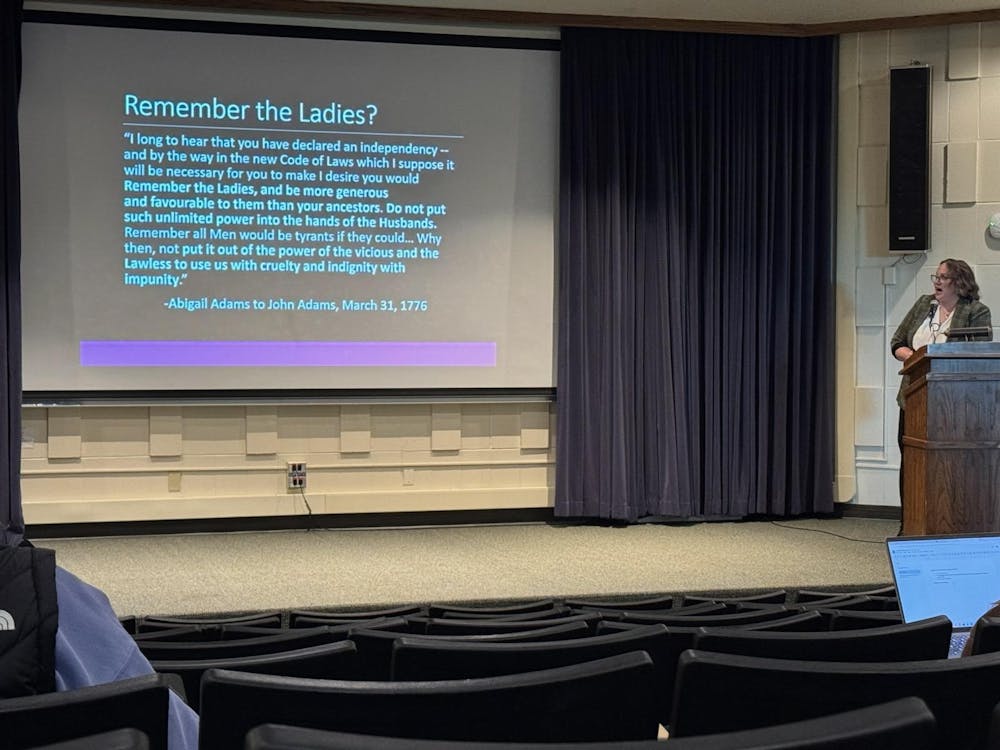
On Monday evening, senior research fellow Jayme Lemke from the Mercatus Center at George Mason University spoke in Carroll Auditorium in Madeleva Hall. Lemke’s lecture, titled “The Struggles for Women’s Independence in the Land of the Free,” considered the historical evolution of women’s rights in the United States.
At George Mason University, Lemke specializes in public choice economics, constitutional political economy and the political economy of women’s rights. She has also researched topics such as public choice and institutional theory as applied to policing, higher education and other local public services.
To begin the lecture, Lemke discussed the impact of the American Revolution on women’s freedom by reciting Abigail Adams’ well-known letter to her husband, John Adams, about "remembering the ladies” and the legal concept of coverture.
Lemke defines coverture as the “idea that women are just completely under the domain of the household patriarch.” This was true during the revolutionary period, when women could not independently own land, businesses, homes or sign contracts because of a lack of legal personhood.
With the progression of women’s rights in the 1900s, more women were able to hold jobs, independently own land and run their own business “with some remaining vestiges of coverture,” allowing young women to move away from farm fields to then go and work in textile mills and the industry.
This shift created “options to move to the city, to interact with people who came from around the country and to start having conversations with other young, ambitious women,” Lemke said.
Lemke implied women’s long hours in factories helped with the evolution of women’s rights by creating a necessity for financial security, and consequently, bank accounts for the income they earned. Although women couldn't "be doctors or lawyers yet," they could "use these funds to but they use these funds to put their brother into medical school or law school and to move their family out of agrarian subsistence,” Lemke explained.
In addition to factory work, Lemke discussed the impact and rise of women’s clubs and the significant role that they played in social reform movements.
“Throughout the 19th century, women voluntarily came together and formed organizations to provide education, schools to teach low-income women, the three Rs (reading, writing, arithmetic), needlework, good conduct and morals, and they also trained teachers and came up with the idea of kindergarten.”
Women’s associations also helped keep women in college, specifically during the Jim Crow era, when universities “forbade Black students from residing in the dormitory, so the local women’s association found housing for all students on their own to make sure that the women could still get an education,” Lemke said.
She underscored that understanding these historical transitions helps women learn from the past and make progress today.
To conclude her lecture, Lemke emphasized that women’s advancement has come a long way. She stated that the goal of the women’s movement is to eliminate hierarchy, not to replace it.


