
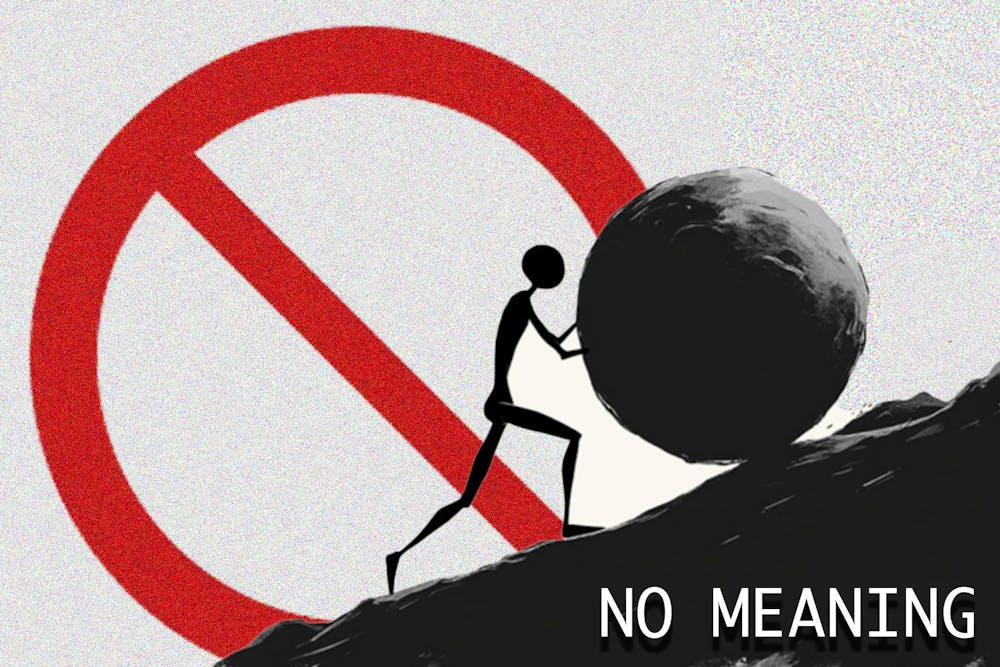
1. The meaning of life is not something we can create for ourselves.
In a culture which struggles to find the meaning of life baked into the world, it is fashionable to say that the meaning of life is something that we can create. I can hardly blame us: The alternative — that the world neither hands us meaning nor can we create it for ourselves — is much worse and, frankly, untenable. It is not possible to live without purpose. The human will acts toward an end, whether the human with the will recognizes it or not.
The existentialists among us say that existence precedes essence. In other words, we are born — we exist — without our identity handed to us, and so also without our purpose handed to us. The natural next step is to say that, even if our identity, essence or purpose is not handed to us, we can still create it for ourselves.
For some, the prospect of creating their own meaning may seem daunting; for the existentialists, who would find a meaning handed to them as overbearing, it seems thrilling. They get chills when staring into the mystery of the abyss (the void of essence or purpose), and, enthralled, they take off from their essence-less existence to fly their own flight and define their own essence. Perhaps they will find meaning in creativity, family, love or knowledge; or perhaps none of these, and that uncertainty is the thrill of it.
The trouble is that what the existentialists would call meaning is not the same as the meaning that may or may not be baked into the world. This trouble becomes apparent when trouble fills our lives. All is hunky-dory when all is hunky-dory. Frolicking around a college campus may not often test us, but what happens to our created meaning when we inevitably suffer? It crumbles; it reveals itself to be as empty as the abyss.
When we think of suffering, let us not think of a trial willingly undertaken to achieve some greater good. Do not think of a trial life has thrown upon us without our consent, which we nevertheless have good reason to believe will result in a greater good. No, think of suffering terribly and not being able to conceive of any greater good which could possibly come of the suffering. Then, it seems to me, we would not want to live at all save for a purpose outside ourselves. But since created meaning is within the self, suffering evaporates its enticing yet evanescent vapors.
Created meaning cannot sustain us in deep suffering, and therefore it is not meaning at all. If life is to be meaningful, then the meaning must be baked into the world.
2. There is no meaning in the journey without the destination.
It is at least as fashionable to say that the meaning of life is found in the journey, not the destination. Having reached the end of a journey, we often find ourselves unfulfilled by our sense of achievement or completion and restless to begin anew. Meanwhile, upon reflection we often realize that we were gripped with purpose at every step along the way. There is surely much purpose and joy that can and should be found while on a journey (such as life), but to dismiss the joy of arrival reveals a deficiency of joy. And if there were no destination, there would be no journey at all, only errant (and indeed meaningless) wanderings.
It is often said, with Camus, that “One must imagine Sisyphus happy.” I must confess that I cannot imagine Sisyphus happy — and, frankly, I do not believe anyone who says they can. The whole point of his punishment was to make him unhappy. His task of rolling the boulder is meaningless because it has no destination and bears no fruit. If life is to be meaningful, there must be a destination.
3. Life is meaningful, because life’s meaning is baked into the world and because life has a destination.
It did not have to be such. We might have found ourselves in a world without meaning and without a destination. We might have found ourselves in world in which there is nothing outside of ourselves to redeem our suffering, in which Jesus did not rise from the dead, in which we could say with Dostoevsky’s Kirilov, “If the laws of Nature did not spare even Him, and made even Him live in the midst of lies and die for a lie, the very laws of the planet are a lie and a farce of the devil. What, then, is there to live for?”
But we do not find ourselves in such a world. Jesus did rise from the dead, and his father created us in his image out of love so that we might return to him in love and praise in heaven. Existence does not precede essence, for we were created by God and for God from the very beginning. We know this not by reason but by faith. By faith we know to be true what St. Ignatius wrote as the foundation of his “Spiritual Exercises”: “Man is created to praise, reverence, and serve God our Lord, and thereby save his soul.”
Richard Taylor is a senior from St. Louis living in Keenan Hall. He studies physics and also has an interest in theology. He encourages all readers to send reactions, reflections or refutations to rtaylo23@nd.edu.


