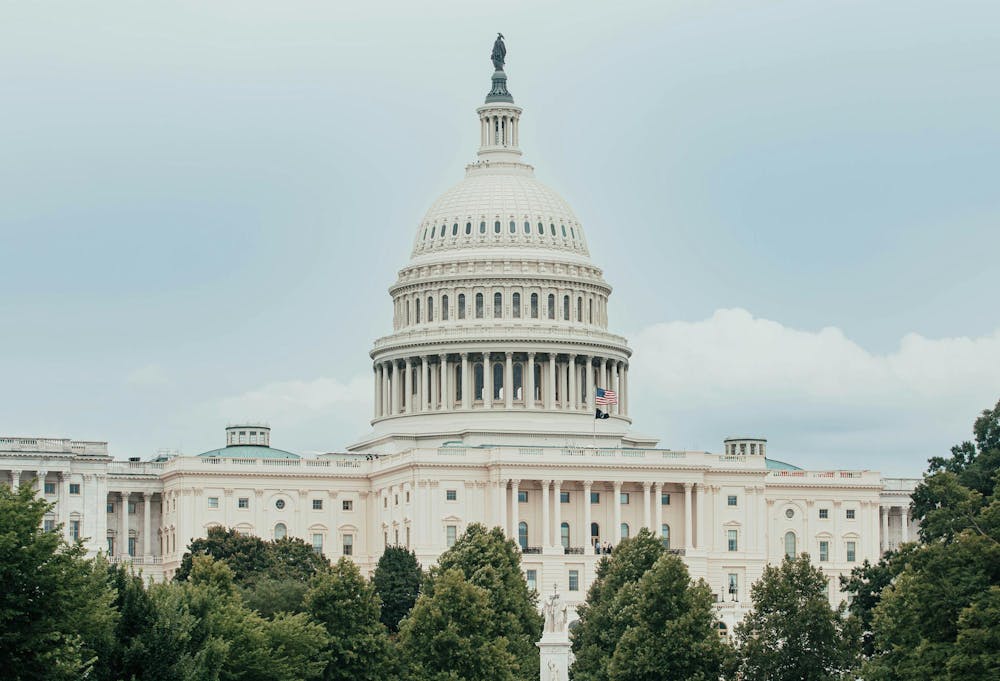
Over the past few months, legislators in Texas, California and Indiana have considered various bills to redistrict their states’ congressional maps, partly in response to one another’s efforts. This redrawing of maps comes ahead of the 2026 midterm elections as Republicans and Democrats get ready to battle over majority rule in the House of Representatives and the Senate. Presently, Republicans hold the majority in both chambers.
James Curry, a professor of political science at Notre Dame, said redistricting is becoming more and more common and that mid-decade redistricting is particularly unusual.
“What stands out this time is how those pushing for it are not even trying to obscure their reasons for doing it,” Curry wrote in a statement to The Observer. “Trump and other Republicans were explicit in telling Republican legislators in states like Texas and Indiana that they wanted them to find congressional Republicans more seats. Usually, the reasons for these efforts are presented in less starkly transactional terms.”
Shri Thakur, co-president of College Republicans, expressed his support for these efforts.
“The College Republicans support the redistricting efforts of Texas, Indiana, and other red states,” Thakur wrote. “This process is necessary to rectify past gerrymandering by the Democrats in New York and Illinois, as well as the rigging of the 2020 census to count illegal alien populations for representation, which significantly benefit Democrat-run states.”
Patrick Kompare, vice president of College Democrats, offered his perspective on the redistricting. “It is sort of like a nuclear arms race where it started off with Texas redistricting and then states reacting and all trying to offset each other with California redistricting to offset Texas and other Republican states trying to redistrict off of that,” he said.
Curry claimed the redistricting is inevitable.
“There is no way to draw a ‘perfect’ district because we don't even know what that means. Moreover, because where people live is correlated with their politics, any drawing of district lines is going to result in most districts being uncompetitive. But where most people find gerrymandering unacceptable is when it is blatantly done in a way that affects the degree to which different groups of voters are represented in a government,” Curry wrote.
Curry claimed that the redrawing of maps in Texas was an effort by Republicans to create more Republican seats to offset the consequences of the seats they are likely to lose in the 2026 midterm elections. However, he emphasized that this could fail on multiple levels.
“You can try to draw district lines to achieve certain ends, but sometimes you make mistakes in your assumptions about how different groups of voters will vote, and your gerrymander turns into a dummymander,” Curry wrote. “The push by California Democrats to redraw lines in that state was absolutely a response to the effort in Texas. This is part of how the Republican effort may be backfiring. Not only might the new Texas map be rejected by the Courts, the Democrats’ response in California may make it even easier for Democrats to win control of the House of Representatives in 2026.”
Kompare interpreted this mid-decade redistricting as a sign of a lack of trust between parties, explaining that the ability to redistrict is not new but previously there was a mutual trust, so parties did not feel the need to “systematically shut people out of the system through the efforts of government.”
In terms of President Donald Trump’s role in the redistricting, Kompare claimed he has been interventionist.
“There has been a record of him intervening ... [Trump] as well as JD Vance came to Indiana personally to urge state leaders to redistrict,” Kompare said. “[Trump] has used the bully pulpit to a large extent, and I think these principles of state autonomy are very important, especially with this right of managing your own elections. That is something that can only be touched with due consideration and caution. I worry that that was not used in the Texas case.”
On Tuesday, a federal appeals court in El Paso, Texas ruled 2-1 that Texas could not use their new redrawn map in the 2026 midterm elections, arguing it disproportionately targeted Black and Hispanic residents. Racial gerrymandering is considered illegal, but partisan gerrymandering is legal. California’s new map still remains in place, barring any future legal challenges.
In Indiana, Governor Mike Braun’s efforts to redistrict have thus far been unsuccessful, as Republicans in the State Senate have resisted supporting such measures. Kompare praised these senators’ efforts.
“I think it speaks to a certain level of integrity,” Kompare said. “I think that it gives me hope that this sort of situation will continue where we will reach a state where we feel like the redistricting has affected both parties equally and it will not go further.”