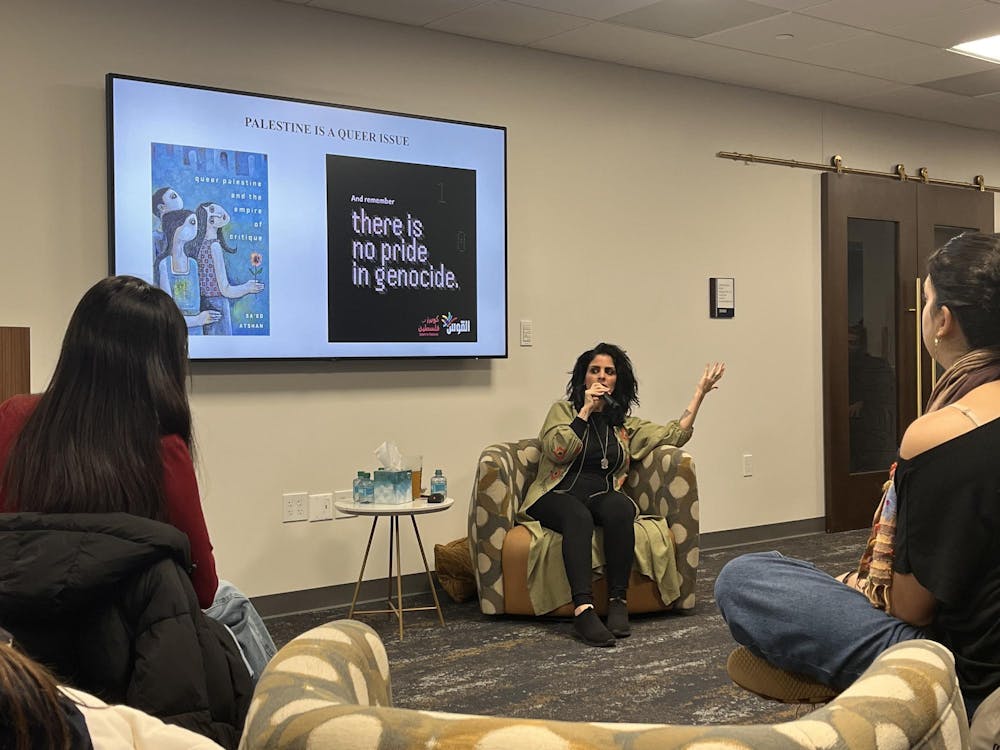
Chicago-based Palestinian artist Mary Hazboun visited Notre Dame on Monday to discuss the intersections of feminism, art and Palestinian liberation for an event called “Palestine is a Feminist Struggle.” Hosted by Student Voices for Palestine (SVP), the evening included the opportunity to meet with Hazboun before her talk, as well as a closing Q&A session.
Although her family immigrated to the U.S. in 2004, Hazboun grew up in Bethlehem, which is part of the West Bank.
She highlighted her Christian Arab identity as often overlooked in discussions of Palestinian people. “I grew up … as an Arab, [and] half Catholic, half Eastern Orthodox Christian and Palestinian and under occupation, [which] basically shaped not only my understanding of the world, but also my politics of resistance … I highlight my Christian upbringing to defy the Christian Zionist claims that Palestinian Christians don’t exist, and also that we did, and we do share the reality with our Muslim Palestinian brothers and sisters,” Hazboun said.
On top of those identities, Hazboun emphasized how her experiences living through the “Second Intifada,” a major uprising by Palestinians against Israel, impacted her.
“The second [uprising] was during [my] last year of school. It was probably one of the most horrifying times, not only in history, in the history of Bethlehem, in particular, because that’s when the Israeli military invaded the town… that time, being exposed to the military machine firsthand, altered my psyche in ways I still live with to this day,“ Hazboun said.
However, that trauma didn’t manifest itself until after Hazboun had immigrated to America, specifically when she was earning her masters degree in women and gender studies at DePaul University. Her professor, Laila Farah, helped her recognize and work through this trauma.
“That [class was] when all my repressed trauma started surfacing, because of reading course material that discussed military gender and displacement violence … So what I was feeling somatically in my body, having to leave the classroom because of post trauma symptoms. It got to a point where I was like, ‘I don't think I’m going to finish this program because I feel like I'm dying.’ So [Farah] said… ‘you're going to go through hell, but I'm going to be there with you every step of the way,’” Hazboun said.
During her studies under Farah, Hazboun discovered that art could be both a way to escape and process her experiences. This unique purpose emerged in her style, which features cramped, minimalistic figures to represent the way women’s bodies have been controlled. This style eventually became part of her masters thesis.
“I remember events and fragments, which echo in my work in the minimalist style, and then you would see a part of a story, or maybe a scene in an event, but you don't see everything else. That’s how I remember my life. The brain does that for protection,” Hazboun said.
For Hazboun, the purpose of her art is to make the experiences and trauma of women in Palestine visible and exigent.
“My work is unapologetically about grief. It is about showing a visual of what trauma would look like if it was visible.” Hazboun said.
Hazboun emphasized her intention is to show how Palestinian feminism is not a single-issue topic. Instead, she believes it’s intertwined with issues of colonialism, racism and militarism and is far more complex than the stereotypical notions of Western feminism.
Alice Lei, a member of SVP who organized this event, highlighted how Hazboun’s art disrupts ideas of a universal, one-size-fits-all feminism.
“What especially stood out to me was [how Hazboun was] shedding light on the Palestinian women’s movement and rejecting the notion that liberal white feminism must be the dominating, patronizing force that speaks for and over women of the Global South, women of color, the queer community and the subaltern,” Lei said.
Lei stressed the difficulty in getting the University to allow events like this to be held on campus, particularly after the pro-Palestinian protests two years ago, in which multiple students were arrested.
“My sophomore year, and I'm a senior now, students were arrested for demonstrating, and this is a memory that is effectively erased from this campus. I don’t see a lot of people talking about it. People don’t really know about mobilization at Notre Dame, [since] it is difficult for us to even get a guest speaker here, because they think it's too political, or they think it's going to instigate something,” Lei said.
For Lei, art is an alternative form of resistance and a “subtle way of navigating” around this difficulty.
“We are still resisting in ways that, maybe under the University’s radar, can be conceived of as less dangerous than a protest or a gathering of students, but still finding ways to insert this dialogue on campus and make sure that these communities of students in this room and faculty and so many people [are] not forgotten,” Lei said.
Despite the current situation in Palestine and the ways people remain hesitant to discuss it, Rebecca Holm, a senior at Saint Mary’s, said Hazboun’s talk gave her hope.
“There’s so much hope in the world, even when it’s difficult to think like that, because ‘Oh, nobody believes it.’ But then you have such a huge turnout here ... and you're like, ‘Wow, there is a community that is paying attention to this,’ and that's really beautiful,“ Holm said.