The Asian American Association of Notre Dame held their annual cultural showcase, Asian Allure, at Washington Hall this past Friday and Saturday.
The show centered on the theme, Heirloom, exploring how, for many Asian American students, culture is passed down through memorabilia and stories from one generation to the next. More than just a series of individual performances, the show was unified by a heartfelt skit following a typical Asian American family as they anticipated their eldest daughter’s departure for college.
The show opened with a lion dance presented by the Vietnamese Student Association, featuring performers concealed beneath traditional lion costumes who lifted one another high into the air. The Vietnamese lion dance mimics the movement of sacred animals and is performed to the rhythm of drums and cymbals to celebrate blessings, prosperity and luck.
Following it was the Filipino American Student Organization’s performance of tinikling, a traditional Filipino folk dance that entails performers stepping over and between bamboo poles that are tapped and slid together. At one point in the act, dancers blindfolded themselves, requiring enhanced rhythmic footwork and coordination. Halfway through the performance, they took on a modern interpretation of tinikling by dancing to the music of Bruno Mars, a notable global star of Filipino descent.
Throughout the show, several acts paid tribute to the international K-pop phenomenon, featuring choreography to hits by Seventeen, KATSEYE, and Blackpink’s Jennie. Sophomore Ian Park took on viral dances, including KAI’s “Mmmh” and TAEMIN’s “Guilty,” hoping his act would reflect a distinct transition in Korean culture.
“In the past, Korea was always known as the ‘shrimp between two whales.’ We never had our own culture and even now, when we’re trying to find what our culture is, it’s pretty difficult to find,” Park said. “K-pop really did pave a way for this new era where people are able to say, ‘Oh, this is part of the culture,’ and are able to expand on the historic importance and significance of Korea through the initial K-pop that got them into the culture.’”
Providing contrast to the night’s more energetic acts, the Hawai‘i Club presented two tranquil performances: “Malama Mau Hawai’i” and “Kanikapila.” “Malama mau Hawai‘i,” which translates broadly to “always care for Hawaii,” featured a traditional hula, a dance form that uses body movement and hand gestures to convey stories recounting history and tradition. The performers wore floral adornments and moved in unison to the Hawaiian song.
Senior Melina Ventura was grateful to perform hula at the event.
“It’s really meaningful to me, because that’s something that was a big thing that I was a part of back home. I danced hula all my life,” she said.
Ventura continued to express gratitude for “the opportunity to showcase that here, and also teach that to other people from Hawaii who maybe didn’t know about it or want to be proud of their culture, or even teach other people that aren’t from Hawaii that want to learn, including them in that beautiful tradition.”
Following the hula performance, sophomores Rob Gonzales and Maya Ventura took the stage playing the ukulele and ipu, a traditional gourd drum. Gonzales sang a Hawaiian song, “Nani Koolau,” and filled the auditorium as a duo with only two instruments, one voice, and no speakers or microphones.
Gonzales said that “a lot of traditional Hawaiian songs actually talk about the beauty of the land and the need to honor and take care of it and that’s what the song kind of correlates to.”
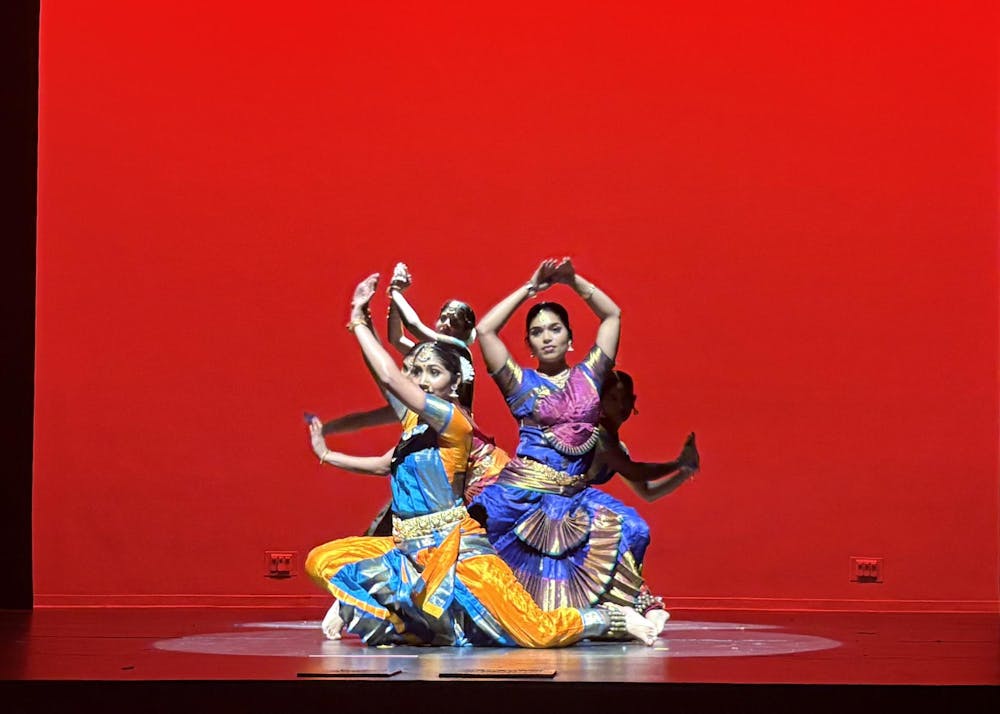
Ending the first act was established dance crew NDeepam, who performed bharatanatyam, a classical Indian dance form known for its vibrant and embellished attire, precise footwork, expressive gestures and storytelling traditions.
“I feel like we don’t really see the traditional aspects of a lot of our culture and I feel like being able to bring that to the campus is a big deal for us,” senior Rachael Thumma said.
In addition, the South Asian Student Association presented a mashup of seven south Asian dance styles such as bhangra, Garba, Bollywood, and dappankuthu. Blending classical and contemporary elements, the performance highlighted the vast diversity that can be found within the region alone.
The Korean Student Association followed with simultaneous performances of Samulnori, a traditional Korean percussion music genre that uses four distinct drums and Talchum. Talchum is a traditional Korean art that combines dance, music and theater, where masked performers use satire and humor to comment on social issues.
“I feel like often people would lump certain ideas into what it means to be Asian and I feel like the show really does a good job of showing that there’s a lot of diversity and that diversity in itself is part of the reason why I find the Asian community at Notre Dame to be so strong,” Senior Matteo Siazon, who led the Samulnori team, said.
The Japan Club performed Wotagei, a Japanese dance style originating from fan culture, characterized by synchronized movements of light sticks and coordinated cheers, transforming audience enthusiasm into choreographed performances.
The Chinese Culture Society danced along to the viral Chinese song, “Stacks from All Sides,” showcasing both modern choreography and traditional fan dancing. Choreographers Scarlett Chu and Kalena Yee shared how they wanted to honor both styles of dance as they are “both very characteristic of our club and culture” in addition to intentionally selecting a song “that has a traditional sounding component to [it] and also a modern sounding component with the rap.”
The last act of the show was a duet performed by senior Gabrielle Benitez and junior Arvin Picardo where they sang “Palagi.” The song, sung in Filipino, expresses a universal sentiment of two lovers who continue to choose each other, bringing the show to an emotional conclusion.
Picardo shared that singing the duet was “a cool challenge, because it reminds me of back home, where I would speak with my family in Tagalog, but when I’m away from them, I don’t really have the chance to speak it.”
She hopes that audience members can learn more about art and culture in the Philippines through the performance provided.
Benitez hopes that their band could “show how other people can relate to [her] culture, especially since the Philippines is known for their love songs and romance. It’s nice to show [the audience] a glimpse of that.”
Both nights concluded with a feast of various Asian cuisine in the community kitchen of LaFortune Student Center.
The theme, Heirloom, was selected by this year’s directors junior Adam Acunin, junior Enzo Gonzales and junior Ryan Nguyen. Through the performances and skit, the directors aimed to highlight the responsibility and opportunity Asian American children have to carry their families cultures and legacies forward.
“[O]ur parents always told us about our culture and they taught it to us and passed it down from their parents. We just thought the idea of passing down the culture is an important part of our Asian community. We think it’s an experience many people have, especially our performers,” Gonzales shared.
He shared that the special meaning of the theme is personal to his experiences in learning his family’s history and culture.
“For me, Heirloom was inspired by countless family nights, getting lost in family memory books and seeing my aunts and uncles as little kids in old photographs,” he said. “My culture has always been something I hold close, and being able to celebrate it through performance is incredibly meaningful. Heirloom is about remembering the stories that shaped me while creating my own.”