$76.8 million. $62.3 million. $54 million.
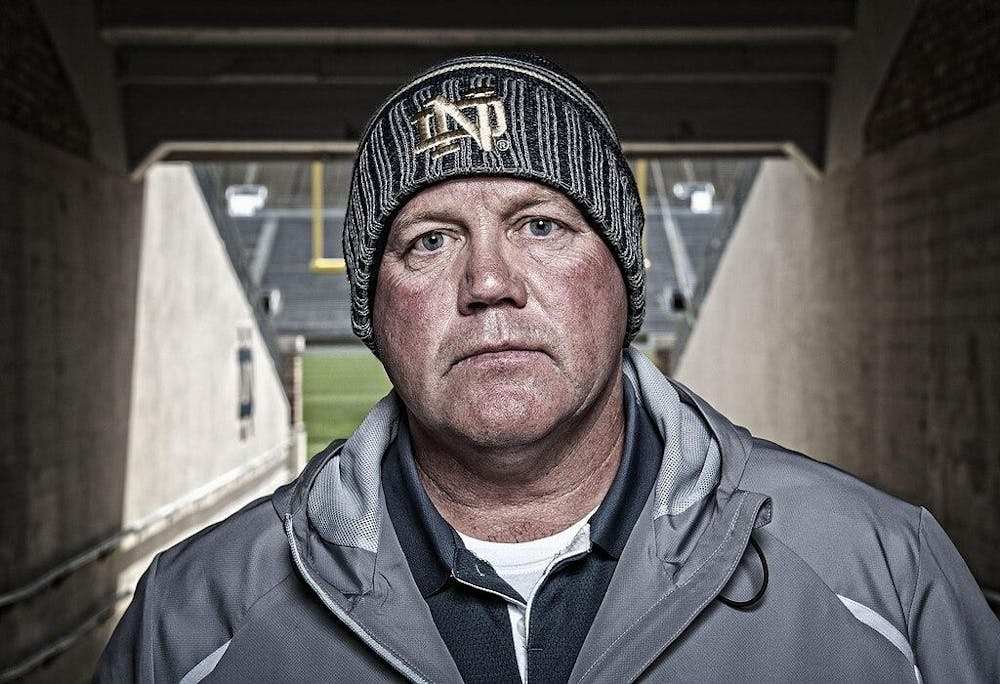
Jimbo Fisher’s 2023 contract buyout. The GDP of Tuvalu, a micronation in Oceania. The initial estimation of Brian Kelly’s 2025 LSU contract buyout.
I believe in college football. I believe in the bargaining power of the worker. I don’t believe in coaches being paid more than a small country’s entire economy to not coach. Call me a radical.
The high-profile firings of James Franklin, Billy Napier and Brian Kelly last month brought the modern college football coaching contract situation into the limelight. With revenues higher than ever, college football coaches are being paid more than ever. Last winter, our own Marcus Freeman signed a lucrative contract extension, paying out nearly $10 million per year until 2030. With these contracts, however, come expensive buyouts in the event their employers relieve the coaches of their duties. It has been speculated that Marcus Freeman’s buyout, for instance, could be upwards of $40 million (God forbid!).
At ultracompetitive blue-chip programs like Penn State and LSU, it takes very little for programs to fire their coaches. It took only three losses for Franklin and Kelly to lose their respective jobs, costing their schools over $102 million combined. Not winning a national championship at these schools constitutes a failed season. In a league with only one annual champion out of a pool of 136 FBS teams, there’s going to be a lot of failure year in and year out.
And of course, with such high-profile job openings, programs with highly coveted coaches respond with lucrative contract extensions. The contract extensions for Curt Cignetti (Indiana) and Matt Rhule (Nebraska) exceed well over $100 million combined. Cignetti and Rhule are just two of many coaches receiving extra compensation in the wake of an historic coaching shakeup.
We must remember, though, that hindsight is 20/20. At the time of his hiring away from Notre Dame, many LSU fans and national observers saw the hiring of Brian Kelly as a slam-dunk replacement for the embattled Ed Orgeron. Who would have thought that James Franklin was at risk of losing his job as he brought his team to the playoffs last season? Undoubtedly, then, will at least some of these leviathan contracts prove to be costly mistakes in due time.
We must then ask the question: What on earth are we doing?
These firings represent not only the fruits of fiscal irresponsibility but also an immeasurable moral shortcoming for America’s universities. Paying such obscene amounts of money to fired coaches to not coach a college football team is the acme of foolishness in a country where nearly 40 million Americans live in poverty. Kelly’s buyout is particularly challenging, especially coming from a taxpayer-supported public university in Louisiana, one of the poorest states in the United States. The gravity of such a burdensome state expense attracted national attention as Louisiana Gov. Jeff Landry used executive pressure to coerce LSU’s dismissal of its athletic director.
Of course, gargantuan athletic programs like those at LSU are funded largely by their own revenue and through private donors. Louisianans’ tax dollars will not be deposited into Brian Kelly’s bank account. In fact, it was announced last week that one private donor would personally bankroll the “lion’s share” of Kelly’s buyout. With lucrative ticketing, merchandising and streaming revenue, the blue-chip collegiate football programs make significantly more money than they expend. One can view a strong coach as an investment, no different than paying for stadium renovations or updating the turf. Like any business investment, a coach may not work out. These buyouts are costly but survivable mistakes.
The more fundamental question to be asked is what we as a society should be valuing. Sure, tax dollars won’t be spent on Brian Kelly’s buyout (or any of the other buyouts discussed in this article). However, the donations and many millions that programs are raking in can no longer be used for investments that benefit the university or its student body. No libraries can be built with the $50 million going to Brian Kelly, nor will hungry children be fed, unless Kelly decides to do so himself. When LSU’s president announces the construction of a state-of-the-art and community-beneficial Kelly Hall on campus in Baton Rouge, funded by its former coach, I pledge to retract this article.
At the end of the day, many college football programs are allocating their resources to appease a tiny group of wealthy men rather than spending money for the betterment of the masses.
Wait … have I heard this story before?
Grayson Beckham is a freshman living in the Coyle Community in Zahm Hall. He hails from Independence, Ky. When he's not publishing woke propaganda inThe Observer, he studies political science and eloquently uses his silver tongue on the mock trial team. You can send him relevant hate mail at gbeckham@nd.edu.