
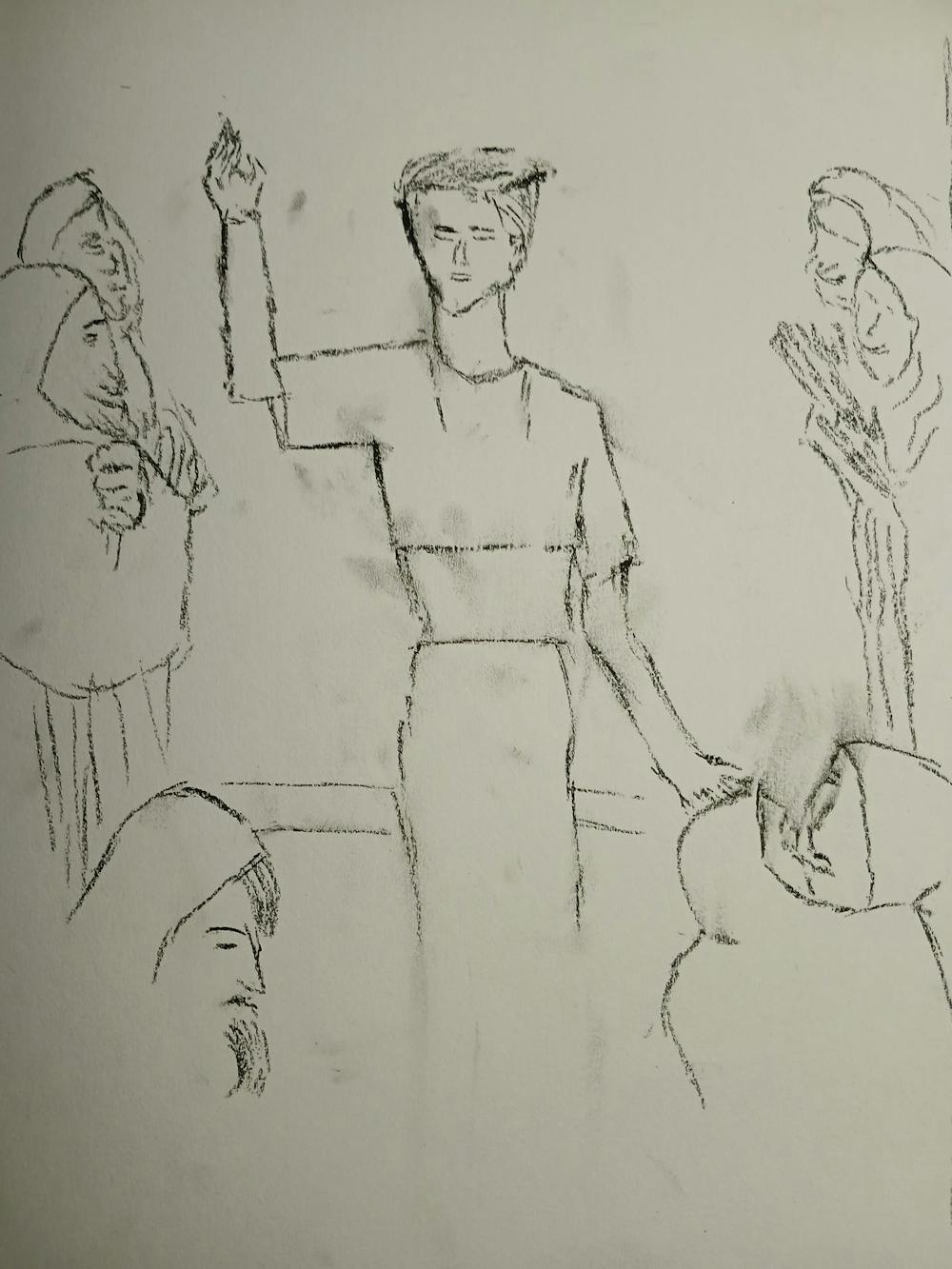
Almost every day, I walk by a beautiful wood-carved panel in the Keenan-Stanford lobby. The panel was carved by Notre Dame’s beloved artist, Ivan Mestrovic, who also made the crucifix in the Keenan-Stanford chapel, the pieta in the St. Joseph chapel of the Basilica and Christ and the Samaritan woman at the well outside O’Shag, among other works of art on campus. The panel depicts Christ as a boy in the temple surrounded by Jewish rabbis. He stands and gestures with not a little bravado for a twelve-year-old among elder distinguished scholars, who appear confused and amazed at Christ.
It has occurred to me, after almost four years of passing by this panel without much thought, that this scene might have something to teach me when I return home from a day of academic coursework — namely, to complement my academic approaches to truth with explicitly spiritual and Christ-centered approaches to truth. The rabbis in Mestrovic’s panels are perhaps not unlike our professors, or us students: academicians. The chaos caused in the panel by Christ’s surprising authority is a reminder to us academicians: Remain focused on Christ, even in midst of careful academic work, lest you forget him, rely only on the meager power of your otherwise darkened intellect and end up baffled when presented with his Truth.
The story of Christ in the temple is the only story from his boyhood in all the gospels. After telling us that “the child [Jesus] grew and became strong, filled with wisdom, and the favor of God was upon him” (Lk 2:40), Luke portrays Jesus “in the temple, sitting in the midst of the teachers, listening to them and asking them questions, and all who heard him were astounded at his understanding and his answers” (Lk 2:46–47). It must be significant that the main thing Luke goes out of his way to tell us about Christ as a boy is that he was a wise and uniquely authoritative teacher. It must be significant that the only picture the gospels paint for us in Christ’s boyhood is that of Christ the Teacher.
The ridiculousness of the story of Christ teaching in the temple should not escape us: Christ is twelve, yet his wisdom seems to surpass old, distinguished rabbis. Imagine a twelve-year-old waltzing into an academic colloquium and besting distinguished Notre Dame philosophers and theologians! And yet, even after Christ has revealed himself, has been conscientiously recorded by Luke and has been carefully carved by Mestrovic, I skim over Luke’s Gospel and pass by Mestrovic’s carving as I expect more wisdom from my professors than from Christ himself.
I do not want to suggest that the truth that our professors, courses, readings, assignments and discussions offer us is necessarily opposed to the truth that Christ offers. In one sense, anything that is at all true points to Christ. For Christ is the Truth (Jn 14:6) — the logos that creates and sustains all intelligible realities. All truths receive their trueness from Christ. The mind, even when unillumined by faith, is capable of reaching these truths, which reveal and point to Christ. He hides beneath all his truths as a face hides behind a veil, ready to be uncovered and to look with love (Mk 10:21) at all who discover him.
On the other hand, there is something challenging to us college students about Christ’s identity as Teacher and Truth, just as there was something challenging about Christ’s authority in the temple among distinguished rabbis all those years ago. The challenge is that Christ’s truth is so unexpectedly brilliant that all human learning and erudition seems like discord and confusion in comparison. The challenge is for us students to remember to turn to Christ for the truth just as much as, and hopefully more than, we turn to the academy for truth. But this challenge is also a gift: How wonderful is the truth which Christ lavishes upon us in the revelation of His Person! We should not see the brilliance of Christ’s truth as a blinding light but as a beacon to journey toward.
What is the nature of the truth we might find at this beacon, and how shall we journey? That is a question which I will save for my next article.
Richard Taylor is a senior from St. Louis living in Keenan Hall. He studies physics and also has an interest in theology. He encourages all readers to send reactions, reflections or refutations to rtaylo23@nd.edu.


