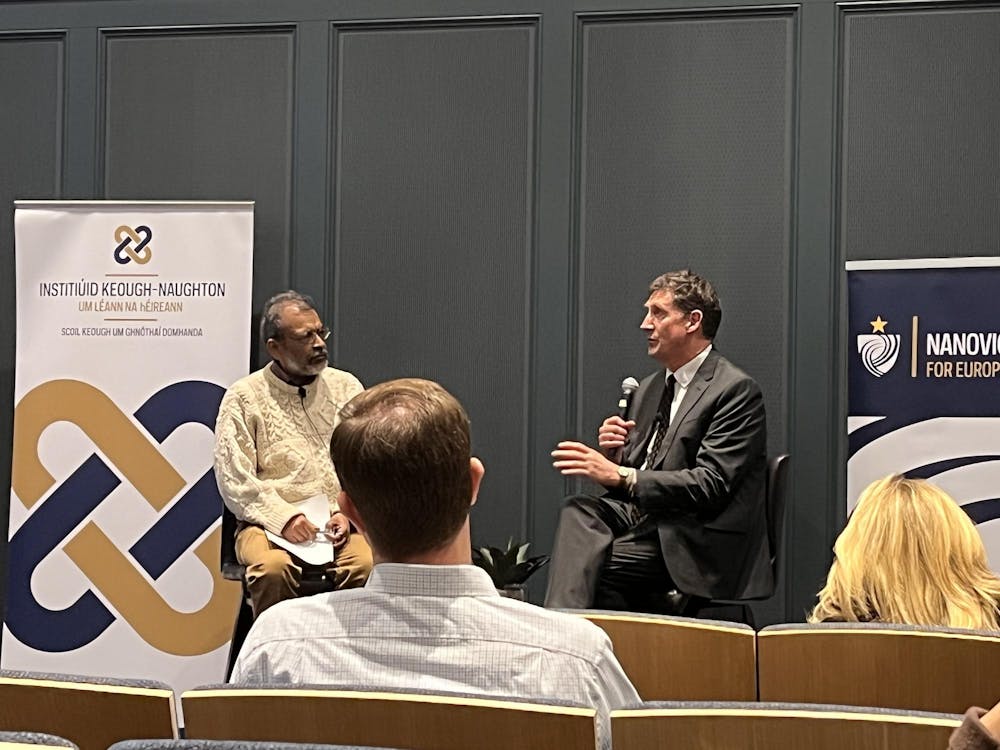
On Tuesday, Eamon Ryan, the former Irish minister for the environment, Green Party politician and current chair of the European Affordable Housing Advisory Board, came to Notre Dame to speak on climate action and hope.
Part of this year’s Notre Dame forum, “Cultivating Hope,” the lecture was hosted by the Keough-Naughton Institute for Irish Studies and the Nanovic Institute. The lecture was in conversation with professor Arun Agrawal, inaugural director of the University’s Just Transformations to Sustainability Initiative.
Centered on both the realities of climate change and the progress that has been made towards mitigating the crisis, this event aimed to not only inform students about the current situation, specifically in Ireland and the European Union, but also to provide a more positive outlook that is largely associated with environmentalism.
“[I want to] share just some of my perspective and understanding of what’s happening in the world to try and give some sense of hope, particularly on climate, and to inform people what’s happening in Ireland and some of the political context … It’s a chance to share my sense of what’s happening and trying to inspire people rather than bore them or terrify them,” Ryan said in an interview with The Observer.
To kick off the lecture, Ryan mentioned that this event came at a pertinent time, just days before the UN’s 30th climate convention will occur this weekend.
Speaking on the importance of this conference, Ryan shared that he met with the director of Notre Dame’s minor in sustainability.
“I met Phil Sakimoto the other day here, the head of the minor in sustainability. And I trust physicists when it comes to this, because what he said to me, and what I see is real, is that science is actually getting more trouble. The modeling may have underestimated the risks and the scale of change that’s taking place, the speed of the change that’s taking place. So it is so important, in my mind, that we get these negotiations right.”
Ryan further contextualized the impact of the upcoming convention in terms of what the United States’ new example on the climate crisis means for the world.
“In truth, I think probably the biggest issue is the political one: Does the rest of the world hold together and continue on the course, or does it accept or yield to the American presidency, which is saying that [climate change] is a hoax, this is a con job. And I think it’s the holding together that will be the most important signal, which I hope comes [out of this convention],” Ryan said.
As the central theme of the talk was hope, Ryan shared some positive statistics in terms of the rise of renewable energy use and the decrease of greenhouse gas emissions.
In terms of renewable energy, Ryan spoke on his belief in the EU and its continuation despite current uncertainties.
“We are in a very frightening situation in the world. [With] geopolitical strains for Europe … we were considering, do we stick with this agreed agenda? And actually, from the European perspective, if you think about it, how could we be competitive on burning other people’s fossil fuels if we don’t have our own? How could we be secure in that? And we’ve seen the security issue with the war in Ukraine be critical and central to us, and for that reason, my expectation is that Europe will continue the course,” Ryan said.
While Ireland hasn’t been historically sustainable, Ryan said his country serves as an example that development can be sustainable both economically and environmentally, because of the switch to renewable energy.
“Historically, we’ve had very high emissions, not from industry, particularly, but mainly from agriculture. 38% of our emissions come from agriculture, but also we’re as car dependent a country as any, and we historically have not had a great record in protecting our environment. In recent years, we’ve lost our pristine rivers to pollution. We have seen real difficulty in meeting the scale of ambition we need to make,” Ryan said. “But in Ireland, I would argue, too, that that is actually changing. And if anything, we’re a good example of a country which can maintain and grow an economy and still reduce emissions.”
Ryan also highlighted Ireland’s carbon taxation system as a sign of improvement.
“Europe has committed to this carbon tax system in the big industrial sector. But what we’ve done in Ireland is we’ve applied that down to every sector in the use of fossil fuels. Each year, the carbon tax goes up seven euros a ton, and we spend it on improving buildings. The majority go into people with very low incomes and small farming and on social welfare increases to protect against the [economic barriers] that do come with the tax, or could, if you didn’t adjust in that way,” Ryan said.
However, despite these instances of progress, Ryan emphasized that there are still three main issues left that need to be addressed in order to stop climate change: the inequalities between the global north and global south, the political divide and the cultural divide over climate action.
Ryan suggested one approach to addressing these inequalities is to start at the local level.
“I think [we need to] stick to a very simple message that’s at the heart and earliest days of the Green Movement, that we need to think global and act local, that we can’t carry the whole burdens of the world on your shoulders. It’s too difficult. It’s too overwhelming,” Ryan said.
He applauded Pope Francis’ framing of the crisis, saying, “It’s integral in two or three ways. It’s integral in putting climate change connected to the protection of nature and by loss of biodiversity, and integral in terms of social advancement, social justice protection as well,” Ryan said.
To tackle the political and cultural divides over climate action, Ryan emphasized a solution that starts at the University level. Although he noted areas where progress could start from, including engineering and business fields, Ryan centered on the importance of theology and the arts as drivers of change as they can alter the way people think and feel.
“I think the school of the arts and the school of philosophy are equally important as theology in this regard … If it’s just done in a piecemeal way through architecture or engineering or other schools, we won’t make the leap in consciousness we need to make, and I think that’s why I start with the school of theology as the place where this begins, and the arts,” Ryan said.
Sophomore Sophia Buck, a French and global affairs major, felt that Ryan’s lecture gave her a new perspective on Ireland.
“I think prior to the lecture … I knew less about how Ireland has been kind of been a really good example of reducing their admissions and things like that … Now I’m seeing Ireland, I guess, as an example to look towards, which prior to this, I probably wouldn’t have,” Buck said.