
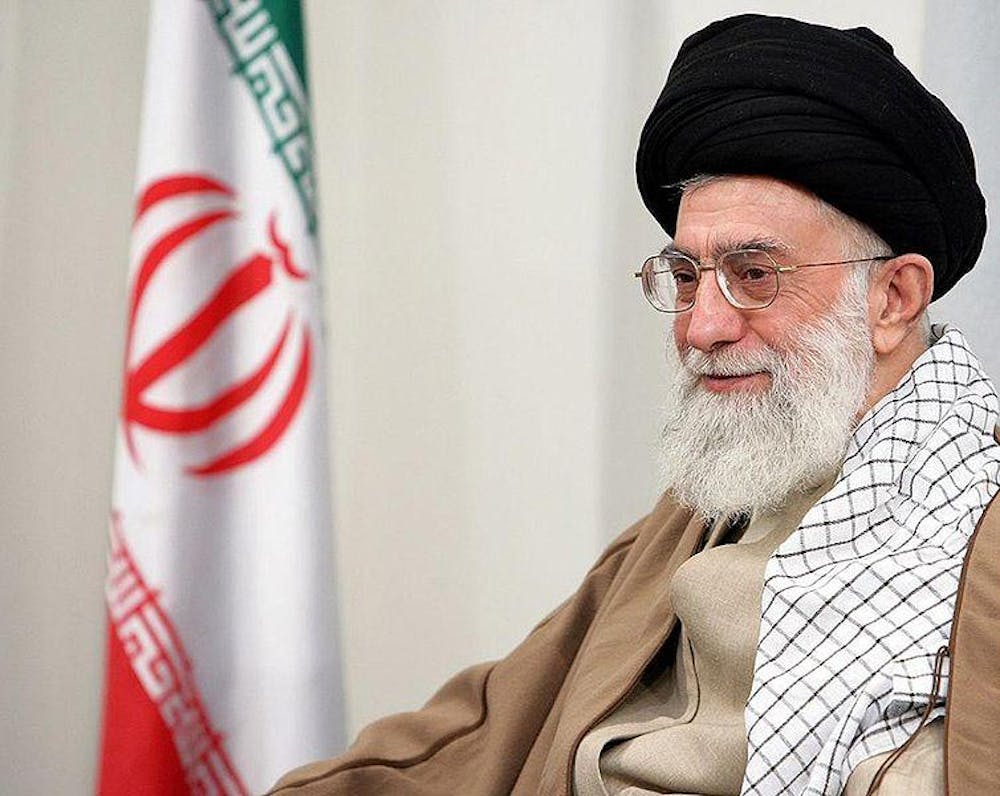
Beginning Feb. 28, the U.S. military operation known as “Epic Fury” brought a series of large-scale military strikes across Iran, killing the supreme leader Ayatollah Ali Khamenei, among others. The fighting was initially spearheaded by Israel and the United States, but Iran has been quick to retaliate on military bases across the gulf. With a tumultuous history of assisted coups, hostage crises, regime revolutions and nuclear deals, the relationship between the United States and Iran has spanned over 70 years.
Dan Lindley, a professor of political science at Notre Dame, noted that the “air defense system in Iran, which should have been half decent” has failed for the second time in only months.
Ebrahim Moosa, a professor of Islamic thought and Muslim studies at Notre Dame, described the overall situation in a statement to The Observer.
“The United States has issued ultimatums to Iran, assembled an armada on its doorstep, and attempted to negotiate with a gun to its head. It is naive to believe that coercive diplomacy of this kind will produce durable or meaningful outcomes. Many of Washington’s demands — which Iran abandon its missile program and sever ties with regional allies — are politically unrealistic,” Moosa wrote.
Rashied Omar, a professor of Islamic studies and peacebuilding at Notre Dame, wrote, “Regime change imposed through military force violates international law. It serves imperialist agendas, strengthens authoritarian narratives, entrenches cycles of violence, and deepens human suffering, undermining Indigenous, justice-centered movements for emancipation.”
Describing Ali Khamenei as “a deeply polarizing figure,” Moosa noted that the protests in January already “revealed significant public dissatisfaction with the government.”
The global implications of prolonged conflict with Iran are far-reaching. If the Strait of Hormuz were closed, even temporarily, the shock to global oil supply would be severe, affecting fuel prices worldwide. Moosa wrote. Lindley also noted the danger Iran posed to its neighbors.
“Iran’s tentacles are all around the Middle East, and that is one of the reasons they have been a threat, and a lethal threat, to the region,” Lindley said.
He noted that Britain and Spain have distanced themselves from the United States’ actions, recognizing that retaliation could befall anyone who gets involved.
Mark Mikhail, a freshman in O’Neill Family Hall, who used to live in Abu Dhabi, explained that the UAE is “very safe,” having intercepted hundreds of missiles and drones already. Nevertheless, people in the United Arab Emirates are instructed people to stay home and avoid large gatherings with schools shifted to virtual conference platforms and churches closed.
Lindley said the reasons for the conflict depend on who and when you ask.
According to Moosa, “The claim that Iran’s missile arsenal constitutes an existential threat to Israel rings hollow when Israel possesses an estimated nuclear arsenal of nearly one hundred warheads — a capability developed outside international oversight and without formal acknowledgment. If the principle is non-proliferation, it must apply universally. To insist that Iran must permanently renounce nuclear ambitions while ignoring Israel’s nuclear monopoly exposes a profound double standard.”
Iran signed a landmark nuclear deal with the U.S. during former President Barack Obama’s second term.
“The first Trump administration withdrew from that agreement, escalating sanctions and hostility. Critics argue that this shift aligned closely with Israeli Prime Minister Benjamin Netanyahu’s long-standing opposition to the deal,” Moosa wrote.
As the U.S. death toll rises to six, Iran reports over 500 deaths, including over 100 students. Lindley said the numbers we have right now are probably still an underestimate.
Saint Mary’s political science professor Sean Savage explained that Trump was quick to critique former President George W. Bush’s “forever wars,” but following his first term he has taken an “America first” approach, prioritizing national self-interest above all else.
Referencing the recent capture of Venezuelan President Nicholas Maduro, Lindley said, “I hope we do not get affected by the ‘Maduro syndrome’ … if we begin to think force is always that easy, I think we are going to get ourselves into a big mess.”
Savage suggested that implementation of the Pottery Barn rule, “You break it, you buy it,” could encourage the installation of longer-term stability systems. He said that using force is the easy part; “the hard part of it is what do we do next? You can’t just go home.”


